x




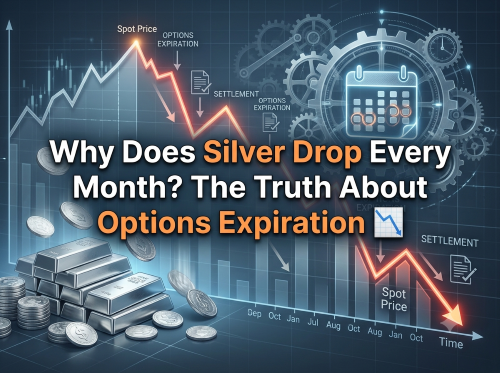
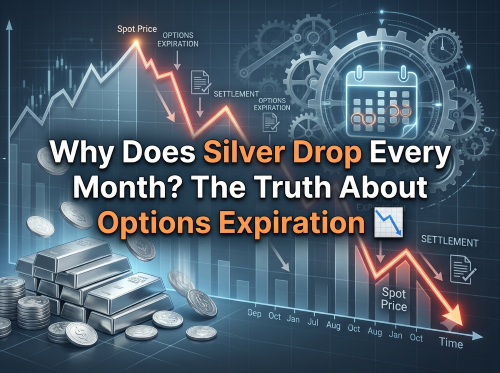
If you have been holding silver or keeping a close eye on the precious metals market, you may have noticed a frustratingly familiar pattern: right near the end of every month, silver prices suddenly take a sharp, unexplained dip.
There is usually no sudden bad economic news, no discovery of a massive new silver mine, and no drop in industrial usage. Yet, the spot price tumbles over the course of a few hours or days, only to recover shortly after.
Why does this happen so consistently? Is it market manipulation, algorithmic trading, or simply financial mechanics at work?
The short answer is that this monthly drop is driven by the mechanics of paper futures and options contracts on the COMEX exchange. Understanding how this process works—and why it does not alter silver’s long-term value—is one of the most powerful tools a precious metals investor can possess.
To understand why silver dips at the end of the month, you have to look at how option contracts are settled.
Every month on the COMEX (Commodity Exchange), silver option contracts reach their expiration date. An option contract gives the buyer the right—though not the obligation—to buy or sell silver futures at a specific, agreed-upon price known as the strike price.
On the other side of these trades are institutional option writers (usually large commercial banks or market makers). When an institution sells a call option—say, at a $50 or $60 strike price—they make maximum profit if the price of silver closes below that strike price on expiration day. If silver closes above that level, the option expires "in the money," and the writer faces substantial payouts.
This creates a massive financial incentive for options writers to push the spot price below major strike prices just before the option contracts expire.
Enter Delta Hedging
How do institutional traders push the price down? They use a practice called delta hedging.
Delta measures how much an option's price changes relative to movements in the underlying asset. To offset risk as expiration approaches, traders buy or sell paper futures contracts.
Because the futures market operates with significant leverage—roughly five-to-one leverage—and options on futures create an additional layer of leverage on top of that, it takes a relatively modest amount of short paper selling to trigger a noticeable drop in silver's spot price.
Automated Algorithms
Nobody sits at a desk manually smashing the "sell" button on expiration day. High-frequency trading algorithms handle the process automatically.
The moment silver touches specific price thresholds leading up to options cutoff, these pre-programmed algorithms execute wave after wave of paper futures sales. It is an automated mathematical reaction designed to minimise risk for options writers, running entirely on paper contracts where no physical silver ever changes hands.
In addition to delta hedging, traders must contend with gamma risk.
In options trading, gamma measures the speed at which delta changes as the underlying price moves. When silver approaches a key strike price right as the expiration clock runs out, gamma spikes dramatically.
When gamma is high, even tiny shifts in silver's price force algorithms to make massive, rapid hedging adjustments. This produces sudden, sharp downward spikes in the spot price during the final hours of trading. While these price swings look alarming on a daily chart, they are driven purely by mathematical formulas in the paper market, not real-world supply and demand.
David Morgan, veteran silver analyst and founder of The Morgan Report, recently discussed this recurring phenomenon, describing the monthly options expiration pattern as clear evidence he would present "in a court of law."
However, Morgan emphasises a crucial distinction that every long-term investor must understand: paper market mechanics can influence short-term prices, but no force can manipulate a market’s long-term trend.
While delta hedging and gamma squeezes can artificially depress paper silver prices for a few hours or days, they operate within a bounded sandbox. They cannot override the structural fundamentals that govern physical supply and demand over months and years.
When retail investors see silver drop several percent in forty-eight hours without an obvious headline, many panic and assume the bull market is over. In reality, nothing has changed except the calendar date.
The core fundamental pillars supporting silver remain completely untouched by monthly paper settlement dates:
Paper algorithms can suppress a price quote on a screen for a brief window, but they cannot print physical silver out of thin air to cover a five-year supply deficit.
Understanding this monthly rhythm completely transforms how you view market pullbacks.
Bull markets are designed to shake out as many investors as possible before reaching new highs. The monthly options dip serves as one of the primary psychological traps used to scare retail holders into selling their physical assets right at the bottom.
Here is how experienced investors approach the monthly options cycle:
GoldSilver: Silver's Biggest Move Is Still Ahead
Silver just dropped from $121 to $60. David Morgan says the biggest move is still ahead — and the data backs him up.
In this conversation, GoldSilver's Maggie Lake sits down with David Morgan — founder of The Morgan Report and one of the most respected voices in precious metals — to make the case that the silver bull market isn't over, it's just shaking off late arrivals before the real move begins. David has lived through multiple silver cycles, including 1980, and explains why every structural driver — supply deficits, expanding investment demand, and a shift in how central banks think about hard assets — is still intact. This is Part 2 of 2 from a longer conversation. Part 1 covers dollar debasement, fiat failure, and financial repression.
David explains why the drop from $121 to $60 is doing exactly what a bull market is supposed to do — and why the investors who hold through it are the ones who actually capture the move. He also covers the $300 billion Russia seizure that permanently changed how nation states think about gold, and the institutional sequence that tells you when mining stocks are about to run.
To dive deeper into the detailed mechanics of options expiration, delta hedging, and expert insights from precious metals analysts, you can read the original coverage and watch the full interview on GoldSilver here:
👉 Why Does Silver Drop Before Options Expiration?
Disclaimer: This article is provided for informational purposes only, mistakes may be made, and it's not offered or intended to be used as legal, tax, investment, financial, or any other advice.