x



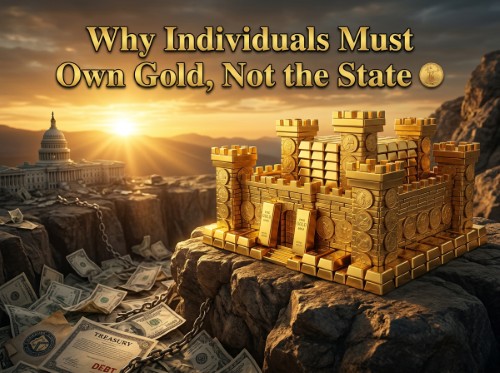
In an era of relentless fiscal intervention, escalating national debt, and expanding central bank powers, the debate over who should control real wealth has returned to the forefront. Recent market volatility has highlighted the fragility of state-managed economies. Despite extraordinary measures by the US Treasury—tripling bond buybacks to calm a nervous debt market—government borrowing costs have continued to climb, while gold remains firmly supported above historic highs of $4,300 per ounce.
For veteran champions of economic liberty such as former US Congressman Ron Paul, these market movements are neither surprising nor accidental. They represent the inevitable friction between artificial paper systems and unalterable economic laws. The fundamental conclusion remains as potent today as it was half a century ago: true financial security lies in physical precious metals owned directly by individuals, not locked away in state vaults under opaque government accounting.
When governments attempt to manipulate market forces, reality eventually catches up. The US Treasury’s recent decision to dramatically increase its debt buyback ceiling was designed to bolster liquidity and suppress rising yields. Yet, the market’s response was immediate and telling—yields surged regardless.
This friction illustrates the growing scepticism among global investors. For decades, central authorities have relied on monetary interventions—from quantitative easing to massive bond-repurchase programmes—to keep the illusion of stability alive. When official measures fail to suppress market yields, it exposes a fundamental truth: central banks and treasuries cannot engineer confidence out of thin air indefinitely.
Critics rightly question whether these aggressive repurchase strategies are simply "Stealth QE" under a different label. By downplaying traditional measures of money supply, such as M1 and M2, policy makers obscure the true extent of currency creation. However, ignoring the quantity of money in circulation does not prevent the real-world consequences of its expansion.
One of the strongest arguments for personal gold ownership is the deep opacity surrounding state-held reserves. Official institutions claim to hold immense stores of precious metals—such as the US Bullion Depository at Fort Knox—yet these holdings lack thorough, independent, bar-by-bar public audits.
More bizarre still is the official accounting mechanism. The US government continues to value its gold holdings at a statutory rate of $42.22 per ounce—a figure established in 1973 that has remained unchanged despite gold appreciating more than a hundredfold in the open market.
When official records rely on arbitrary statutory valuations rather than transparent market clearing prices, trusting government balance sheets becomes an act of blind faith. Physical possession eliminates the counterparty risk inherent in state accounting. As the saying goes among seasoned bullion holders, if you do not hold it, you do not truly own it.
Politicians and commentators frequently lament the rising cost of living, framing the issue around "affordability"—whether in terms of fuel, housing, or daily necessities. Yet this terminology misdiagnoses the problem entirely.
The core issue is not that goods and services are spontaneously becoming more expensive; it is that paper money is rapidly losing its purchasing power.
When central banks dilute the currency to fund endless government expenditure and war, the purchasing power of every existing unit of money diminishes. Framing this decline as a simple "affordability crisis" shifts the blame onto private merchants rather than pointing it at the central authorities responsible for monetary expansion.
Another troubling development in modern economic policy is the steady drift towards corporatism—a system where private enterprises become extensions of state power. When executive agencies and sovereign funds acquire direct stakes in private corporations, the line between free enterprise and state direction vanishes.
History demonstrates that companies nurtured by government subsidies, bailouts, and regulatory favours eventually succumb to inefficiency and collapse. By contrast, entities that operate independently of state funds are forced to remain disciplined, productive, and resilient.
By repeatedly propping up unsound ventures and absorbing private losses onto public balance sheets, authorities have constructed what may well be the largest economic bubble in history. Unpayable debt and malinvestment cannot be papered over forever; eventually, a market-driven liquidation must clear away the structural imbalances.
The case for personal gold ownership is ultimately rooted in moral principles and human liberty. Decisions made by political leaders—whether severing the final ties between paper currencies and gold in 1971 or embarking on endless deficit spending—historically benefit central planners at the expense of ordinary citizens.
Governments inevitably seek to expand their authority, control resources, and manage currency value to suit political needs. Gold, by contrast, cannot be printed, devalued, or fabricated by decree. It stands as a timeless check against state overreach.
Restoring economic health requires an educated public that understands the crucial relationship between sound money and personal freedom. Holding physical gold is more than just a defensive investment strategy; it is a assertion of independence from an increasingly centralized and unstable financial system.
Ron Paul: The System is 'Embezzling' Your Money — And It’s About to Break
"Former Congressman Ron Paul joins Jeremy Szafron on Kitco News to discuss the Treasury's expanded bond buybacks, who should actually own the gold in Fort Knox, and why he says the affordability debate is really a debate about the value of the dollar.
Dr. Paul explains why he wonders whether the current buyback program could become another round of quantitative easing, why he considers government equity stakes in private companies a form of corporatism, and what his grandmother told him about war and money when he was a boy during the Second World War.
He also revisits the 42 years when Americans were not permitted to own gold, why he says a restored gold standard would fail without deeper reform, what would make him sell his own gold, and the night in 1971 he watched Nixon close the gold window."
Disclaimer: This article is provided for informational purposes only, mistakes may be made, and it's not offered or intended to be used as legal, tax, investment, financial, or any other advice.