x




As Web3 technologies continue to mature, the race to bring the next wave of mainstream users onto the blockchain is heating up. While many networks focus on narrow niches, Solana is increasingly positioning itself as a versatile powerhouse capable of scaling consumer applications to millions of everyday users.
According to Mike Dudas, co-founder of crypto venture firm 6th Man Ventures, Solana possesses the precise infrastructure required to anchor crypto's transition into the mainstream. Speaking on Decrypt's Fomo Hour podcast, Dudas outlined why Solana's performance, adaptability, and evolving economic model give it a distinct edge in an increasingly competitive landscape.
For crypto applications to achieve widespread adoption, the underlying blockchain technology must become completely invisible to the end user. Most mainstream users do not want to manage complex private keys, calculate gas fees, or navigate clunky wallet interfaces just to execute a basic transaction.
Consumer-facing applications are solving this problem by abstracting away the technical mechanics of Web3. Through integrations with familiar payment methods such as Apple Pay, users can fund accounts and interact with digital assets seamlessly.
However, this frictionless user experience relies heavily on the foundational network beneath it. Solana's core strengths—including round-the-clock availability, deep liquidity, low transaction fees, and near-instant settlement—provide the robust base required for high-volume consumer products. As Dudas noted, it is often the unsexy backend infrastructure that enables the compelling front-end consumer experiences people actually want to use.
The landscape of Layer-1 and Layer-2 blockchains is diversifying rapidly, with major financial and corporate institutions launching their own networks, such as Coinbase's Base and Robinhood's blockchain initiative. While these corporate chains bring substantial user bases and brand recognition, they operate under vastly different commercial incentives.
Corporate-backed networks ultimately answer to parent companies that must generate predictable revenue. Consequently, these chains face ongoing structural pressure to steer user activity towards proprietary, fee-generating products.
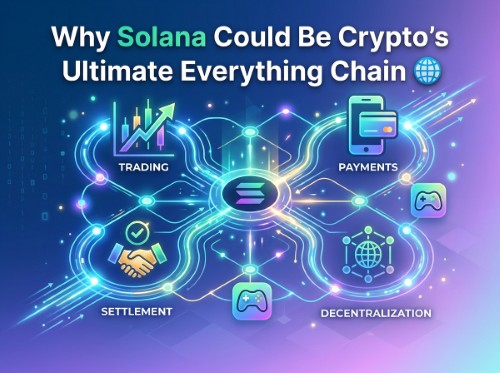
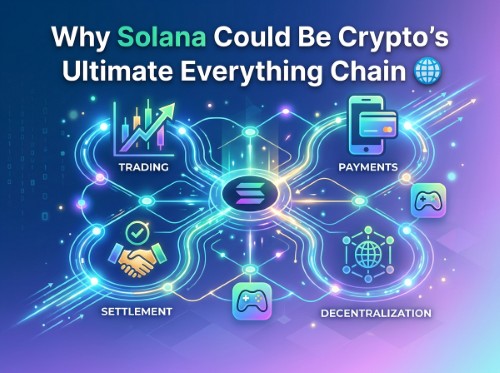
In contrast, Solana functions as an open, multi-use public ecosystem. It is designed to act as a neutral "everything chain" for trading, payments, and settlement. Because it is not tied to a single corporate entity's revenue targets, developers have greater freedom to build neutral financial tools and consumer applications without fear of platform bias or restrictive ecosystem boundaries.
Beyond user experience and decentralisation, Solana's economic architecture is undergoing a major shift. Network validators are weighing a significant governance proposal, designated as SGP-0003, which seeks to refine the network's tokenomics.
The proposal combines two key Solana Improvement Documents aimed at curbing the rate of new SOL token issuance while simultaneously increasing fee-burning mechanisms:
By reducing inflation and accelerating supply destruction, SGP-0003 aims to align Solana's economic model with long-term asset sustainability. If market demand remains steady or expands as user adoption grows, this reduced supply rate could create favourable supply-side dynamics for token holders.
Solana’s strength also lies in its willingness to support an exceptionally wide spectrum of activity. During recent market downturns, the network's meme coin ecosystem demonstrated unexpected resilience, keeping transaction volumes and user engagement high while other networks saw activity stall.
At the same time, Solana continues to expand into traditional finance, supporting tokenised stock trading, institutional payments, and high-frequency trading applications. Rather than shunning speculative activity in favour of purely institutional use cases, the Solana Foundation has actively supported a diverse spectrum of on-chain activity. This open approach allows the network to capture liquidity across multiple markets rather than relying on a single growth vector.
As blockchain technology becomes woven into mainstream consumer products, the networks that win will be those that combine speed, low costs, and high flexibility. Solana's trajectory as an "everything chain"—capable of powering speculative trading, seamless consumer payments, and institutional settlement on a single performant layer—makes it one of the most compelling networks to watch.
Disclaimer: This article is provided for informational purposes only, mistakes may be made, and it's not offered or intended to be used as legal, tax, investment, financial, or any other advice.