x




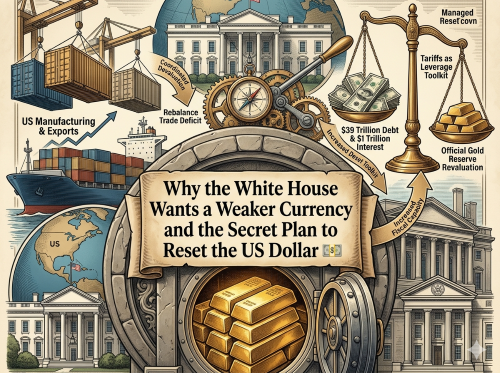
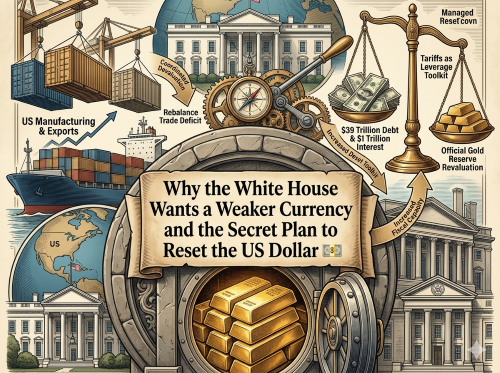
The stability of the global financial system has long relied on the dominance of the US dollar. For decades, its status as the world’s undisputed reserve currency has been viewed as America's ultimate economic superpower—a setup famously dubbed an "exorbitant privilege" by French policymakers in the 1960s. However, a major shift in economic thinking is taking root within Washington. Top economic advisers are now arguing that this reserve status has transformed from a blessing into an "exorbitant burden" that is structurally hollowing out American manufacturing.
To rectify this, a quiet strategy is being mapped out to engineer a managed devaluation of the US dollar. Far from a chaotic market collapse, this proposed currency reset is designed to be intentional, gradual, and executed behind closed doors. By exploring the policy blueprints, the economic levers at play, and a hidden trillion-dollar accounting trick involving gold vaults, we can see exactly how this reset could unfold and what it means for everyday wealth preservation.
At the core of the argument for a weaker dollar is a classic economic paradox known as the Triffin dilemma. Because the global economy requires a steady supply of dollars to facilitate international trade, the US is fundamentally forced to run permanent trade deficits to pump those dollars into the global system.
This constant global demand keeps the US dollar structurally overvalued year after year. While a strong currency sounds positive on the surface, it makes American exports artificially expensive on the global stage and makes foreign imports incredibly cheap. Over decades, this imbalance has eroded the American industrial base, sending well-paid manufacturing jobs overseas and turning the trade deficit into a permanent fixture of the economy.
A radical blueprint to fix this imbalance emerged from Steven Miran, a prominent macro strategist who authored a guide on restructuring the global trading system. Miran argued that the only way to rebalance the trading system and revive domestic manufacturing is to deliberately weaken the US dollar by an estimated 30% to 40%. This theory moved from the fringes of finance straight into the halls of power when Miran was appointed as the chair of the Council of Economic Advisers, putting the primary architect of the dollar-devaluation blueprint in direct communication with the presidency.
Devaluing the world’s dominant reserve currency is an incredibly delicate task. A government cannot simply hold a press conference and announce a sudden 40% devaluation without shattering global markets overnight. Instead, the strategy relies on a specific toolkit of economic levers.
The primary lever is the strategic use of tariffs. In this framework, tariffs are not merely revenue-generating tools; they act as aggressive bargaining chips. By placing heavy tariffs on imports, the US can reduce the flow of dollars leaving the country to foreign central banks, easing the natural upward pressure on the currency. Simultaneously, it forces international trading partners to the negotiating table.
Economists have pointed out that the historical precedent for this manoeuvre is the Plaza Accord of 1985, an agreement where major global economies coordinated a controlled devaluation of the dollar, causing it to fall roughly 50% against the Japanese yen and West German deutsche mark over two years. The modern iteration has been nicknamed the "Mar-a-Lago Accord." However, whilst the 1985 agreement was entirely voluntary, the modern strategy relies heavily on coercion, using tariffs as the primary stick to force compliance from trading partners.
Perhaps the most fascinating lever in this reset strategy lies deep inside the government’s balance sheet, tied to a statutory number that has not been touched in over 50 years: $42.22. This is the official price at which the US Treasury values its gold reserves, a legal relic left over from 1973 when the last formal link between the dollar and gold was severed.
On the open commodities market, gold has surged to over $4,300 an ounce. The US government officially holds roughly 261.5 million ounces of gold. When calculated at the ancient statutory price of $42.22, the entire national gold hoard is booked at a meagre $11 billion. However, at current market prices, that very same gold is worth over $1.1 trillion. This leaves a massive valuation gap of roughly $1.12 trillion frozen on the books.
The Treasury has the existing legal authority to revalue its gold to match current market prices. By doing so, the Treasury could issue new gold certificates to the Federal Reserve reflecting the updated value. The Federal Reserve would then credit the Treasury’s account with the difference. In a single bureaucratic stroke, the executive branch could conjure over a trillion dollars in new fiscal capacity without issuing a single dollar of new debt or raising taxes.
This mechanism is not unprecedented. President Franklin D. Roosevelt executed a nearly identical manoeuvre in 1933, revaluing gold from $20.67 to $35 an ounce to instantly expand government spending power and fund the New Deal. Interest in this modern balance sheet trick is evidently growing; the Federal Reserve recently published a formal staff note examining international experiences with official reserve revaluations.
While retail investors focus on daily market headlines, the world's largest financial institutions are already shifting their portfolios. Data from the European Central Bank reveals that gold has officially overtaken US Treasuries to become the single largest reserve asset held by global central banks, accounting for 27% of global reserves while Treasuries have slipped to 22%.
Geopolitical tensions have heavily accelerated this trend. A prime example is China, which has steadily halved its exposure to US debt, dropping its holdings to roughly $652 billion from a peak of $1.3 trillion. Analysts view this aggressive divestment as "sanctions-proofing"—a direct response to Western nations freezing Russian foreign reserves in 2022, which proved to the world that dollar-denominated assets can be weaponised. Central banks are choosing to hold physical gold because it carries no counterparty or political risk.
To bridge this shifting landscape, some monetary economists have proposed the introduction of Treasury Trust bonds. These would be long-dated bonds that give investors the option at maturity to be repaid either in paper dollars or in a fixed weight of physical gold. This would represent a soft, back-door reintroduction of gold into the modern financial architecture.
The pressure to execute a monetary reset is driven by stark fiscal realities. The US national debt has climbed past $39 trillion, and the annual interest bill alone has surpassed $1 trillion. The government is currently spending roughly $3 billion every single day just to service existing debt before a single dollar is spent on public services, infrastructure, or defence.
When a sovereign nation is buried under debt that it can no longer grow or tax its way out of, a controlled currency devaluation becomes less of a fringe theory and more of a balance sheet necessity. Devaluing the currency allows the debtor nation to pay down its nominal obligations with cheaper, less valuable units of money.
However, the path to a reset is a heavily contested battlefield. The Federal Reserve has pushed back with a hawkish stance under its leadership, with calls to shrink the central bank's bloated $6.7 trillion balance sheet and resist political pressure. Furthermore, a chaotic collapse of the dollar is in nobody’s interest; a strong, stable appearance on the surface is required to give policymakers the necessary leverage to rebuild the financial plumbing underneath.
For the ordinary saver, a deliberate devaluation of the currency acts as a quiet, regressive tax. A weaker dollar means that the real cost of the reset is measured directly in lost purchasing power—leading to stickier inflation and more expensive everyday goods. As the rules of the global fiat system are quietly rewritten, understanding these deep institutional shifts is the first step in successfully navigating the changing financial landscape.
Finance Bureau - Trump Will RESET The US Dollar
"A radical blueprint to reset the US dollar was written in 2024. Then its author took the keys to Trump’s economic playbook. This video reveals how tariffs, bond restructuring, and a trillion-dollar gold revaluation could drag the dollar lower without warning, directly impacting your savings and prices.
See the specific timeline insiders are watching, the subtle toolkit already in use, and why July 2026 could change global markets. You’ll never read another 'dollar collapse' headline the same way. Watch now for the details that affect your wallet."
~ TIMESTAMPS ~
0:00 – Why the White House Wants to Weaken the US Dollar
2:20 – Meet the Architect Behind the Radical Dollar Reset
4:37 – Treasury vs. Fed: The Stealth Plan to Devalue Your Savings
6:35 – The Trillion Dollar Secret: Revaluing US Gold Holdings
8:51 – Central Banks Ditching US Treasuries for Gold
11:01 – July 4, 2026: A Gold-Backed Bond Countdown?
13:10 – Managing the Reset: Why a Strong Dollar is the Perfect Cover
15:04 – Protecting Your Purchasing Power as the Rules are Rewritten
Source 👉 https://www.youtube.com/watch?v=3clcjK0ZZLw
Disclaimer: This article is provided for informational purposes only, mistakes may be made, and it's not offered or intended to be used as legal, tax, investment, financial, or any other advice.