x




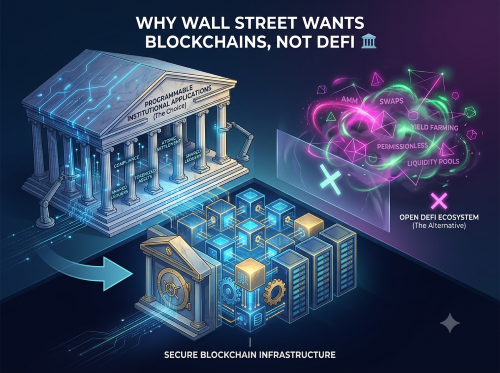
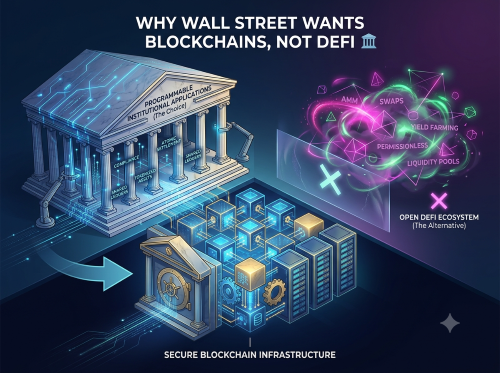
For years, a comforting story has dominated cryptocurrency circles: Traditional Finance (TradFi) and Decentralised Finance (DeFi) are on an inevitable path towards convergence. In this idealised future, permissionless liquidity pairs with institutional capital, creating a friction-free hybrid system that eventually replaces legacy infrastructure altogether.
It is an appealing narrative, but it fundamentally misreads institutional intent.
The reality is far more pragmatic. Wall Street is not embracing decentralisation as a philosophical ideal. Instead, financial institutions view distributed ledger technology through a practical operational lens: as a cost-of-goods-sold (COGS) efficiency story. Where blockchain technology reduces back-office overheads, eliminates counterparty risk, and speeds up settlement, institutions will adopt it with enthusiasm. Where it demands open access, pseudonymity, or a loss of central control, they will reject it outright.
What is emerging is not a merger between TradFi and DeFi, but a distinct new market category: programmable financial infrastructure.
Institutions do not evaluate software protocols the way crypto-native developers do. They operate within strict regulatory frameworks, rigorous risk mandates, and traditional procurement procedures. Consequently, when TradFi examines DeFi primitives, it puts them through an exacting selection process based on two mandatory criteria:
Primitives that pass both tests are selectively integrated. Features that pass the first test but fail the second are stripped away or heavily modified.
Primitives Retained for Institutional Use
Primitives Discarded by Wall Street
Permissionless access, pseudonymity, and immutable execution form the bedrock of native DeFi. To an institutional risk committee, however, these characteristics represent unmanageable liability. Regulated entities require mandatory Know Your Customer (KYC) checks, Anti-Money Laundering (AML) monitoring, sanctions screening, transaction reversal capabilities, and legal recourse.
When institutions launch blockchain projects—such as BlackRock’s tokenised funds, Franklin Templeton’s on-chain money market offerings, or JPMorgan’s permissioned deposit networks—they are not adopting DeFi. They are using public or private blockchain plumbing to modernise traditional products while deliberately discarding the anti-establishment ethos of open networks.
Whenever a disruptive technology encounters a heavily regulated industry, it undergoes significant reconfiguration—just as enterprise firewalls shaped the open internet and private clouds transformed corporate computing. In financial markets, this reconfiguration is following two distinct architectural patterns:
1. Purpose-Built Institutional Networks
Rather than modifying existing DeFi protocols, some platforms are engineered specifically around enterprise requirements from day one. Networks like Canton prioritise institutional confidentiality, governance, and controlled interoperability. The goal is not to bring banks into permissionless ecosystems, but to provide blockchain-based coordination while preserving institutional privacy and regulatory oversight. Similarly, initiatives from Circle (such as Arc) and SWIFT frame blockchain purely as compliant settlement infrastructure designed to strengthen existing banking relationships.
2. Modular Adaptation of Crypto Primitives
The alternative approach involves adapting crypto-native infrastructure so it can be safely consumed by institutional capital. Morpho, a decentralised lending protocol, illustrates this strategy well. While maintaining its permissionless core primitives, Morpho’s architecture allows enterprise asset managers—such as Apollo with its ACRED fund—to build compliant lending products on top. This model pairs high-efficiency DeFi primitives with institutional-grade distribution, compliance, and legal fund structures.
This bifurcation in the market creates two complementary opportunities for founders and software engineers. Attempting to pursue both within a single product is usually a mistake, as the target customers, sales cycles, and success metrics are fundamentally opposed.
Lane 1: Building Programmable Financial Infrastructure
Designing software for banks, asset managers, and fintechs requires deep expertise in enterprise procurement, regulatory compliance, and risk controls. Success in this lane is measured by capital efficiency, system reliability, and seamless integration with legacy banking APIs.
Lane 2: Building Open, Permissionless Networks
Open networks remain the essential research-and-development engine for global finance. Every primitive that institutions adopt today—from automated market making to yield-bearing tokens—originated in permissionless sandboxes. Designing for developer composability, global liquidity, and open access continues to drive ground-breaking financial innovation.
These two pathways are not in conflict; they are mutually reinforcing. Open networks act as the primary engine of discovery, creating new financial primitives without the burden of legacy constraints. The institutional layer acts as the engine of commercialisation, refining proven mechanisms, adding regulatory compliance, and scaling them to global markets.
Over time, convergence will happen naturally—not because TradFi surrenders to DeFi, or because open networks submit entirely to traditional regulation, but because both systems will increasingly settle transactions on shared public blockchain rails.
For builders, the winning strategy is focus: determine precisely which customer base you are serving, design directly for their operational constraints, and execute accordingly.
To read the original thesis by a16z crypto, explore the full article here:
👉 TradFi doesn’t want DeFi. It wants blockchains
Disclaimer: This article is provided for informational purposes only, mistakes may be made, and it's not offered or intended to be used as legal, tax, investment, financial, or any other advice.