x




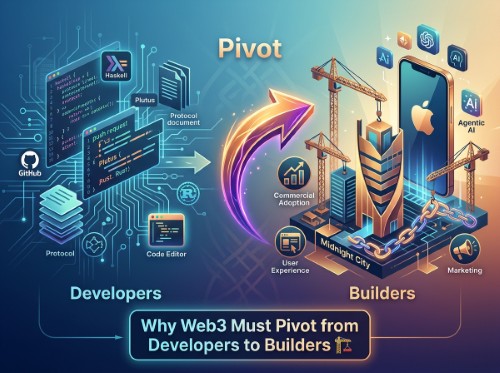
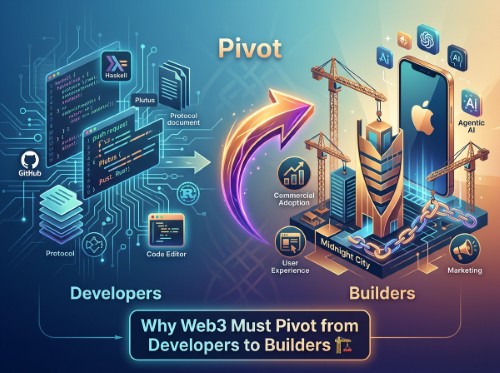
The Web3 landscape is undergoing a decisive paradigm shift. For years, blockchain ecosystems measured their strength through developer activity—counting the number of active programmers, lines of code written, and hackathon submissions logged. However, in an era defined by rapid advances in artificial intelligence and automated software engineering, raw developer metrics are quickly becoming vanity metrics.
In a recent comprehensive address, Cardano founder Charles Hoskinson outlined why the future of Web3 belongs not simply to developers writing code, but to holistic builders who can turn technical capabilities into commercial, user-centric products.
Here is a detailed breakdown of why this strategic pivot is happening, what it means for privacy-focused platforms like Midnight, and how blockchain ecosystems must evolve to achieve mass adoption.
Traditionally, hiring technical talent was the primary bottleneck in software development. A developer devoting hundreds of hours to writing Rust, Plutus, or TypeScript represented a scarce and valuable commitment.
However, the rise of modern AI coding assistants and "vibe engineering" has fundamentally changed this dynamic. Tools capable of generating, translating, and refactoring complex code bases in minutes have made functional code abundant. As a result, judging a blockchain’s potential solely by its developer count no longer reflects its true enterprise value.
When AI can automatically produce functional scripts, relying on raw developer figures creates distorted incentives. Ecosystems risk spending immense time and resources verifying whether code was authored by humans or generated by AI, rather than evaluating whether the project actually solves a real-world problem.
In this new environment, the competitive moat is no longer the code itself—it is the vision, product design, marketing, and commercial execution behind it.
While developers excel at solving specific technical tasks, writing protocols, and conducting rigorous security testing, builders take a broader, holistic view of product creation.
A builder evaluates the entire lifecycle of an application, addressing crucial questions:
Hoskinson illustrated this distinction using Steve Jobs' famous unveiling of the original MacBook Air. Jobs did not merely present engineering blueprints or hardware specifications; he placed the ultra-thin laptop inside a standard Manila office envelope and pulled it out on stage. That moment combined technical achievement with masterful storytelling and showmanship.
Builders rally engineers around a clear vision, packaging complex infrastructure into intuitive, compelling experiences that capture the public's imagination.
A core area where the builder mindset is urgently needed is privacy-preserving technology. For over three decades, cryptographers have advocated for digital privacy, yet adoption among everyday consumers remains minimal.
Consider Pretty Good Privacy (PGP) email encryption: although available since the early 1990s, the vast majority of web users do not encrypt their daily emails because setup requires cumbersome multi-step key management. Consumer behaviour proves time and again that ease of use, speed, and affordability almost always trump technical complexity.
For privacy-centric networks like Midnight—an agile, privacy-focused blockchain ecosystem built alongside Cardano—the lesson is clear. To achieve widespread adoption, privacy cannot be presented as a complex 28-step protocol that users must manually configure. Instead, privacy must function like a frictionless backdrop—an automated default integrated seamlessly into agentic AI workflows and financial applications.
Users will not adopt private platforms simply because they ought to care about data sovereignty; they will adopt them because the private option is simpler, cheaper, and superior to its non-private counterparts.
To drive sustainable growth, blockchain ecosystems must move past short-term speculation, vanity tokens, and dramatic online discourse. Real value creation requires focusing on applications that deliver measurable utility across global markets:
Projects like Midnight City, Pogan, and RealFi demonstrate how advanced cryptographic research can be translated into functional, commercial ventures. When builders construct systems that operate seamlessly on mobile phones, gaming consoles, or desktop computers with single-click simplicity, Web3 can finally bridge the gap from niche experimentation to mainstream integration.
The evolution from developer-centric metrics to builder-focused outcomes marks a vital maturity phase for the entire cryptocurrency industry. Whitepapers, theoretical frameworks, and technical documentation are essential building blocks, but they are not end products.
Winning the next cycle of global adoption requires celebrating entrepreneurs who can package sophisticated zero-knowledge proofs and blockchain infrastructure into clean, effortless user interfaces. By prioritising commercial execution, intuitive design, and real-world utility, Web3 can fulfil its original promise of creating a fairer, more accessible, and sovereign digital economy.
Charles Hoskinson - Devs versus Builders
Charles Hoskinson discusses the evolving strategy for the Midnight ecosystem, focusing on the transition from traditional developer-centric metrics to a builder-oriented approach. This shift emphasises product-market fit, commercial viability, and the integration of advanced tools to drive mass adoption and sustainable growth within the broader blockchain landscape.
Source: 👉 https://www.youtube.com/watch?v=VI5OuB6o5BU
Disclaimer: This article is provided for informational purposes only, mistakes may be made, and it's not offered or intended to be used as legal, tax, investment, financial, or any other advice.