x




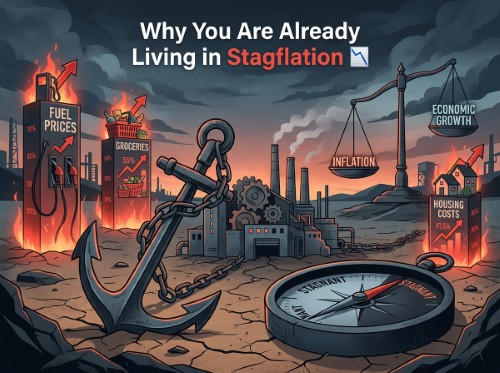
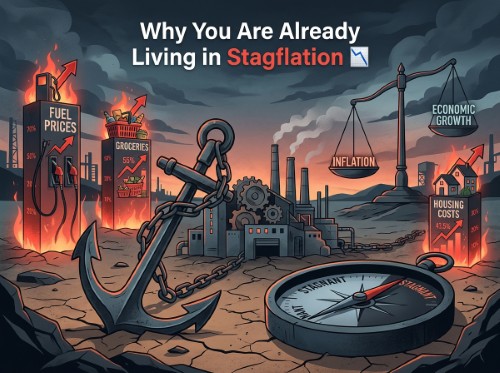
The global economic narrative often revolves around whether central banks can achieve a smooth economic landing or if a recession is looming on the horizon. However, according to veteran banking analyst and author Christopher Whalen, the conversation is missing the fundamental truth of our current economic environment: stagflation is not a future threat—it is already here.
For millions of households navigating rising everyday costs alongside stagnating real wages and falling real estate momentum, the uncomfortable realities of stagflation are an active daily experience rather than a theoretical macroeconomic risk.
Stagflation is traditionally defined as a macroeconomic condition characterised by stagnant economic growth, high unemployment, and persistent price inflation. In today's economy, however, the phenomenon presents a distinct modern structure. While official headline figures may portray a resilient labour market, consumer purchasing power is being steadily eroded by the compounding impact of essential living expenses, high borrowing costs, and stubborn core inflation.
In his extensive analysis of bank balance sheets and monetary mechanics, Christopher Whalen highlights how persistent inflationary pressures continue to squeeze household budgets while traditional avenues for wealth generation—such as residential real estate—face significant structural headwinds.
One of the central tenets of Whalen's outlook is that the era of ultra-low mortgage rates is firmly behind us. Many prospective homebuyers and property investors have remained on the sidelines, harbouring hopes that central banks will rapidly cut benchmark rates back to the historic lows seen over the past decade.
Whalen contends that there is virtually no realistic scenario that returns mortgage interest rates to the 5% threshold, let alone lower. The underlying monetary dynamics, persistent fiscal deficits, and structural inflation mean that elevated borrowing costs are likely to remain a permanent feature of the financial landscape.
For renters hoping to buy, the tactical advice shifts dramatically:
A particularly compelling insight from Whalen’s analysis is the stark divergence in default risk between single-family residential housing and commercial or multifamily property sectors.
Single-Family Residential Stability
Following years of rapid price appreciation, many single-family homeowners hold substantial equity reserves. Consequently, when defaults occur, mortgage lenders frequently experience near-zero loss given default (LGD) because the underlying asset value is sufficient to cover the outstanding loan balance upon liquidation.
Multifamily Property Vulnerability
Conversely, multifamily residential property presents an entirely different risk profile. Rent-regulated apartment buildings in major metropolitan areas face strict caps on rental income growth, even as maintenance, insurance, energy, and labor costs skyrocket due to general inflation. Unable to reprice their income streams to match rising expenses, these properties suffer severe net operating income compression, driving asset valuations down sharply and leaving lenders exposed to massive default losses.
As traditional commercial banks adjust their risk appetites and adjust to changing regulatory capital requirements, a fundamental shift is occurring in how credit flows through the economy.
Banks are increasingly pulling back from direct real estate lending, opting instead to extend credit lines to non-bank financial intermediaries and leveraged private funds. This shift tilts the system’s overall risk profile away from conventional credit underwriting and toward market-based liquidity. When systemic stress manifests, these non-bank lenders may face liquidity crunches that reverberate across broader financial markets.
Living in a stagflationary environment requires a conscious recalibration of personal finance strategies and asset allocation. To maintain financial stability, individuals and investors should consider several core principles:
Accepting that stagflation is already part of the present economic landscape enables consumers and investors to make informed, realistic choices rather than waiting for an economic return to the past.
GoldSilver - You're Already Living In Stagflation
"The cost of living keeps climbing while the value of the biggest thing most families own is falling. That combination has a name, and Christopher Whalen thinks we are already living in it.
53% of American homes lost value over the past year, the highest share since 2012. Not in a crash. Quietly, while the headlines were about something else.
Whalen is Chairman of Whalen Global Advisors, a columnist for National Mortgage News, and the author of The Institutional Risk Analyst. He spent four decades in banking and mortgage finance, including the Federal Reserve Bank of New York and Kroll Bond Rating Agency, so when he talks about how mortgages get valued he is describing an industry he has worked inside."
~ Timestamps ~
0:00 Half Of US Homes Are Falling In Value
0:13 What Should Ordinary People Hold?
0:29 Gold In The Sock Drawer
0:48 Cutting Your Living Costs In Half. Twice.
1:57 Mortgage Servicing Rights And The Audit Firms
3:42 Why The Big Banks Are Poaching Mortgages
4:15 Should You Wait To Buy A House?
5:26 "Misery On The 8s"
6:27 Why A Correction Is An Opportunity
7:07 Stagflation Is Already Here
7:52 What If Quantitative Easing Stops Working?
9:10 Where To Follow His Work
Source 👉 https://www.youtube.com/watch?v=woXEy69UEu4
Disclaimer: This article is provided for informational purposes only, mistakes may be made, and it's not offered or intended to be used as legal, tax, investment, financial, or any other advice.