x




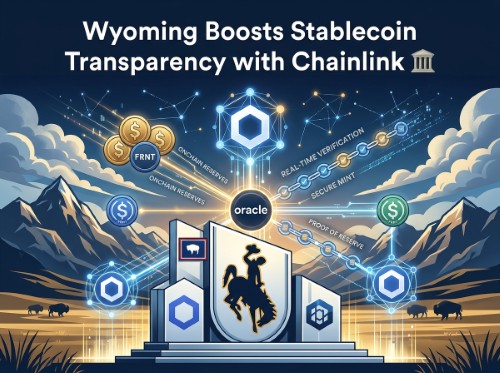
The US state of Wyoming is taking another significant stride in bridging public finance with blockchain technology. By deepening its partnership with oracle network Chainlink, Wyoming is introducing near-real-time onchain reserve verification for its state-issued Frontier Stable Token (FRNT).
This development marks a crucial milestone for state-backed digital assets, setting a fresh benchmark for transparency, collateral management, and security in the rapidly evolving real-world asset (RWA) tokenisation space.
Launched in January, Wyoming’s Frontier Stable Token (FRNT) is designed as a fully backed, dollar-pegged digital asset. The token’s reserves consist exclusively of US dollars and short-term US Treasuries, ensuring high liquidity and low risk. Crucially, interest income generated from these underlying reserves is funnelled directly into Wyoming’s School Foundation Programme, providing an innovative revenue stream for public education.
While Wyoming was already providing daily reserve attestations and adhering to statutory requirements for monthly disclosures under the GENIUS Act, government officials recognised that traditional reporting schedules leave visibility gaps between publication dates. By incorporating Chainlink’s automated infrastructure, the state is moving beyond retrospective reporting toward continuous operational oversight.
To achieve near-real-time visibility, the Wyoming Stable Token Commission has integrated Chainlink Proof of Reserve (PoR).
This mechanism combines independent financial examinations conducted by specialised accounting firm The Network Firm with Chainlink’s decentralised oracle nodes. The system continuously verifies FRNT’s backing and publishes cryptographic proof of the state's reserve balances directly onchain.
Key advantages of this integration include:
Beyond passive reserve monitoring, Wyoming is actively implementing Chainlink’s Secure Mint feature to enforce backing algorithmically before new tokens can even enter circulation.
Under traditional stablecoin issuance models, token creation relies on administrative keys or manual off-chain approvals. If human error occurs, or if administrative credentials are ever compromised, unbacked tokens could theoretically be minted before fiat deposits clear.
Secure Mint solves this risk by converting reserve verification from a passive reporting tool into an active, programmatic gatekeeper:
By hardcoding this conditional logic into the token's smart contract, Wyoming ensures that FRNT can never become undercollateralised, eliminating human error and centralized minting risks entirely.
The adoption of Chainlink Proof of Reserve follows another major infrastructure shift by the state. Wyoming recently completed a full migration of FRNT from LayerZero to Chainlink’s Cross-Chain Interoperability Protocol (CCIP).
With CCIP now acting as FRNT’s exclusive cross-chain transfer solution, Wyoming benefits from a unified security framework covering both cross-chain messaging and reserve verification. CCIP provides institutional-grade cross-chain security, featuring an independent Risk Management Network that constantly monitors for suspicious cross-chain activity.
Wyoming’s decision reflects a broader industry trend: traditional financial institutions and public entities are increasingly relying on Chainlink to connect legacy financial assets with blockchain environments.
Recent institutional milestones across Chainlink's ecosystem include:
Wyoming's proactive approach provides a compelling blueprint for other regional and national authorities considering public digital currencies. By combining high-quality collateral, public revenue distribution, and automated onchain auditing, the Frontier Stable Token demonstrates how governments can issue digital assets that are both innovative and strictly compliant.
As regulatory scrutiny surrounding stablecoin backing continues to heighten globally, near-real-time verification and automated minting guards are likely to transition from pioneering features into universal industry standards.
Disclaimer: This article is provided for informational purposes only, mistakes may be made, and it's not offered or intended to be used as legal, tax, investment, financial, or any other advice.