x



The Bauer brothers founded scientific botanical illustration
In the 18th century, Josef, Franz and Ferdinand Bauers – three boys from Valtice (Valtice (Czech pronunciation: [ˈvalcɪtsɛ]; German: Feldsberg) is a town in Břeclav District in the South Moravian Region of the Czech Republic. It has about 3,600 inhabitants.)
– left their Moravian town to travel to royal courts and prestigious scientific institutions across Europe. Their precise watercolours of botanical and zoological motifs are still considered among the world’s finest scientific illustrations.
The Bauer brothers – Josef, Franz and Ferdinand – had a very close and mutually supportive relationship that accompanied them throughout their extraordinary life and professional journeys. They grew up together in a small Moravian town and their common beginnings were connected to the monastery of the Brothers of Mercy in Valtice, where their educational career began. During their studies in Vienna and subsequent work on important projects such as the Codex Liechtenstein, the brothers helped and inspired each other. Their relationship was based on a shared passion for science, art and nature, which also united them in their different professional directions – Josef was dedicated to the management of art collections, Franz was a court painter and Ferdinand participated in scientific expeditions.
Newly published richly illustrated publication Bratři Bauerové: Příběh tří chlapců z Valtic (“The Bauer Brothers: The Story of Three Boys from Valtice”) presents the stories of three exceptional brothers whose names are indelibly inscribed in the history of botanical and zoological illustration for the first time in the Czech Republic.
The Bauer brothers' watercolors had a major impact on scientific illustration and are considered the pinnacle of this artistic and scientific field. Their work stands out for its extraordinary precision, detail, and aesthetic quality, which allowed scientists to better document and study natural objects, especially plants and animals.
.png)
Beginning sounds like a fairy tale
There were three brothers born in Valtice, South Moravia. And what were they like? Famous for their incredibly accurate and beautiful botanical illustrations throughout the world of the second half of the 18th and first half of the 19th centuries, and still respected and recognized in professional circles in our time. Only in their birthplace in the Břeclav region, no one wanted or was allowed to know about them for years.
Just as Valtice went through a dark history, when parts of the castle shamefully served as a women's prison, a tobacco drying room or a tractor workshop, the fascinating story of the three brothers was also in danger of being forgotten in their birthplace.
The brothers were born into the family of the Liechtenstein painter Lucas Bauer. Their works – detailed watercolors of plants and animals – are now held by royal and scientific institutions in London, Oxford, Vienna, Vaduz and New York. Prices for the originals start at one hundred thousand euros.
Each of the brothers worked in a different place – Joseph with the Liechtensteins in Vienna, Franz in England as painter to King George II, Ferdinand on expeditions in Australia and Greece. The works of the Bauer brothers, which are often of incalculable value, are dominated by a unique watercolor-painted herbarium in fourteen volumes called the Liechtenstein Codex.
New book about botanical illustration geniuses recalls forgotten cultural heritage of Valtice / New York, August 8, 2025 – The newly published, richly illustrated publication The Bauer Brothers: The Story of Three Boys from Valtice presents for the first time in the Czech Republic the fates of three exceptional brothers, whose names have been indelibly inscribed in the history of botanical and zoological illustration.
The publication introduces children and adults to the life path of Josef, Franz and Ferdinand Bauer, who rose from a small Moravian town in the 18th century to royal courts and prestigious scientific institutions. The reader follows their story from childhood in the monastery of the Brothers of Mercy in Valtice, through their studies in Vienna and work on the Liechtenstein Codex, to their international careers:
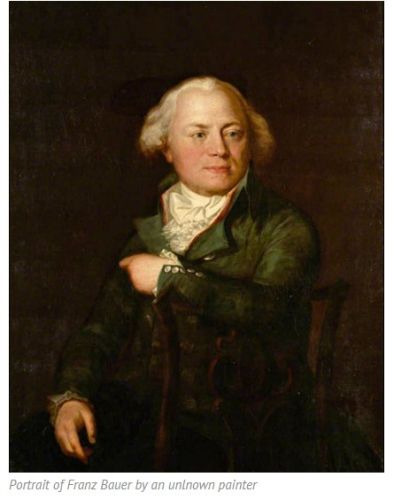
Franz (Francis) Bauer, 14.3.1758 Valtice - 11.12.1840 Kew
Josef became director of the Liechtenstein Gallery in Vienna Franz worked as a court painter at Kew Gardens for King George III of England. Ferdinand participated in research expeditions to Australia and Greece. Their precise watercolors are among the world's pinnacles of scientific illustration and are now preserved in institutions such as Kew Gardens, Oxford University and the Natural History Museum in London. Their work was admired by Johann Wolfgang von Goethe, who compared it to the work of Leonardo da Vinci.
.png) Protea cyranoides
Protea cyranoides
Ferdinand Lucas Bauer was born on January 20, 1760 in Valtice (formerly Feldsberg in Lower Austria), died on March 17, 1826 in Hietzing near Vienna. This excellent botanical illustrator was the youngest son of Lucas Bauer, court painter to the Liechtensteins. After his father's death, he and his brothers Joseph Anton (1756–1830, court painter to the Liechtensteins) and Franz Andreas were placed in the care of Norbert Boccio (1731–1806), prior of the monastery in Valtice, a friend of the Liechtenstein family.
In 1777, the first volume of his 14-volume work was published, entitled Liber regni vegetabilis retinens plantas ad vivum pictas ab admodum reverendo ac venerabili patre Norberto Boccius ord. S. Joannis de Deo actuali Priori Feldsbergensi collectae et a Josepho, Francisco et Ferdinando Bauer pictae.
Boccius donated all 14 volumes to the Liechtensteins, and today they are kept in the Liechtenstein collections in Vaduz.
In mid-1786, on Jacquin's recommendation, Ferdinand Bauer joined Oxford professor J. Sibthorpe (1758–96) as a painter on a research trip to Greece and Asia Minor. They returned to England in December 1787 with over 1,500 sketches of plants, animals, birds, and landscapes, some of which appeared in Flora Graeca. In the Latin introduction to the publication, Sibthorpe stated that Bauer had an excellent reputation and that his illustrations proved his merit.
In 1801, on the recommendation of J. Banks, Ferdinand traveled to Australia as a plant and animal draftsman for the Flinders expedition. The expedition left England on 18 July 1801 via Brazil and around the Cape of Good Hope. Bauer had already drawn birds on the way, but many of the drawings were ruined by damp. They landed in Western Australia on 8 December 1801. The working conditions were very demanding, Bauer even collapsed from fatigue and lack of fluids on one trip inland. Nevertheless, he continued to draw, resulting in about 1,000 drawings of plants, 200 drawings of animals.
Some of his works remained unpublished, many of the completed ones were acquired by the British Admiralty (transferred to the British Museum in 1843). Bauer worked on his publication Illustrationes Florae Novae Hollandiae for 5 years (until 1812), making the engravings himself. Unfortunately, the publication was not a commercial success, about 50 sets were printed (it is therefore not surprising that in 1997 one set was sold for 125,000 pounds).
.png)
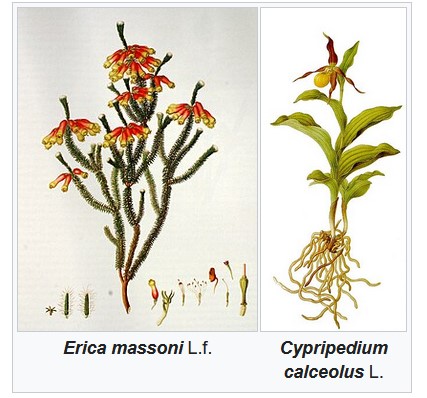
Although Ferdinand was one of the best botanical illustrators, he was almost forgotten soon after his death. The first to revive interest in his work was J. Lhotsky (1795–1866), who visited New South Wales and Tasmania in 1832–38. He wrote a short biography of Ferdinand Bauer for the London Journal of Botany and published Bauer's letters from Australia. Many of Bauer's paintings and herbaria are now in the Natural History Museum in Vienna, and paintings are in the library of the Natural History Museum in London and at Oxford University.
Thanks for reading
Margaret
Sources:
https://en.wikipedia.org/wiki/Franz_Bauer
https://www.nhm.ac.uk/our-science/services/library/collections/bauer-brothers.html
https://www.amazon.com/Bauers-Ferdinand-Masters-Botanical-Illustration/dp/3791354892
(1)(2)(1)(1)(1)(1)(1)(1)(2)(1)(1)(1).jpeg)