x




Outrage in Czech Republic – highest provocation from Sudetendeutsche Landsmanschaft
The Sudetendeutsche Landsmannschaft (English: Sudeten German Homeland Association; Czech: Sudetoněmecké krajanské sdružení) is an organization representing Sudeten German expellees and refugees from the Sudetenland in Czechoslovakia. Most of them were forcibly expelled and deported to western Allied occupation zones of Germany, which would later form West Germany, from their homelands inside Czechoslovakia during the expulsion of Germans after World War II. Many settled in Bavaria. (from Wikipedia)
On January 15, 1961, the Sudeten German Council approved and on May 7 of the same year adopted the "20 Points", which are in principle still in force today. Among other things, they demand the resettlement of Sudeten Germans in the original territories where they lived until 1945.
This year for the first time in the history the Sudetendeutsche Landsmannschat (SL) decided to organize their annual meeting on Czech territory.
Czech president P.Pavel, former intelligence officer already in 2024 declared at a meeting with citizens that the First Republic (years 1918 - 1938) allegedly ignored the Germans, and so Hitler allegedly used this to radicalize them. In essence, he shifted the blame for the formation of Henlein's Sudeten German Party, which won the parliamentary elections in Prague in 1935, onto us Czechs. In fact, he made the claim that if Czechoslovakia had been interested in the Germans, they would not have listened to Henlein or Hitler.!
The Germans were not interested in politics, and it was Konrád Henlein who founded his party for them in October 1933 on the instructions of the then new German Chancellor Adolf Hitler, in order to use the mass of 3.5 million Germans in Czechoslovakia to unleash the so-called "German question".
For Munich 1938 and for the expulsion of Germans after 1945, responsibility lies with Hitler, Henlein and K. H. Frank, who broke up our republic, not with us Czechs who ignored the Germans!
Its goal was the secession of the borderlands. The plan was prepared by the German intelligence SD as early as 1934, as revealed by materials and files released to historians after the war. It was a Nazi plan to incite the Germans in the Sudetenland against the Czechs and against the government in Prague. It was therefore not the fault of the Czechs that they ignored the Germans. They did not become radicalized because of any ignorance, but because of speeches from Berlin directed by Konrád Henlein and, last but not least, because of a certain bookseller from Karlovy Vary who helped him organize demonstrations.That bookseller was a certain K. H. Frank.
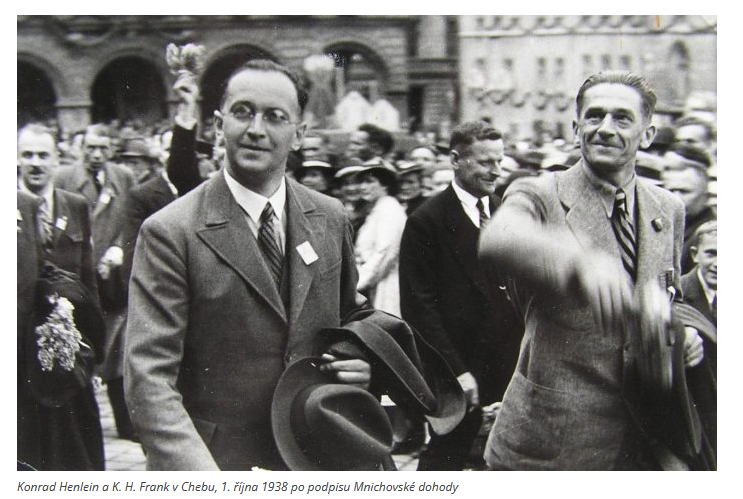
Henlein and Frank 1st Oct. after the Munich agreement was signed
In 1938 the SdP (Sudetendeutsche Partei) got in the election 90% , 10% belonged to social democrats.
And suddenly in 2024 we hear the Czech president performing a disgusting apologetic in favor of the Sudeten people, saying that we are to blame for their radicalization, that we ignored them.
My God, this can't be the Czech president, right? But that's nothing compared to what he has shown now. Petr Pavel officially expressed his patronage over the congress of Sudeten Germans in Brno. And this despite the fact that the official statutes call for the abolition of Beneš's decrees, on which the Czech Constitution, statehood and constitutional law are based.
Dismantling of national memory under presidential auspices
The Prague castle office is trying to downplay the whole situation with rhetoric about “open dialogue without fear” and “mutual understanding”. However, the reality of the written word is much colder than political marketing. The basic documents of the Sudeten German Landsmanship, which are officially presented and approved by its leadership, speak in a very clear language. Their declared and long-term goal remains the repeal of the decrees of President Edvard Beneš and all subsequent post-war laws.
If today’s political elites applaud the congresses of organizations that question this arrangement, they indirectly question the very results of World War II and the legitimacy of post-war international law.
The attempt to create the impression that both sides suffered equally and that the historical account is symmetrical is a gross distortion of history. The aggressor and the victim cannot stand on the same moral level. If the Czech president legitimizes a platform where decrees are referred to as “injustice,” there is a moral blurring of historical truth. This opens the door to revisionism that may generate far-reaching legal and political claims in the future.
Brno is thus becoming the scene of an event that rightly arouses deep concern and a sense of historical betrayal in a part of the Czech public. Holding a congress of an organization with this agenda directly in the Moravian metropolis, moreover with the blessing of the highest places, acts as a provocation and an attack on the resilience of Czech society. It is testing how far one can go in revising the post-war arrangement without provoking fundamental resistance from the political elites. The cautious statements of diplomats and the active support from the Castle point to a deep crisis of national self-confidence. State sovereignty is not a self-evident thing that is enough to possess; it is a value that must be actively defended daily. If we sacrifice the foundations of our legal continuity in the interest of false pacifism and EU conformity, we may soon wake up to a world where other elements of our state sovereignty will also be questioned.
President of Czech Republic Petr Pavel risks a treason lawsuit
Czech politician who cooperates with the Landsmanship is most likely committing treason.
And in the case of the President of the Republic, high treason. Because anyone who cooperates with, supports, incites, patronizes, finances, or otherwise assists an organization, group, individuals, or associations in promoting steps that threaten the Czech constitutionality or statehood is committing treason, or high treason, in the case of the President.
At a time when Europe is facing geopolitical upheaval, when calls are being made from Hungary to question the Beneš decrees from the mouth of the new prime minister Magyar, and when the stability of borders and the rule of law is once again becoming a key security issue, gambling with the legal foundations of our post-war existence is an inexcusable act.
The Landsmanshaft climbed out of its political grave and on its back its sponsors forced themselves onto the Czech and European scene: Bavarian Prime Minister Markus Söder and German Federal Minister of the Interior Alexander Dobrindt.
The governments of the victorious powers decided on the expropriation of property and the removal of the people and made this decision part of major international treaties. Beneš's presidential decrees on the Czechoslovak side were therefore only an administrative safeguard for these decisions, so that these actions would take place in an orderly manner.
The Czech government and parliament have clearly spoken out against holding the meeting in Brno, but this event has been approved by Brno councilors and the government cannot cancel it. The President has stood by the organizers and supports the event, just as he supports the opposition in parliament.
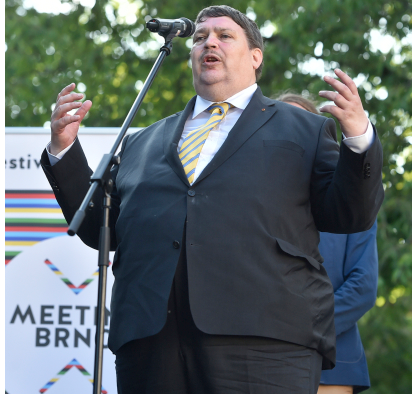 Bernd Posselt rebukes Czech politicians: You are sliding towards communism!
He also mocks Czech Parliament which adopted a government resolution on last Thursday rejecting the holding of the Sudeten German Expatriate Association (SdL) congress in Brno. The text called on the organizers of the event to withdraw from holding it, which representatives of the organizing organizations refused.
But the fight is not over yet, even though the SL meeting in Brno is very near - from 22.5 - 25.5.2026.
At the time of Pentecost.
From the Heart of Europe
Margaret
Source: czech web