x




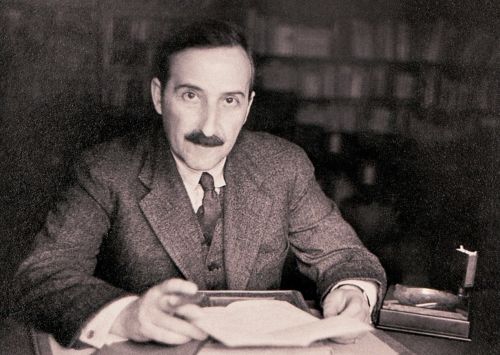
Stefan Zweig, great writer
He is considered one of the founders of psychological prose. He was one of the most prominent intellectuals of the 20th century. His historical novels and novellas, which became bestsellers, have been translated into more than 50 languages and are sold worldwide to this day.
From Wikipedia:
Stefan Zweig (28 November 1881 – 22 / 23 February 1942) was an Austrian writer. At the height of his literary career, in the 1920s and 1930s, he was one of the most widely translated and popular writers in the world.
Zweig was born in Vienna and died in Petrópolis in Brazil.
(in some language versions of Wikipedia date of death 22. Feb, in others 23.Feb.)
In 1934, as a result of the Nazi Party's rise in Germany and the establishment of the Ständestaat regime in Austria, Zweig emigrated to England and then, in 1940, moved briefly to New York and then to Brazil, where he settled. In his final years, he would declare himself in love with the country, writing about it in the book Brazil, Land of the Future. Nonetheless, as the years passed Zweig became increasingly disillusioned and despairing at the future of Europe, and he and his wife Lotte were found dead of a barbiturate overdose in their house in Petrópolis on 23 February 1942; they had died the previous day.
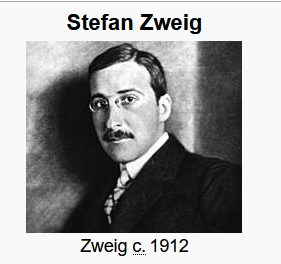
A native of Vienna he came from a Jewish business family. His father Moritz born in Prostějov (today Czech Republic) was a merchant and manufacturer. Stefan Zweig lived with his parents in Vienna since childhood.
Stefan Zweig did not give any further details about his ancestors in his memoir The World of Yesterday. He wrote only in general terms: “My father’s family came from Moravia. In the small country towns there, Jewish communities lived in the best possible harmony with the peasants and petty burghers, and so they completely lacked the despondency and, on the other hand, the flexible, predatory impatience of the Galician, Eastern Jews…. They soon emancipated themselves from the Orthodox religion, became passionate adherents of the religion of the age of “progress,” and in the political era of liberalism they gave the most respected deputies to parliament."
During World War I he lived in Vienna and worked in the archives of the Ministry of War. In 1914 he published an open letter to Friends Abroad. Together with intellectuals from various countries, such as Romain Rolland, he joined the peace movement and drew attention to the inhumanity of war.
Stefan Zweig was a prominent European intellectual, humanist and pacifist. He spoke out against war, violence and indifference. He was friends with a number of important figures. Among them were the physician and psychologist Sigmund Freud, the poets Rainer Maria Rilke, Emile Verhaeren and Paul Valéry, the writers Romain Rolland, James Joyce, Heinrich and Thomas Mann, Franz Werfel, Jules Romains, Jane Adams, H. G. Wells, Maxim Gorky and the musicians Maurice Ravel and Richard Strauss.
He put a whole series of his reflections, opinions and ideas into the book The World of Yesterday with the subtitle Memories of a European (German: Die Welt von gestern). He wrote it shortly after the outbreak of World War II and summarized his human and writing experience, which he had gained from the end of the 19th century to the tragic present. He also showed himself to be an excellent observer of ordinary life, customs, social behavior, fashion, the color of cities, editorial offices, theaters, schools. The book also contains his observations and reflections on Judaism and the political events of the time. For example, he mentions humiliation and torture, including the inhuman order when his eighty-four-year-old sick mother, as a Jew, was not even allowed to sit on a park bench shortly after the Anschluss of Austria in 1938.
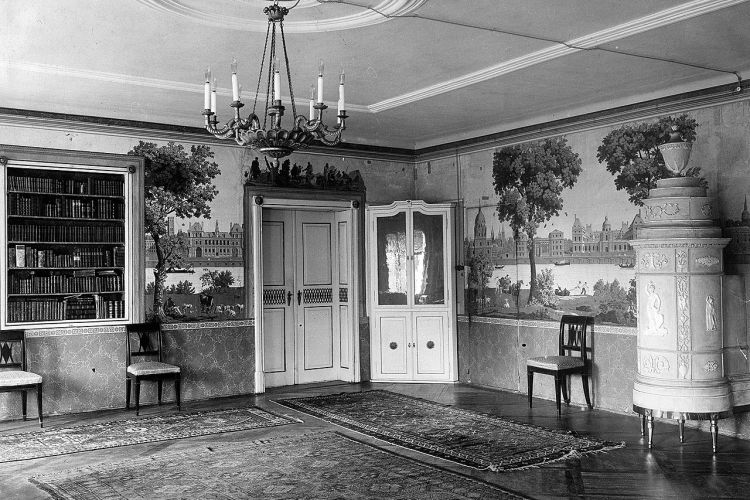 Living room of Stefan Zweig in Salzburg
In 1934, as a result of the Nazi Party's rise in Germany and the establishment of the Ständestaat regime in Austria, Zweig emigrated to England and then, in 1940, moved briefly to New York and then to Brazil, where he settled. In his final years, he would declare himself in love with the country, writing about it in the book Brazil, Land of the Future.
The list of works by this magnificent author is very long. He wrote historical novels and biographies (Mary Queen of Scots, Ferdinand Magellan and more), novellas (The royal game, Amok....) and dramas.
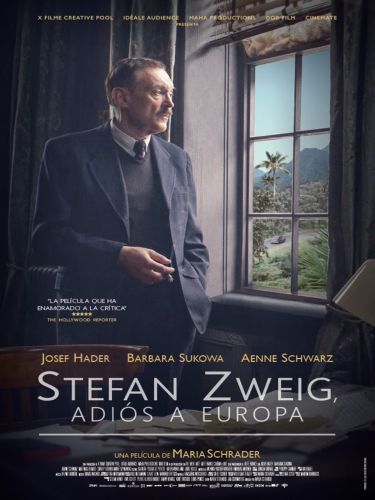
When he decided to end his life Zweig wrote a letter , here a part of it:
"... But after sixty, extraordinary strength would be needed to start over again. And mine are exhausted by long years of homeless wandering. I therefore consider it better to end a life in good time and standing up, for which spiritual work has always been the purest joy and personal freedom the highest good of this world. I greet all my friends! May they still see the morning rays after the long night! I, too impatient, precede them. "
Zweig died in 1942, the same year he wrote his famous Chess Novel, a scathing condemnation of the brutality of Nazism.
------
The concept of mystery played a significant role in Stefan Zweig's work. The last verse of the poem, which he introduced in the book Amok, says that there is life only where mystery is at work, and he once underlined the sentence in one of his short stories: "I think that only he who experiences his life as a mystery truly lives." Can we apply this to this death? If we were to examine it with an imaginary X-ray, what would we see? Fear, hopelessness, or simply putting down the pen and with it ending his life? This suicide had neither health problems nor material worries, and he was aware of his worldly fame. All this was apparently not enough to outweigh the longing for the lost world of yesterday.
Thanks for reading about my favourite writer
Margaret
Source:
https://www.nli.org.il/en/discover/literature-and-poetry/authors/stefan-zweig
https://hanackyjeruzalem.cz/clanky/pred-osmdesati-lety-zemrel-rakousky-spisovatel-s-prostejovskymi-zidovskymi-koreny-stefan-zweig/