x






An Australian team designed the eye-catching robot to spark conversations about diversity in engineering and robotics.
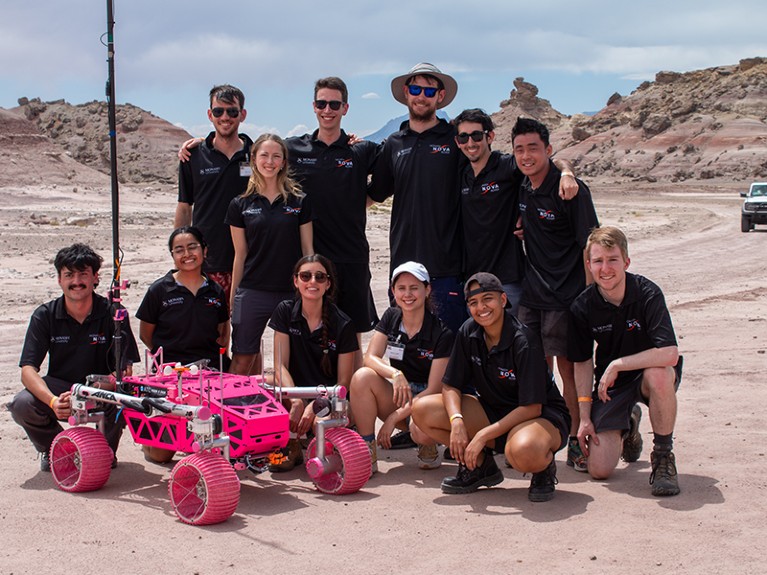
Members of the Monash University rover team pose alongside Waratah, named after an endemic Australian flower.Credit: Amanda Heidt
In late May, dozens of teams travelled to tiny Hanksville, Utah, population 162, to compete in one of the world’s largest university-level robotics competitions. Held annually in a swathe of the southern Utah desert chosen for its likeness to Mars, the University Rover Challenge pits the next generation of space scientists and their rovers against one another over three days.
The Monash Nova Rover team, from Monash University in Melbourne, Australia, placed second for the second consecutive year, deftly navigating its robot through Utah’s rugged badlands as it searched for life, delivered tools to astronauts and repaired a mock lander. But beyond its engineering prowess, the team was notable this year for another reason. In a competition largely dominated by men, women made up roughly half of the team’s leadership, and the group’s rover — named Waratah, after an endemic Australian flower — is a glaringly hot shade of pink, impossible to miss amid a sea of black and silver competitors. “It’s a conversation starter because it’s an antithesis, and it shouldn’t be,” says Chloe Chang, a fifth-year robotics and mechatronics undergraduate and joint leader of the team.

Chang says that she and her teammates designed Waratah in part to prompt conversations about women in science, technology, engineering and mathematics (STEM). Although most of the 31 teams did contain at least one woman, the demographics of the event mirrored a broader lack of representation in engineering and robotics, with women holding just one in five engineering degrees in the United States and United Kingdom, and only one in six in Australia. The proportion of women who go on to have successful, full-time engineering careers is smaller still.
The robot’s striking colour, Chang says, has been a simple but powerful way to engage with others over what diverse thinking can bring to engineering and robotics. “The pink rover has brought a bunch of different people together to support a very complicated cause.”
Before transitioning into engineering in 2019, Chang was a fashion-design student. Having switched, she felt self-conscious at first about her colourful clothes and dampened her personality among her mostly male peers. But being inauthentic to herself quickly became tiresome. When she joined the rover team, Chang resolved to create a supportive space and set about recruiting more women. The most important thing for her was that a prospective member be curious and collaborative.
“Robotics is fundamentally creative, and we want to be accessing a greater pool of creative thinking and ideas to ultimately find the best solutions to engineering problems,” Chang says. “Seeing more women coming into leadership and having that visibility definitely helps.”
Although some of Chang’s recruits grew up interested in STEM, others, like Chang herself, took a less conventional path. Rebecca Leith, the group’s other leader, left a career as a dancer with the Queensland Ballet for dual degrees in chemistry and engineering, and has been surprised that robotics requires the same coordination and grit that dancing does. Lauren Earls, who helped to design and build the rover’s chassis, attended a Catholic girls’ school that didn’t place an emphasis on STEM subjects. During a retreat at a convent, she joined a group of pupils on a team-building exercise that involved using cardboard and rubber bands to build a prosthetic arm. “I don’t know how I pulled it off, but I managed to make something, and my teachers were quite impressed,” Earls says. “I remember that as a core memory, thinking, ‘If this is what makes me happy, I need to go out and seek it.’”
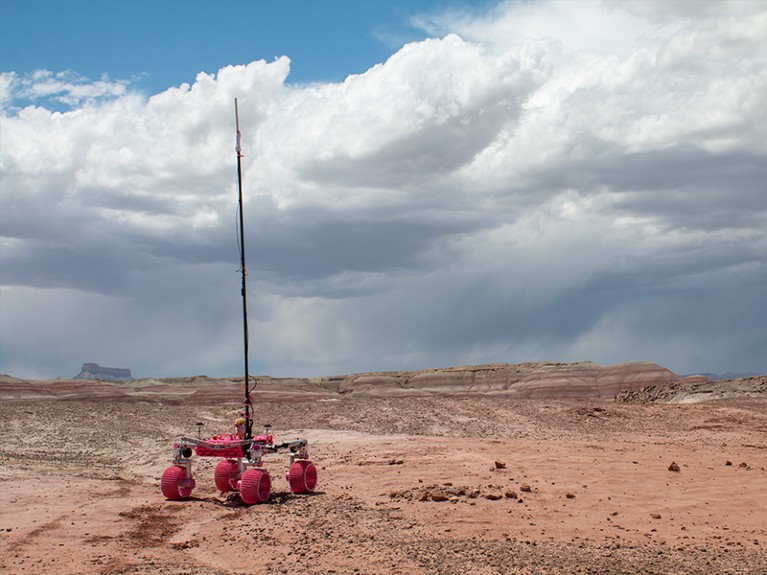
The Monash University rover against the Mars-like landscape of the Utah desert.Credit: Amanda Heidt
Building the pink rover required pitching the idea to all 100 members of the team, 30 of whom were women. Not everyone liked the idea, Leith says: some worried that choosing pink to represent women would be tokenizing, because not every woman likes the colour. The group workshopped their campaign messaging for months, and then voted on the final language.
Seeing the project through after the vote was also a logistical challenge. In some cases, the team’s sponsors had to put in special orders just to source pink parts. But in February, Waratah made its debut before an audience of 300 supporters, including representatives of the Australian Space Agency. A month later, the team won its first competition, the Australian Rover Challenge.
To further bolster its message, the group also launched a three-pronged initiative, including outreach to local secondary schools, a social-media campaign to draw in sponsors and highlight the team’s work, and a Pink Rover Women in STEM night, held in May in Melbourne.
“You can’t be what you can’t see, and so we’re really keen to make sure others do see the amazing work that these women are doing,” Chang says.
The Monash team’s efforts come at an opportune time. Australia is currently jump-starting its space sector, with efforts including a Moon to Mars Initiative, with Aus$150 million (US$100 million) to fund the development of new technologies. In mid-2022, NASA launched rockets from the continent for the first time since 1995.
These changes have meant new opportunities, including the potential for students to pursue careers in space engineering when they might otherwise have taken jobs in mining or agriculture. Chang has accepted a remote position as a mechanical engineer at the Colorado-based technology company Lunar Outpost, a member of one of two consortia to receive a Trailblazer grant, through the Moon to Mars Initiative, to design a lunar rover that could be deployed as soon as 2026. Developers have even discussed making the rover a bright colour to stand out against the Moon’s grey surface, she says.
Surrounding herself with supportive teammates has given Chang the confidence to go after these big goals, and other colleagues share that sentiment as well. Some members are talking about starting their own companies or otherwise taking on leadership positions.
“When I talk to people on the team about what they want to do after they graduate, it’s not just ‘Oh, I want to do this job in this industry.’ Everyone is thinking about how to improve and innovate,” says Manika Goyal, the group’s software lead. “Had I not joined the team, I would just have been a software engineer at a company, but I think I’m more inspired now to also do other things that I’m passionate about.”