x



There's a quiet anxiety simmering in the modern workforce: the fear of being replaced by a robot. We're told to work harder, learn new skills, and compete against the tireless efficiency of machines. But what if that's the wrong fight entirely?
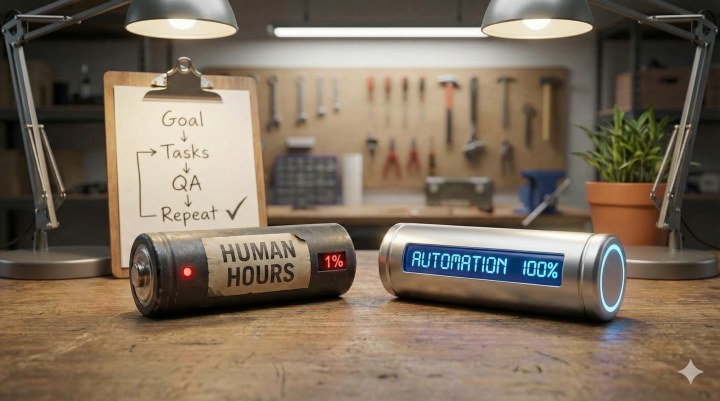
The core premise of the coming economic shift is simple: competing with a robot on "muscle" is a losing battle because the "human battery is obsolete." A machine is stronger, faster, and never needs to sleep.
The real opportunity isn't to work harder; it's to change the game. The future belongs not to the person who can do the work, but to the person who can direct the work. It’s a fundamental shift from being a tool in the system to being the Director of your own fleet.
Stop selling your sweat. Start selling your scale.
In the old economy, a worker was defined by their biological limits. You had "two hands" and "a back that breaks." Your income was capped by the number of hours you could physically work before your energy ran out.
The Sovereign Economy shatters that model. A "One-Person Conglomerate" is an individual who owns their capital—for example, a fleet of three general-purpose robots—and sells the output of that capital, not their own labor. You stop selling your time and start selling results at scale.
As a Sovereign Worker, you operate in three distinct capacities simultaneously:
This model destroys the "Wage Ceiling." An employee's income is capped by fatigue. A Director's income is capped only by their bandwidth to manage and command their assets.
The obvious question arises: "How can a guy with three robots compete with a corporation that has 300,000?" The answer is Agility.
Imagine a framer in 2030. He stands on the ridge of a new roof, holding a tablet, not a hammer. Below him, two robots cut trusses to exact specifications while a third passes lumber up a ladder. A job that used to take a crew of four two days is now completed by one director and three machines in six hours. He isn't tired. He isn't broken. And he keeps the profit margin of the entire crew.
This agility provides a decisive advantage in the real world, which is messy and unpredictable.
The Sovereign Worker wins in the "Complexity Gaps." They have a faster OODA Loop (Observe, Orient, Decide, Act). While a corporation observes in seconds but decides in days, the on-site Director observes and decides in seconds.
For decades, we’ve witnessed the slow death of the skilled trades. The work was honorable, but the "body tax" was too high. An entire generation was told to go to college or risk breaking their backs. The result is a massive labor shortage and a crisis of know-how.
The Sovereign Worker model solves this by Severing the Link between Skill and Pain. This isn't about turning a construction site into a "White Collar" Zoom call. You are still on-site, wearing boots, smelling the dust. But you are not breaking your body to do the work.
This shift delivers two transformative benefits:
We are saving the trades by automating the toil. We are turning the "Blue Collar" worker into the "Steel Collar" Director.
The transition ahead is not just about adopting new technology; it's about adopting a new identity. It's about moving from being an employee who is managed by others to a Director who commands their own fleet and their own future. You stop being the tool and become the Director who wields it.
--------------------------------------------------------------------------------
Your Directive: Draft your first One-Person Conglomerate Offer. Pick one job you already do, break it into (1) the tasks a robot fleet would handle and (2) the critical director decisions you would make. Finally, write down a flat package price you’d charge, freeing yourself from selling your time by the hour.