x





Quantum Decoherence (Or, Why Your Best Ideas Die in Meetings)
.jpeg)
The collision of vibrant ideas with the structured corporate world.
We have all been there.
You are in the shower, washing your hair, when suddenly—BAM!—the heavens open, and the universe hands you a brilliant, pristine, world-changing idea. It is elegant. It is innovative. It is the holy grail of creative solutions.
In your mind, this idea exists in a state of perfect, infinite potential. It is flawless.
But then, Monday morning arrives. You log into Zoom. You clear your throat, share your screen, and present your beautiful brain-child to the committee.
By the end of the one-hour meeting, after being subjected to "budgetary constraints," "legal compliance reviews," "brand alignment guidelines," and Dave from marketing’s opinion on color schemes, your beautiful idea has been beaten, bruised, and watered down into a standard, compromised, utterly boring project.
It didn't just get edited. It suffered from Quantum Decoherence.
As it turns out, the tragedy of the Monday morning meeting isn't just a corporate phenomenon—it is a fundamental law of physics.
To understand why your ideas die in conference rooms, we first have to look at the bizarre world of quantum mechanics.
In the quantum realm, particles like electrons can exist in a state called superposition. This means they don't have to choose a single state of being. An electron can be in multiple places at the exact same time, spinning in opposite directions simultaneously. It exists as a cloud of pure, beautiful, infinite possibility.
But there is a catch.
.jpg.jpeg)
The duality of creativity: exploring possibilities vs. making decisions.
A quantum system can only maintain this beautiful state of superposition if it is perfectly isolated from the rest of the universe. The moment a single outside photon bumps into that electron, or the moment the system interacts with its messy external environment, the magic is ruined.
The superposition collapses. The infinite possibilities vanish, and the system is forced to snap into a single, boring, predictable, classical state.
Physicists call this heartbreaking collapse Quantum Decoherence.
The environment, simply by interacting with the quantum system, destroys its potential.
The Human Translation: The Solo Brainstorm vs. The Committee
Now, let’s translate this to human creativity.
When you are brainstorming alone—whether you are walking the dog, staring at the ceiling, or enjoying a quiet cup of coffee—your mind is a perfectly isolated quantum system.
Your idea exists in Superposition:
Because it hasn't interacted with the "real world" yet, it is allowed to be everything at once. It is pristine.
But the moment you bring that idea into a meeting, you are exposing it to the harsh, chaotic environment of other people's minds. You are forcing your quantum idea to interact with:
Just like a delicate quantum particle bombarded by stray photons, your idea undergoes decoherence. Under the pressure of observation and critique, the infinite possibilities collapse. What was once a flying, majestic unicorn is forced to snap into a realistic, cost-effective, beige-colored donkey.
If quantum decoherence is an inevitability of nature, does that mean we are doomed to a lifetime of boring, compromised ideas?
Not necessarily. Physicists go to extreme lengths to protect quantum systems from decoherence—using deep-freeze vacuums and magnetic shielding. As a creative thinker, you must build your own "magnetic shields" to protect your ideas before they are ready to face the world.
Here is how you can fight decoherence in your daily life:
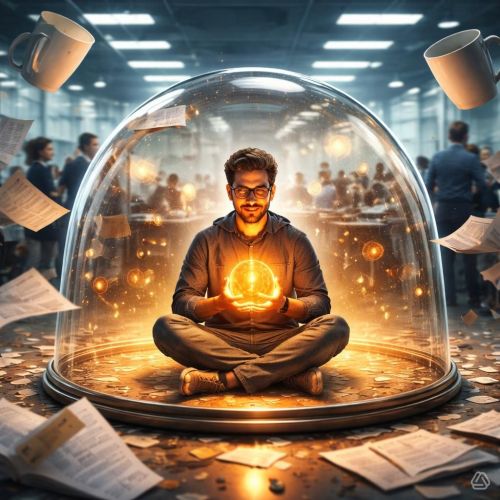
Protecting your creative spark from external distractions.
Do not pitch an idea when it is still a fragile, half-formed spark. Keep it in your "vacuum chamber" (your private notebook or a trusted circle of one or two collaborators) until it has gathered enough mass and structure to withstand the environment. A fully fleshed-out concept is much harder to decohere than a vague suggestion.
The rate of quantum decoherence is directly proportional to the size of the environment. In office terms: the more people in the meeting, the faster the idea dies. If you need feedback, don't invite fifteen people to a Zoom call. Present it to one or two key decision-makers first. Keep the environment small to keep the superposition alive.
If you are a leader, establish brainstorming sessions where decoherence is physically outlawed. Make it a rule that during the first phase of a project, no one is allowed to say "but the budget," "that’s too hard," or "legal won't like that." Allow the ideas to spin in all directions at once before you force them to collapse into reality.
While decoherence can feel like a tragedy, we must also remember that without it, the physical universe couldn't exist. If everything stayed in a state of infinite quantum possibility, we would just be a formless cloud of probability. We need particles to collapse into solid objects so we can have planets, trees, and coffee cups.
Similarly, ideas must eventually collapse into reality to become useful. A brilliant concept in your head doesn't help anyone; it has to be built, coded, or written.
The secret to creative genius isn't avoiding the collapse altogether—it is knowing exactly when to let your idea run wild in the quantum clouds, and having the courage to shield it until it is strong enough to survive the landing.
So, the next time a meeting turns your brilliant concept into a boring spreadsheet, don't take it personally. It’s not your fault, and it’s not even your coworkers' fault.
It’s just physics.
The next time you walk into a meeting room, remember: you are entering an environment of high observation. How will you protect your team's "superposition" of creative possibilities today? If this perspective changed how you view your weekly syncs, pass it along to a colleague who needs a fresh take on team collaboration.
***************
Olov Forsgren is a writer and strategist focused on the architecture of abundance. Drawing on a long career in systems thinking and engineering, he provides clear, actionable frameworks for personal transformation. His work is for those who are ready to move beyond limiting beliefs and consciously build a life of purpose and flow.