x





.jpeg)
In 1927, physicists at the Solvay Conference basically agreed on something highly unsettling: Reality doesn’t exist in a solid state until someone looks at it.
Before you measure a quantum particle, it exists as a "wave of probability." It is a fluid, beautiful cloud of endless potential. It is everywhere and nowhere, doing everything and nothing. But the very millisecond a scientist points a camera or a detector at it?
Pop.
The wave function collapses. The fluid cloud vanishes, and you are left with a single, hard, boring little speck of dust. This is known as the Observer Effect.
Physicists treat this like a profound mystery of the universe. But if they had ever tried to walk past a patio full of outdoor diners while wearing a pair of slightly squeaky shoes, they would have realized it’s not a mystery at all.
It’s just basic social anxiety, scaled down to the subatomic level.
When you are alone in your house, you are a quantum wave. You flow through your hallway like water. You glide from the kitchen to the living room with the effortless grace of a gazelle.
If you drop a piece of toast, your foot shoots out and cushions its fall with the reflexes of a ninja. You dance while waiting for the kettle to boil. You are a masterpiece of biological engineering, operating in a state of pure, unmeasured potential.
Why? Because nobody is watching. Your wave function is completely uncollapsed.
Now, let’s change the environment.
You are walking down a busy city street. You’re still flowing. But up ahead, you spot them: a group of cool-looking people sitting outside a cafe. Their chairs are pointed directly toward the sidewalk.
You have to walk right past them.
The moment you realize their eyes might drift toward you, the quantum transition begins. You are no longer a wave. You are about to be measured.
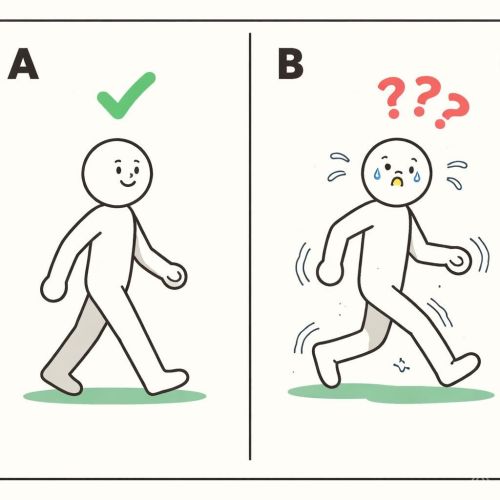
A visual representation of your brain forgetting how legs work the
second another human makes eye contact. It turns out, this isn't just
a personal social failure—it's actually a fundamental law of the
universe...
As you enter their field of vision, the Observer Effect hits your central nervous system like a power surge. Your wave function collapses into a rigid, localized particle.
Suddenly, your brain’s autopilot—which has successfully managed your walking mechanics since you were toddlers—goes completely offline. Your conscious mind is forced to take manual control of your limbs.
And your conscious mind has absolutely no idea how to walk.
A frantic, internal dialogue begins:
"Okay, we are being observed. Act natural. Just walk. Wait... what do I do with my arms? Do they swing in sync with my legs, or opposite? Opposite, definitely opposite. But how far? Am I marching? Oh god, I’m marching like a tin soldier. Put your hands in your pockets. No, not both pockets, you look like a penguin. One hand in a pocket. Yes. Casual. Now, why does my left ankle feel like it’s made of solid oak? Am I breathing? I’ve been holding my breath for three storefronts."
By the time you pass the cafe, you aren't walking. You are piloting a malfunctioning biological mech-suit, praying that your knees don't bend backward.
The Observer Effect doesn't just ruin our legs; it destroys our spatial reasoning.
Consider parallel parking. When you are alone on a quiet side street, you are a driving deity. You slide your car into a tight spot with a single, fluid motion, barely even looking in the mirrors. You are one with the machine.
But add an Observer—say, a pedestrian who stops on the sidewalk to watch you park, or a driver waiting behind you—and the physics changes instantly.
Under the weight of their observation, your spatial wave function collapses. Your brain forgets the geometry of a circle. You turn the wheel the wrong way. You hit the curb. You pull out, try again, and somehow manage to park further away from the curb than when you started.
You haven't forgotten how to park. You have simply been collapsed into a highly awkward particle.
So, how do we survive a universe governed by the Observer Effect?
The mistake we make is trying to fight the collapse. We try so hard to look like a perfect, solid, competent "particle" that we freeze up.
The next time you feel the eyes of the world on you, and your arms start swinging like loose windmills, just remember: You are light. You are a wave of infinite potential temporarily trapped in a world of rigid observers.
If you trip over a perfectly flat sidewalk, don't try to play it cool. Just look at the nearest observer, shrug, and say: "Sorry, my wave function collapsed."
They won't know what you mean, but they’ll probably stop looking at you—which is exactly what your quantum system needs to start flowing again.
***************
Olov Forsgren is a writer and strategist focused on the architecture of abundance. Drawing on a long career in systems thinking and engineering, he provides clear, actionable frameworks for personal transformation. His work is for those who are ready to move beyond limiting beliefs and consciously build a life of purpose and flow.