x




The Quantum Zeno Effect: Why "Watching the Pot" Genuinely Freezes Your Business
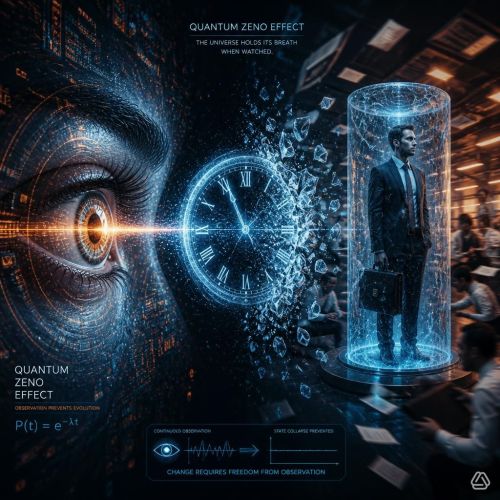
Imagine holding a radioactive atom in your hand. You know that, on average, it will decay in exactly one hour, emitting a flash of radiation.
Now, imagine you stare at this atom. You don't just glance at it; you measure its state with an ultra-fast detector trillions of times every second. According to the laws of quantum mechanics, as long as you keep staring at it with this extreme frequency, the atom will never decay. You have effectively frozen it in time.
This is the Quantum Zeno Effect (QZE). Named after the ancient Greek philosopher Zeno of Elea—famous for his paradoxes arguing that motion is impossible—this effect proves that in the quantum world, the act of observation doesn't just record reality; it actively dictates it.
But this isn't just a quirk of subatomic particles. When we look closely at human systems, projects, and business relationships, we find that the Quantum Zeno Effect is quietly running our daily lives.
To understand why "watching" freezes a system, we first have to look at how a quantum system transitions from one state to another (for example, from an "excited" state to a "decayed" state).
In classical physics, things happen linearly. If a car is traveling at a constant speed, it covers equal distance in equal time.
In quantum mechanics, transitions start off incredibly slowly. At the very beginning of a transition, the probability of a particle changing states grows quadratically (proportional to time squared, or $t^2$). Because of this curve, the transition starts with an incredibly flat, slow crawl before it curves upward and speeds up. This initial slow-growth phase is called the Zeno region.
Now, let’s introduce measurement.
When you measure a quantum system, you cause its wave function to collapse into a definite state. Suppose we have an atom that is starting to decay. We let it evolve for a tiny fraction of a second, well inside that flat "Zeno region" where the probability of decay is almost zero, and we make a measurement. We ask the atom: "Have you decayed yet?"
Because the probability was so minuscule, the math overwhelmingly dictates that the wave function will collapse back into the "not decayed" state.
But here is the kicker: the act of measurement resets the quantum clock to zero.
The system has to start its transition all over again. By measuring the system repeatedly at incredibly short intervals, we never let it escape the flat part of the curve. The probability of decay never gets the chance to curve upward. Continuous observation holds the universe still.

In the business world, we see this exact physical law play out in team dynamics.
A manager assigns a complex, creative project to an employee. Because the manager is anxious, they check in constantly: "How is it going now? Any updates? Show me what you’ve got."
In physics, the transition to a creative "flow state" starts slowly. It requires uninterrupted time to build momentum.
By continuously observing the system, the manager physically prevents the project from transitioning into its completed state. Micromanagement is the Quantum Zeno Effect in office clothes.

We see this constantly in sales. A prospect is on the fence. They need time to think, process, and naturally transition from "undecided" to "buyer."
An anxious salesperson sends an email on Monday: "Just checking in!" They send another on Wednesday: "Any thoughts on my last email?" They call on Friday: "Just wanted to see where we stand."
Each of these touchpoints is a forced measurement. Instead of letting the prospect's decision-making process mature, the constant pressure forces them back into a defensive, undecided state. You are resetting their internal clock. To let them buy, you have to stop observing them so they can transition.

You launch a new ad campaign, publish a new blog post, or buy a new cryptocurrency.
Instead of letting the campaign run for a week to gather statistically significant data, you refresh the dashboard every 15 minutes. You see a tiny dip, get nervous, and tweak a headline. You refresh again, see no change, and change the budget.
By constantly measuring and micro-adjusting, you never let the system escape the "Zeno region." You freeze your campaign's potential because you never allow it the time and space to actually perform.
If freezing a system with your gaze isn't strange enough, quantum mechanics has an even weirder counterpart: The Anti-Zeno Effect. Under certain conditions, if you measure a quantum system at just the right frequency—not too fast, but not too slow—you can actually speed up its transition.
This also has a beautiful human equivalent.
Continuous, obsessive monitoring freezes progress (Zeno). But structured, rhythmic check-ins accelerate it (Anti-Zeno).
This is why daily stand-up meetings in software development, weekly weigh-ins during a fitness journey, or monthly financial reviews work so well. They don't interrupt the flow; instead, they act as a rhythmic pulse that keeps the energy high and drives the system toward its target state much faster than leaving it entirely unobserved.
Whether you are managing a subatomic particle, a software development team, or a marketing funnel, the lesson of the Quantum Zeno Effect is clear:
Observation is an active force.
If you want something to change, grow, or transition, you must give it the freedom to do so. Stop staring at the pot. Step back, trust the system you built, and let the quantum clock run.
I am not a licensed professional. My responses are generated by AI, and I do not guarantee 100% accuracy.
***************
Olov Forsgren is a writer and strategist focused on the architecture of abundance. Drawing on a long career in systems thinking and engineering, he provides clear, actionable frameworks for personal transformation. His work is for those who are ready to move beyond limiting beliefs and consciously build a life of purpose and flow.