x




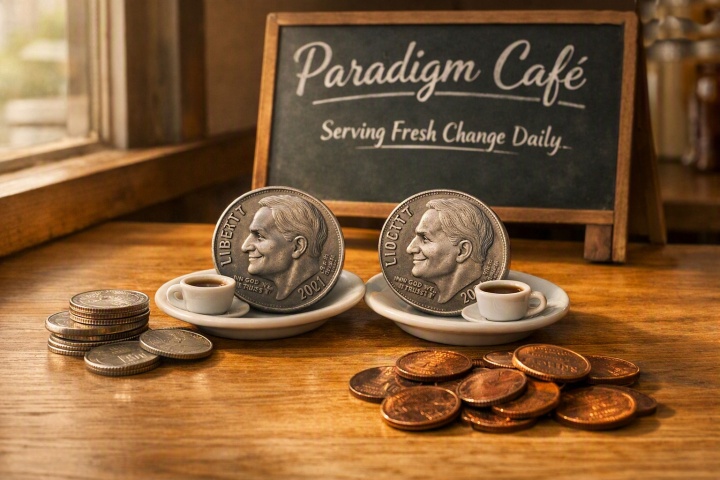
If I ask someone, "Do you want change for a paradigm? They might say... "Oh shit! More change! I don't need any more change. Change is clumsy and basically a pain in the, you know what."
If they accepted that change, anyway. No doubt, they would stuff it in a jar. And save it with the rest of their nickels, dimes, and quarters. Some day. If the day ever came. To use it to buy something that they deemed valuable.
Not me. I like change. I keep it in my pocket and use it whenever I'm out and about and need to buy something. I find it useful. I don't like keeping jars of it around. I like change.
When it comes to real change, like paradigm shifts. I like that too. I think change is the only true constant. I got that when I read the book, or at least the introduction and the preface, etc., of the I Ching, the Chinese Book of Changes. It's like an oracle. It expresses a deep understanding of yin and yang, internal and external, east and west, north and south, and all those wonderful things that make up the reality we live in.
In general, a paradigm is basically a framework or a set of beliefs and assumptions that shape the way we understand or approach a certain subject. So, it's like a lens or a model that people use to interpret information and make sense of the world around them.
There are lots of paradigms in the minds of humanity that need changing, in my opinion, anyway.
I have published three books on Amazon about changes to paradigms that I think are needed. One is about changes to the healthcare system and technology; one is about why we believe what we believe; and the other, which is the most important to me, is a book that offers a paradigm shift in the understanding of how humanity has developed since the first seven symbolic days of creation or, more accurately, since what Christianity refers to as the fall of man, or the fall of Adam and Eve. I have come to know that process as the Providence of salvation or the Province of restoration, and it has been a long process, perhaps six thousand years or so!
So what is the book called or named, some might ask? It's called "THE SAINTS" and can be found here: a.co/d/0g7OGHu7
It is a thought-provoking read. Partly fictional, but mostly based on real-life experiences. That happened.