x






Daylight Savings Time Has REAL Health Consequences!
The Three Clocks Inside You...
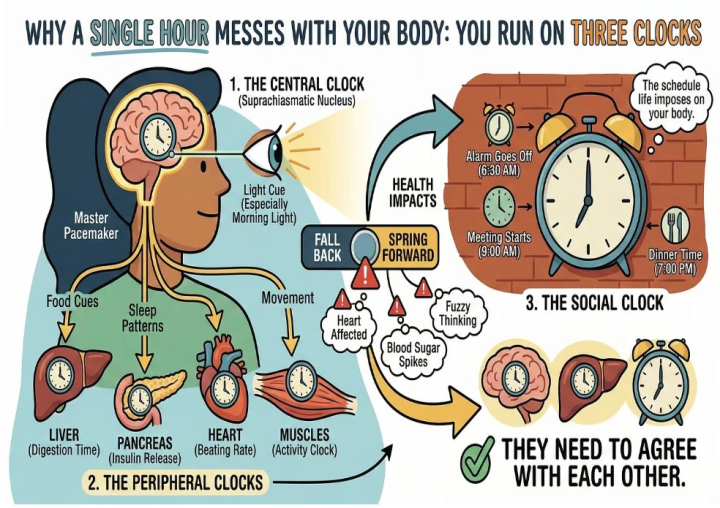
To understand why changing the clock by a single hour can affect your heart, your blood sugar, and your ability to think clearly, you need to understand that your body does not run on one clock. It runs on three. And they need to agree with each other.
The first is your central clock. It sits in a tiny region of your brain called the suprachiasmatic nucleus, deep in the hypothalamus. This is your master pacemaker. It takes its primary cue from light hitting your eyes, especially morning light. When light enters your retinas at the right time, your central clock sets the tempo for almost everything that happens downstream: when you feel alert, when you get sleepy, when your hormones rise and fall.
The second set is your peripheral clocks. Your liver has one. Your pancreas has one. Your heart, your muscles, your adrenal glands. Each of these organs keeps its own time, and they take their cues partly from the central clock and partly from other signals like when you eat, when you move, and when you sleep.
The third is your social clock. This is external. It’s when your alarm goes off, when your meeting starts, when dinner happens. It’s the schedule your life imposes on your body.
When all three clocks are aligned, your body operates with remarkable precision. Cortisol, the hormone that wakes you up and gets you moving, peaks around 7 to 8 in the morning.
Melatonin, the hormone that helps you sleep, rises when darkness falls and peaks between 2 and 4 AM. Your sensitivity to insulin, the hormone that manages blood sugar, is highest in the morning and drops as the day goes on. This is why the same meal produces a smaller blood sugar spike at breakfast than it does at dinner.
All of this runs on schedule. And when that schedule gets disrupted, even by one hour, the downstream effects are measurable and immediate.
This is the same mechanism that gets disrupted whether you spring forward in March, fly from Los Angeles to London, or work a rotating shift. The biology does not care why your clocks disagree. It only registers that they do.
Let’s start with sleep, because that’s the most obvious casualty.
You might assume that springing forward costs you exactly one hour of sleep on that Sunday night, and that you make it up within a day or two. A large study tested that assumption using objective data. Instead of asking people how they slept, researchers strapped accelerometers to the wrists of thousands of adults in their 40s through 70s. These devices measured actual movement patterns, not subjective recall.
On the Sunday of the spring clock change, participants lost an average of 65 minutes of sleep compared to the week before. That is more than the theoretical 60-minute loss. And in the days that followed, recovery was incomplete. Research suggests it can take up to four days to fully recover from a single hour of lost sleep. Women in the study slept less on weekdays after the spring change than before it, while men slept slightly more. Many of the women in the sample were likely in perimenopause or beyond, stages of life already associated with higher sleep disturbance.
Now consider your heart. The largest systematic review on DST and health, covering over 150 studies from dozens of countries, found that the spring transition is consistently associated with an increased risk of heart attack. Multiple high-quality studies confirmed the finding. Fatal traffic accidents also increase after the spring shift, particularly in the United States. A separate large-scale analysis using health records from two countries estimated that each spring DST shift is associated with a staggering number of negative health events across the population.
To be fair, the picture is not entirely one-sided. The same systematic review found that the fall-back transition appears associated with decreased workplace accidents and possibly decreased overall mortality. The review’s authors made a point of noting that the messaging of DST being uniformly harmful is not supported by the evidence. But the spring shift is where the documented danger concentrates, especially for cardiovascular events.
And then there is blood sugar. This is where it gets personal for anyone managing metabolic health, which is most of my readers.
In a healthy body, insulin sensitivity follows a daily rhythm. It is highest in the morning and drops through the day. Your pancreas secretes more insulin during waking hours than during sleep. An identical meal will produce a bigger glucose spike at dinner than at breakfast. This rhythm depends on your central clock running on schedule.
When circadian timing gets disrupted, whether from DST, jet lag, or shift work, that rhythm breaks down. Cortisol patterns flatten, insulin sensitivity drops, and glucose regulation suffers. A detailed review of the evidence laid out the cascade: disrupted light-dark cycles suppress melatonin while elevating nighttime cortisol, which in turn decreases insulin secretion and worsens insulin resistance.
The concept researchers use is “social jet lag”: the mismatch between your biological clock and your social schedule. DST creates exactly this kind of mismatch. And the data on social jet lag is striking. People with more than one hour of social jet lag had a substantially higher prevalence of diabetes or prediabetes compared to people with less than one hour of mismatch.
Evening chronotypes, the people we casually call night owls, face increased risk of type 2 diabetes independent of how much sleep they get. Rotating shift workers, who live with chronic circadian disruption, carry a meaningfully higher risk of diabetes compared to day workers. The clock change each spring is a brief version of the same biological insult.
Why Your Doctor’s Organizations Want This to Stop
In 2024, the largest sleep medicine organization in the United States published a formal position statement calling for the elimination of seasonal time changes in favor of permanent standard time. Their reasoning was straightforward: standard time aligns best with human circadian biology.
That position was endorsed by roughly 20 medical and safety organizations, including groups representing sleep research, dental sleep medicine, lifestyle medicine, metabolic health, public safety, and education. The American Medical Association and the National Sleep Foundation have separately voiced support for the same position.
The position statement noted that the body clock does not fully adjust to DST even after several months. Studies of people living in the western edges of time zones, where the social clock is already shifted further from solar time, found that the extra hour of evening light reduced sleep every single night and increased the likelihood of insufficient sleep. It was, in effect, permanent social jet lag.
Meanwhile, Mexico largely abolished DST in 2022 (retaining seasonal time only in certain northern border areas and Baja California). The European Parliament has voted to end mandatory clock changes within its jurisdiction. Bills have been introduced in the U.S. Congress, but none have passed both chambers.
The last time the U.S. tried permanent DST was in 1973, during the energy crisis. It was reversed after one winter. Morning darkness was deeply unpopular, and there were safety concerns, especially for children, as a major driver of backlash.
The medical community is in unusual agreement on this one. The spring transition carries real, documented risk, especially for people already managing heart disease, metabolic conditions, or sleep problems. That describes a significant share of the population over 45.