x





If you’re looking to improve your metabolic health, you likely have one or more of several health conditions going on.
So, how do you improve your metabolic health?
You need to get moving, you need to eat smart, and you need to pay attention to your body. Here are 14 actionable tips to improve metabolic health.
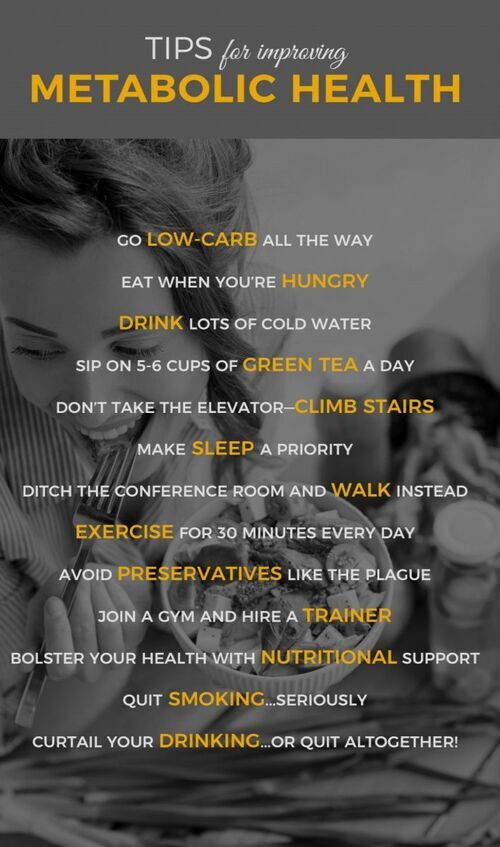
Go on a low-carb diet. A low-carb diet means avoiding sugar. The keto diet is shown to help obese people lose weight, at least in the short to middle-long term, according to research published in the International Journal of Environmental Research in Public Health. You can learn more about the keto diet and other low-carb diets by checking out some books at your local library or perusing Amazon.
Never let yourself go hungry. Strange as it may seem, feeling hungry means your body is about to make you fatter. That’s because it will begin to slow down metabolism thinking you’re starving it. Have a snack that fits into a low-carb diet when you have hunger pangs.
Only snack on low-carb foods. What might qualify as low-carb snacks? Think string cheese, peanuts, olives, and cashews, to name a few. Be sure to watch your sodium intake. Too much sodium can aggravate high blood pressure (or contribute to its onset).
Drink plenty of water—cold water. When the water you drink is cold, your body will work harder to bring it to body temperature, possibly burning an extra calorie or two in the process.
Drink green tea. Green tea has been proven in several studies to help improve cardiovascular and metabolic health. About 5 or 6 cups of green tea per day conveys the best metabolic health improvements, according to an overview of research on the matter published in the Journal of the American College of Nutrition.
Live in the Midwest? Bad weather outside? Try walking up and down your basement stairs. It may sound silly, but those sprints make for a great workout. Just don’t conk your head going up or down them; those ceilings can be awfully low.
Sleep, sleep, sleep! While the research as to why this is the case isn’t clear, lack of sleep is linked to lower metabolism, according to research published in the International Journal of Endocrinology.
If you must have a meeting at work, make it a walking meeting (or suggest it if you’re not the boss). Walking meetings are a great way to get some exercise outside the office. Or, in inclement weather, some corporations even have gyms on site. You and a co-worker could go walk at an indoor mall. Brainstorming while blood is pumping to the brain may result in better ideas, and for sure will help you get in at least 30 minutes of walking.
Make at least 30 minutes of physical activity your goal every day. However, if you have a disability that prevents you from putting in that kind of sweat equity, the U.S. Centers for Disease Control and Prevention says, “Even 60 minutes a week of moderate-intensity aerobic activity is good for you.” Not only does physical exercise help you lose weight, but it also helps lower your blood pressure and “bad” LDL cholesterol.
Don’t put anything containing preservatives into your body. Period. Research published in the journal Nature in 2015 showed a direct link between food additives and obesity.
Consider joining a local gym and even getting a trainer. You would be surprised, so long as you find the right gym, how many people you meet who are just like yourself. If you go to the gym during off-peak hours, in particular, you’ll notice you are not the only person with metabolic syndrome or poor metabolic health who is working hard to improve it. The gym also is just easier to deal with during off-peak hours, especially when you are starting out.
Quit smoking. You know smoking is bad for your health when the economic cost to the U.S. is a staggering $300 billion per year (estimated for years 2009 to 2012). Of that, $170 billion came in the form of direct medical care, according to the U.S. Centers for Disease Control and Prevention. For people with metabolic syndrome, the body already is in a heightened state of inflammation. Most people with metabolic syndrome also suffer from high blood pressure or have other cardiovascular risks, making smoking akin to playing with fire.
Stop or curtail your drinking. The CDC calculated the annual economic burden of smoking on the American economy at $249 billion in 2010. The pile of lost money came in the form of healthcare costs, lost workplace productivity, and alcohol-related crimes.
Take an essential amino supplement. Essential amino acids are the key to metabolic health. A higher intake will improve insulin sensitivity, reduce the concentrations of “bad” lipids (LDL, triglycerides) in the blood, and also reduce liver fat. Essential amino acids are part of a normal diet, and are particularly abundant in high-quality protein food sources such as chicken, fish, meat, and dairy. However, these food sources usually fail to deliver the amount of essential amino acids necessary for optimal metabolic health. A dietary supplement of essential amino acids can therefore provide significant benefit.
AGING - MUSCLE LOSS - DISEASE ARE YOU AT RISK LEARN MORE