x






Try it right now. Now do it five times in a row.
If you are breathing harder than expected or your legs feel shaky, your body may be sending you a message. Your muscles are not as strong as they once were, and that quiet loss of strength could be reshaping your future.
Muscle health is not just about how much you can lift. It is the difference between living independently and relying on others. Strong muscles regulate metabolism, protect your balance, and shield you from chronic diseases. They are a built-in safety net when life throws you a curveball, helping you recover from illness and injury.
Yet as adults age, a slow and silent process called sarcopenia begins to erode this protection. Bit by bit, muscle fibers shrink and vanish. What starts as small inconveniences, needing help with a jar lid or gripping the railing on stairs, can snowball into falls, hospital stays, and a permanent loss of independence.
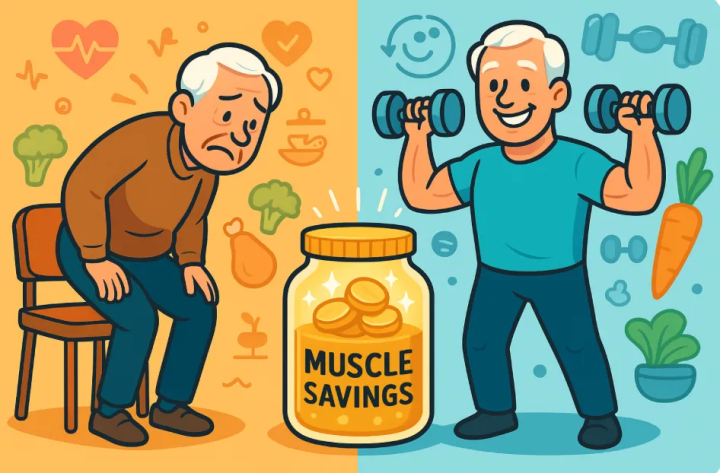
Think of your muscles as a retirement account. The strength you build and maintain over the years is a savings fund you will draw on later in life. Each workout and healthy meal is a deposit. Ignore it, and withdrawals will outpace deposits, leaving you without reserves when you need them most.
In the sections ahead, you will learn how muscle loss develops, why it matters, and what you can do now to stop it. You will discover how to measure your muscle health, how to build and preserve strength at any age, and how nutrition can amplify your results.
Hormonal changes: Lower levels of testosterone and growth hormone slow repair.
Anabolic resistance: Older muscles respond less effectively to protein, making it harder to build new tissue.
Chronic inflammation: Low-grade inflammation steadily breaks down muscle.
Neuromuscular changes: Nerves deteriorate, leaving muscle fibers without the signals they need to stay active.
Physical inactivity: A sedentary lifestyle accelerates all of the above, creating a downward spiral of weakness.
These forces feed off each other. Weak muscles lead to less activity, which worsens hormonal shifts and inflammation, further accelerating muscle loss.
Muscle is highly adaptable at any age. Regular resistance training and adequate protein can slow or even reverse sarcopenia. Each time you lift a weight, climb stairs, or eat a protein-rich meal, you are making a deposit in your muscle savings account—one that can protect your independence for years to come.
Sarcopenia does not just make you weaker. It sets off a ripple effect that touches nearly every part of your life.
Imagine trying to get up from a low chair and realizing you cannot. Without muscle strength, walking, climbing stairs, and even bathing become more difficult. That loss of independence often leads to long-term care.
Muscle is your body’s largest metabolic engine. When it shrinks, you lose the ability to handle blood sugar, cholesterol, and inflammation effectively. Sarcopenia often pairs with increased body fat, a dangerous combination called sarcopenic obesity, which raises the risk of diabetes, heart disease, and stroke.
Weaker muscles can lead to social withdrawal, depression, and loneliness. More falls and longer hospital stays add emotional strain and financial stress for families and healthcare systems.
Muscle is the cornerstone of your foundation. Remove it, and everything else begins to weaken.
You cannot see muscle loss in the mirror until it is already advanced. A belt notch or a number on the scale tells you nothing about strength or function. That is why measuring muscle health matters.
Chair Stand Test: Can you rise from a chair without using your arms, and how many times in 30 seconds?
Grip Strength: Your grip is a surprisingly accurate indicator of overall strength.
Balance Test: Can you balance on one leg for at least 10 seconds?
Walking Speed: How long does it take you to walk 10 feet at a normal pace?
Body fat percentage: Healthy levels are generally under 38% for women and 27% for men.
Waist-to-height ratio: Your waist should be less than half your height.
Appendicular lean mass (ALM): If you have access to a DEXA scan, this measures muscle in your arms and legs.
Used together, these assessments give you a complete picture. They tell you how much muscle you have and, more importantly, how well it works.
Picture yourself walking on a winter sidewalk. Your foot slips. Do your legs catch you, or do you go down hard? The answer often depends on one thing: how much muscle power you have left.
If you only choose one type of exercise, make it this. Lifting weights, using resistance bands, or even doing bodyweight moves like squats sends a clear message to your body: keep this muscle.
Start where you are. Two sessions per week can build strength.
Focus on big muscle groups: legs, back, chest, and core.
Progress by adding reps, sets, or weight as you get stronger.
Power is strength delivered quickly. It helps you catch yourself when you trip. Train it by standing up from a chair quickly, climbing stairs with purpose, or moving through the “up” phase of an exercise faster.
A strong heart and stable footing are as important as strong muscles.
Aim for 150 minutes of brisk walking, cycling, or swimming each week.
Practice balance drills like tai chi or single-leg stands to use your strength in real life.
Muscle gains build slowly but can vanish quickly. After just three weeks without training, strength and muscle mass begin to decline. Consistency is the secret.
Exercise builds the framework, but nutrition provides the bricks and mortar. Without enough of the right fuel, your body cannot repair and grow muscle.
Most adults need 1.0–1.3 grams of protein per kilogram of body weight per day.
Spread protein evenly across meals for best results.
Leucine is the amino acid that tells your body to start building muscle. Aim for about 3 grams per meal. Soy products like tofu and tempeh, lentils, beans, and edamame are excellent sources.
Pair protein with carbohydrates in the first hour after exercise. A smoothie with soy milk and fruit, hummus on whole-grain toast, or yogurt with berries works well.
Preserving muscle is not optional. It is your foundation for independence, vitality, and long-term health.
The good news: you do not have to figure it out alone.
This step-by-step system will help you:
Identify your current strengths and weaknesses with at-home muscle health checks.
Set clear goals with a baseline and progress tracker.
Follow a 4-week training map with space to record every set, rep, and workout.
Use practical meal templates and protein guides to fuel your results.
Stay accountable with a momentum tracker so you keep progressing each week.