x






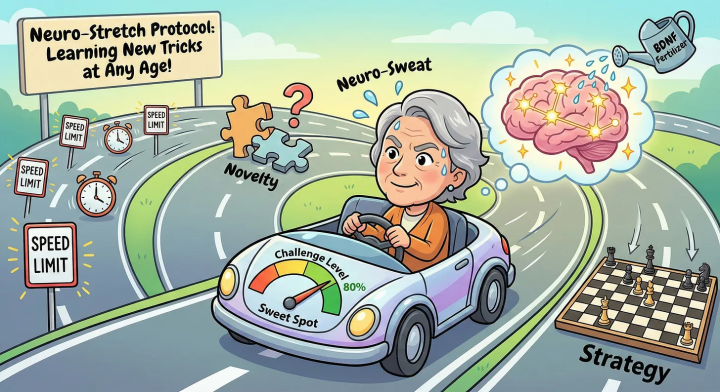
In 2013, a team of researchers at the University of California, San Francisco, brought a group of older adults into a laboratory to play a video game. These participants were in their sixties, seventies, and eighties. The game was called “NeuroRacer”. It was not a leisurely Sunday drive. It was a high-pressure test of multitasking that required players to steer a car on a winding track with one hand while simultaneously shooting down specific signs that popped up on the screen with the other.
When the experiment began, the results were predictable. The older adults struggled to keep the car on the road while tracking the signs. Their reaction times were slow. Their ability to handle two tasks at once was significantly worse than that of twenty-year-olds. The gap between the generations was massive.
But the researchers did not stop there. They asked the older adults to play the game for twelve hours over the course of a month. By the end of the training, the data showed a remarkable shift. The eighty-year-olds were no longer performing like typical seniors. They had improved their multitasking skills so thoroughly that they were now beating the scores of untrained twenty-year-olds.
We often view aging as an inevitable slide into slowness and forgetfulness. The NeuroRacer study suggested that the brain is not necessarily a machine that is breaking down. It is a machine that has been coasting. When researchers forced these aging brains to engage in a task that was genuinely difficult, the brains did not just cope. They reorganized.
The success of the NeuroRacer experiment relied on a specific feature hidden in the game’s code. The difficulty was not static. It adapted in real-time to the player’s performance. If a player started hitting every sign, the game sped up. If they started crashing, it slowed down. The algorithm was designed to keep the player’s success rate hovering right around 80 percent.
This is the “sweet spot” for neuroplasticity. When you succeed at a task every time, your brain is running on autopilot. When you fail constantly, you become frustrated and disengage. But when you are succeeding about 80 percent of the time, you are in a state of effortful engagement. You are making errors, correcting them, and trying again. That friction is the signal the brain needs to build new connections.
This concept of “adaptive difficulty” helps explain why some popular brain games fail to deliver on their promises. Many people spend years doing the daily crossword puzzle, believing it is keeping their mind sharp. However, if you are an expert at crosswords, the puzzle is no longer a challenge for you. You are simply retrieving words you already know from your memory. The research indicates that casual, repetitive play of easy games does not push the brain enough to induce change. To get the benefit, you have to be bad at the activity. The moment you master the game, it stops being medicine.
For years, scientists could only guess at what was happening inside the skull during these intense training sessions. But in 2022, a study finally gave us a glimpse into the biology of “thinking hard”.
Researchers recruited 144 healthy older adults and divided them into groups. One group practiced mindfulness meditation. Another group performed physical exercise. A third group engaged in a computerized working-memory game. After five weeks, the researchers analyzed the participants’ blood for a protein called Brain-Derived Neurotrophic Factor, or BDNF.
BDNF is critical for brain health because it acts like fertilizer for neurons, supporting their growth and survival. The results were surprising. In this specific five-week window, the meditation group did not show a rise in BDNF. The exercise group did not show a rise in BDNF either. The only group that experienced a significant increase in this neural growth factor was the group that had spent weeks struggling with the difficult cognitive game. The mental effort had triggered a physiological release that the other activities had not.
The finding that exercise did not spike BDNF in that specific study raises a question about the role of physical activity. We know exercise is good for the brain. But the type of exercise matters.
Repetitive physical motion, like walking on a treadmill, is excellent for cardiovascular health, yet it allows the mind to wander. Research suggests that the most powerful benefits come when cognitive challenges are combined with physical movement. This is often seen in “exergames,” video games that require physical interaction, or complex activities like dancing.
One study found that playing board games, which requires no physical exertion, actually improved balance and mobility in older adults. This implies that the brain regions controlling executive function are deeply connected to the regions controlling movement. When you train your brain to handle complex rules and strategy, you may inadvertently be training it to better manage your body in space. The ideal brain workout might not be a solitary run, but a complex dance class where you must learn steps, keep time, and coordinate with a partner simultaneously.
If you are going to commit to a cognitive training regimen, the evidence suggests you should prioritize one specific skill: speed.
The ACTIVE study is the largest and longest-running trial of its kind, following thousands of older adults for ten years. Participants were trained in either memory, reasoning, or speed of processing. Ten years later, the researchers looked at who had developed dementia. The memory training group did not show a statistically significant reduction in risk compared to the control group. The reasoning group did not either. However, the group that trained on “speed of processing,” identifying visual targets rapidly, showed a 29 percent lower risk of dementia.
Speed of processing appears to be a foundational capability. It is the bandwidth of the brain. If your processing speed is slow, you cannot capture information quickly enough to remember it or act on it. By training the brain to notice and react to visual information faster, you are widening the pipeline for all other cognitive functions.
You do not necessarily need a computer to achieve these results. A study by Denise Park found that older adults who learned digital photography or quilting, hobbies that require learning complex new skills, showed memory improvements similar to those seen in brain training studies.
The key ingredient was novelty. The participants who engaged in familiar social activities did not see the same benefits. The brain craves new problems to solve. If you have been an accountant for forty years, doing more math puzzles is likely insufficient. You need to do something that makes you feel incompetent again.
The science has handed us a very specific set of ingredients. We know we need the raw processing speed identified in the ACTIVE study. We need the uncomfortable novelty found in the Synapse Project. And crucially, we need the frustration of “adaptive difficulty” to turn on the chemical switches for growth. But knowing the ingredients is not the same as baking the cake. The reason most cognitive resolutions fail is not a lack of effort, but a lack of structure. We treat brain training as a hobby rather than a regimen, doing what is fun rather than what is necessary.