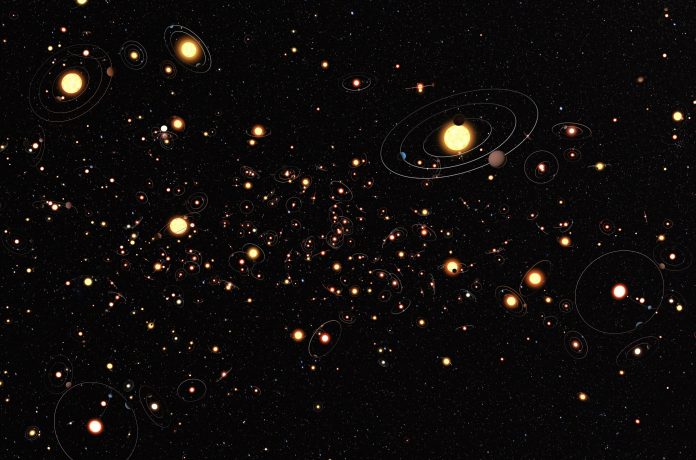
It is very difficult to assume that the Blue Planet is the only one in the Universe that shelters life. At the same time, the problem of finding life on other planets is a fundamental one for human knowledge. That is why scientists are extremely concerned with identifying the places in the Universe where life is possible, in order to later develop rigorous methods of identifying it. Where will we find those magical places where life would be possible?
From the very beginning, I must emphasize, I always do, that we have only one type of life at our disposal, the one hosted by old Terra. Of course, we can also imagine life forms that are based on mechanisms completely different from those we already know. We told you about them in the article " A strategy for the search for extraterrestrial life" in the November 2018 edition of our magazine. In the following we remain anchored in the area of life forms that are based on mechanisms similar to those we encounter everywhere on Earth.
Living area
It can be defined extremely easily, although too simplistically, as the area around a star where the conditions on the surface of the planets there are similar to those on Earth. Here we will find liquid water, a level of radiation that does not destroy life forms and so on. I will not go into more detail. So far, 55 planets have been identified on which life forms could exist.
I think it is quite obvious that the habitable zone translates into a certain range of distances from the planet to the central star in which the conditions stated above are ensured. Equally obvious is that it depends on the type of star.
In early 2020, at the 253rd Conference of the American Astronomical Society, American researcher Edward Guinan of the University of Villanova, Pennsylvania, USA, presented a paper discussing the issue of the connection between the habitable zone and the type the star. Rather, he tried to answer the question: what kind of star is friendlier to life? He analyzed three types of stars: stars similar to our Sun, red dwarfs and orange dwarfs. Let's try it too.
Stars similar to our Sun.
It goes without saying, Sun-like stars are extremely life-friendly, otherwise I wouldn't be able to type these lines. However, it is worth taking a closer look at this friendship. The sun was "born" about 4.6 billion years ago. The first complex organisms appeared on Earth only about 500 million years ago. Homo Sapiens began to enter the planet only 200,000 years ago. All this evolution was due to the friendship of the Sun with life on Earth.

Will this friendship last forever? Unfortunately no. In about five billion years the Sun will become a red giant and will probably swallow our planet. I have even worse news for you. The end of earthly life will come much sooner. The Sun's energy is produced by the fusion reactions of hydrogen nuclei in the solar nucleus. Hydrogen and energy nuclei result from them. If we look more closely and take into account that the fusion of two hydrogen nuclei results in a helium nucleus, we realize that the volume of helium resulting from thermonuclear reactions is smaller than that of the hydrogen that fused. This results in a continuous decrease in the volume of the solar core. The outer layers of the Sun will exert an increasing gravitational force, which leads to an intensification of fusion reactions in the nucleus. The temperature of the Sun will gradually rise. It has already increased by 30% compared to the period of the Sun's first childhood. Current calculations show that for 1-1.5 billion years, the Earth's climate will be so hot that the water on its surface will boil… Bad news, won't it? Unfortunately, this is the truth, our friendly Sun will only be able to sustain life for a maximum of 1.5 billion years.
We can think that the stars that live a long time are the most suitable to support life. The lifespan record for them is held by the red dwarfs.
Red dwarfs
Red dwarfs, or M-type stars, can survive for tens of billions of years. They are relatively cold stars, with temperatures between 2,300 and 3,800 K and masses between 7.5% and 50% of the Sun's mass. A lot of planets have been discovered around them, several dozen of which are in the habitable zone. Are red dwarfs friendly with life?
Unfortunately, the answer is no. As I told you, they are relatively cold stars, which means that their habitable zone is in their immediate vicinity. Due to the small distance from the central star, the habitable planets will be tidally blocked, which means that they will always show the same face to the star, just like the Moon, which shows us every night only one part of it. . We can imagine the relatively harsh conditions on such a planet. Huge temperatures will reign on its bright face, far above the boiling point of the water, while on the dark side the temperature will be so low that the gases in the atmosphere will begin to freeze. Red dwarfs are not friendly at all.
Perhaps it is possible that some biological forms may appear in the border area between darkness and light. Unfortunately, hopes are very low. Red dwarfs are very unstable. On their surface, especially in the early stages of stellar evolution, often erupt stellar eruptions, which, at least the initial stages of the evolution of the solar system, can throw into space the atmosphere of nearby planets, thus destroying any chance of life in a reasonable future. . The intensity of ultraviolet radiation and X-rays in the habitable zone is much too high, thus leaving too little chance of survival of possible early life forms.

If all this harshness was not enough, one more is added. The earth, our home, is protected from electrically charged particles of high energy from cosmic radiation, fatal to life, from the Earth's magnetic field. In the case of planets in the habitable zone of red dwarfs, things become complicated. Their magnetic field interacts with the very strong one of the star, thus losing its quality of protective shield. To maintain its quality as a planetary defender, the planetary magnetic field should be up to several thousand times more intense than the Earth's magnetic field.
Not to mention, red dwarf stars are most likely toxic to any form of life as we know it. Unfortunately, even though they are the longest-lived stars in the Universe, they are unfriendly to life, I repeat, as we know it now.
Logically, we will now turn our attention to the stars that lie between the red dwarfs and those similar to our Sun.
Orange dwarfs
Orange dwarfs are stars with masses between 50% and 90% of the mass of our Sun. The temperature at their surface is between 3,700 K and 5,200 K, and their brightness is between 8% and 60% of that of our Sun. In their case the habitable zone varies between 0.1 and 0.4 to 0.3 and 1.3 ua (ua is the astronomical unit, 1 ua is equal to the average distance between the Earth and the Sun). They are not as long-lived as red dwarfs, but their lifespan, being between 15 and 30 billion years, is significantly longer than that of our Sun. I think you have already realized that orange dwarfs are really friendly with the appearance and evolution of life in their living area. I just need to add that they are very stable and, compared to the red dwarfs,
I have good news for you. Planets have already been discovered in the habitable area of the orange dwarfs. For example, the planet Kepler-442b, which is about 1,120 light-years away, has a mass equivalent to 2.34 Earth masses. It is stated in the article entitled “Comparative habitability of transiting exoplanets”, published in the November 19, 2015 issue of The Astrophysical Journal, that it offers better conditions for the appearance of life than Earth itself.
Guinan, who supported the communication on the issue of the connection between the habitable zone and the type of star, stressed an important aspect at the Conference of the American Astronomical Society: “Many of the orange dwarfs are much older than the Sun. If life appeared and evolved on a planet in their habitable zone, then it could be billions of years older than our Sun. That's where smart life could develop. "
There would be something else to add. On Earth, as we showed earlier, from the appearance of the first life forms until the moment when the planet will become totally inhospitable, it will take a period of time of 2-2.5 billion years. The planets in the habitable zone of the orange dwarfs will ensure favorable conditions for life for at least 10 billion years. On the other hand, stars similar to the Sun represent only 6%, while orange dwarfs represent about 13% of the stellar population of our galaxy. I leave it to you to meditate on this cold information.

The characteristics of the main types of stars discussed in this text.
The future
We now know that orange dwarf stars are the most favorable for the appearance and support of life. It is clear that they will become the target of our future pursuits. However, we still need more information to establish the best possible correlations between stellar behavior and the chances of life occurring. For this reason, Edward Guinan formed a team of researchers and started the GoldiloKs project, which aims to determine age, the flow of ultraviolet radiation and X for a large number of orange dwarfs and stars similar to our Sun. Chandra, NASA, XMM Newton, ESA (for X-ray observations) and Hubble (for ultraviolet observations) will be used for this.
end
By narrowing the search, we increase the chance of discovering life beyond the Solar System. There are still many steps to be taken, we need to build those advanced tools that will allow us to detect extraterrestrial biosignatures. As I said on other occasions, we will have to be able to analyze in detail the composition of the atmospheres of extrasolar planets, because, for example, one of the biosignatures is represented by the presence of a significant percentage of atmospheric oxygen. Until then, we should not neglect the search for life in the Solar System. Mars and the Jupiter satellite Europa are just two extremely promising places to discover life forms. And we must never forget that life is most likely extremely persevering. It can appear in places and in forms that, for the time being, we cannot even imagine.