x






Your mental health influences how you think, feel, and behave in daily life. It also affects your ability to cope with stress, overcome challenges, build relationships, and recover from life’s setbacks and hardships.
Strong mental health isn’t just the absence of mental health problems. Being mentally or emotionally healthy is much more than being free of depression, anxiety, or other psychological issues. Rather than the absence of mental illness, mental health refers to the presence of positive characteristics.
Having solid mental health doesn’t mean that you never go through bad times or experience emotional problems. We all go through disappointments, loss, and change. And while these are normal parts of life, they can still cause sadness, anxiety, and stress. But just as physically healthy people are better able to bounce back from illness or injury, people with strong mental health are better able to bounce back from adversity, trauma, and stress. This ability is called resilience.
People who are emotionally and mentally resilient have the tools for coping with difficult situations and maintaining a positive outlook. They remain focused, flexible, and productive, in bad times as well as good. Their resilience also makes them less afraid of new experiences or an uncertain future. Even when they don’t immediately know how a problem will get resolved, they are hopeful that a solution will eventually be found.
Whether you’re looking to cope with a specific mental health problem, handle your emotions better, or simply to feel more positive and energetic, there are plenty of ways to take control of your mental health—starting today.
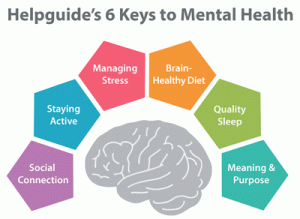
Anyone can suffer from mental or emotional health problems—and over a lifetime most of us will. This year alone, about one in five of us will suffer from a diagnosable mental disorder. Yet, despite how common mental health problems are, many of us make no effort to improve our situation.
We ignore the emotional messages that tell us something is wrong and try toughing it out by distracting ourselves or self-medicating with alcohol, drugs, or self-destructive behaviors. We bottle up our problems in the hope that others won’t notice. We hope that our situation will eventually improve on its own. Or we simply give up—telling ourselves this is “just the way we are.”
The good news is: you don’t have to feel bad. There are practices you can adopt to elevate your mood, become more resilient, and enjoy life more. But just as it requires effort to build and maintain physical health, so it is with mental health. We have to work harder these days to ensure strong mental health, simply because there are so many ways that life takes a toll on our emotional well-being.
Our inability to address our mental health needs stems from a variety of reasons:
No matter how much time you devote to improving your mental and emotional health, you will still need the company of others to feel and function at your best. Humans are social creatures with emotional needs for relationships and positive connections to others. We’re not meant to survive, let alone thrive, in isolation. Our social brains crave companionship—even when experience has made us shy and distrustful of others.
Phone calls and social networks have their place, but nothing can beat the stress-busting, mood-boosting power of quality face-to-face time with other people.
The key is to interact with someone who is a “good listener”—someone you can regularly talk to in person, who will listen to you without their own conceptions of how you should think or feel. A good listener will listen to the feelings behind your words, and won’t interrupt, judge, or criticize you.
Reaching out is not a sign of weakness and it won’t make you a burden to others. Most people are flattered if you trust them enough to confide in them. If you don’t feel that you have anyone to turn to, there are good ways to build new friendships and improve your support network. In the meantime, there is still a great benefit to interacting face-to-face with acquaintances or people you encounter during the day, such as neighbors, people in the checkout line or on the bus, or the person serving you your morning coffee. Make eye contact and exchange a smile, a friendly greeting, or small talk.
The mind and the body are intrinsically linked. When you improve your physical health, you’ll automatically experience greater mental and emotional well-being. Physical activity also releases endorphins, powerful chemicals that lift your mood and provide added energy. Regular exercise or activity can have a major impact on mental and emotional health problems, relieve stress, improve memory, and help you to sleep better.
Well, you’re not alone. Pounding weights in a gym or jogging on a treadmill isn’t everyone’s idea of a great time. But you don’t have to be a fitness fanatic to reap the benefits of being more active. Take a walk at lunchtime through a park, walk laps in an air-conditioned mall while window shopping, throw a Frisbee with a dog, dance to your favorite music, play activity-based video games with your kids, cycle or walk to an appointment rather than drive.
You don’t have to exercise until you’re soaked in sweat or every muscle aches. Even modest amounts of physical activity can make a big difference to your mental and emotional health—and it’s something you can engage in right now to boost your energy and outlook and help you regain a sense of control.
Stress takes a heavy toll on mental and emotional health, so it’s important to keep it under control. While not all stressors can be avoided, stress management strategies can help you brings things back into balance.
Talk to a friendly face. Face-to-face social interaction with someone who cares about you is the most effective way to calm your nervous system and relieve stress. Interacting with another person can quickly put the brakes on damaging stress responses like “fight-or-flight.” It also releases stress-busting hormones, so you’ll feel better even if you’re unable to alter the stressful situation itself.
Appeal to your senses. Does listening to an uplifting song make you feel calm? Or smelling ground coffee or a favorite scent? Or maybe squeezing a stress ball works quickly to make you feel centered? Everyone responds to sensory input a little differently, so start experimenting now to find what works best for you. Once you discover how your nervous system responds to sensory input, you’ll be able to quickly calm yourself no matter where or when stress hits.
Make leisure time a priority. Partake in your favorite activities for no reason other than that they make you feel good. Go to a funny movie, take a walk on the beach, listen to music, read a good book, or talk to a friend. Doing things just because they are fun is no indulgence. Play is an emotional and mental health necessity.
Make time for contemplation and appreciation. Think about the things you’re grateful for. Mediate, pray, enjoy the sunset, or simply take a moment to pay attention to what is good, positive, and beautiful as you go about your day.
Take up a relaxation practice. While sensory input can relieve stress in the moment, relaxation techniques can help reduce your overall levels of stress—although they’re likely to take more time to learn effectively. Yoga, mindfulness meditation, deep breathing, or progressive muscle relaxation can put the brakes on stress and bring your mind and body back into a state of balance.
.png)