x




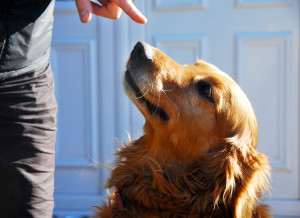
I have a great relationship with my own dogs. We often communicate with a look or a body posture. I get them. They get me. I think that far more people than not have this kind of a relationship with their dogs without even realizing it. Most people who parent dogs are not dog training experts. Yet they communicate effectively with their dogs with just the relationship that they have built. Communication is often silent. But silent communication is the purist.
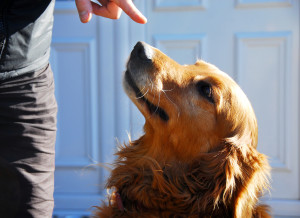
Facial expressions in dogs are often similar in humans. Dogs that are tense keep their mouths tightly closed. So do humans in this state of mind. Dogs that are relaxed often have a slightly open mouth with no tension in the flews. Humans that are feeling relaxed have a very similar facial expression. Happiness that is more than a relaxed state leads to a smile. In humans this means bared teeth, from a small amount to a large amount. In dogs, bared teeth typically mean aggression. But with family, in a trusting comfortable atmosphere, a bared teeth mouth with relaxed flews usually means a smile. There are numerous versions of a dog smile and it behooves the savvy dog owner to learn as much about dog body language as possible in order to properly communicate with their dogs.
Learning about dog body language doesn’t sound like it would have anything to do with dogs recognizing human facial expressions but it actually has a lot to do with it. The fact is that the more of a connection that a dog feels towards their main human, the better their communication skills will be with all humans. They will learn to recognize and read normal human facial expressions and trust what they have learned thus far. Dogs that have less of a stabilized connection with humans may be able to recognize some facial expressions but they will have a harder time trusting what they see if there has been less consistency in their experiences. This happens because less stability in their typical relationships with humans means that the negative associations often outweigh the positive. Humans are unpredictable to dogs with these experiences. So not trusting what they see is survival instincts at their finest.
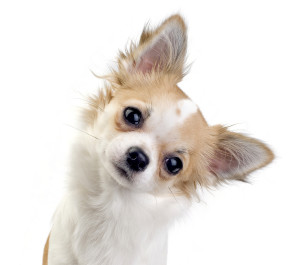
There are differing views on what all a dog is recognizing when they seem to recognize a facial expression. When I asked this question of a wide variety of dog lovers from behavior professionals to loving dog parents, I got varying answers. Among the responses was the thought that perhaps they are recognizing the entire body language picture as a whole. I believe that they absolutely do that. But I also believe that facial expressions are very telling and dogs have learned what ours mean. Of course, science has already shown us that they are so much better at getting us than we think they are.
For example, a study led by researcher Miho Nagasawa of Azabu University who wrote in the July 2011 issue of Animal Cognition magazine explained that five dogs were trained using photos of their owners. Some of the photos had their owners smiling and some showed them with a neutral expression. They were trained to touch their nose to the smiling photos. Those five dogs were then shown photo pairs of smiling and neutral expression faces that were unfamiliar to them, as well as faces of their owners. When shown photo pairs of strangers who were the same gender as their owners, the dogs selected the smiling faces more often than would be randomly expected.
In an even more recent study, published in the journal of Current Biology in February of 2015, co-author Dr. Ludwig Huber, head of the University of Veterinary Medicine in Vienna, Austria, states that the study “demonstrates that dogs can distinguish angry and happy expressions in humans, they can tell that these two expressions have different meanings, and they can do this not only for people they know well, but even for faces they have never seen before”.
In his study, eleven dogs were trained to discriminate between images of the same person making either an angry face or a happy face. Some dogs were rewarded with a treat for choosing the happy voice while other dogs were rewarded for choosing the angry face. Some of the dogs were only shown the upper half of the face and the others were only shown the bottom half of the face.
The researchers tested the dogs’ facial expressions discrimination abilities in a series of four experiments. They showed them slightly different images than those that they were trained on. There were several variations of this. For example, some dogs were shown the same half of a face they were trained on but with a different person in the photograph. In other instances, they were shown the other half of a face that they were trained on with the same person in the picture.
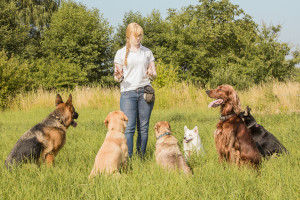
The researchers found that the dogs discriminated between the two very different facial expressions more often than a random choice would indicate. The dogs rewarded for choosing happy faces during this training seemed to learn this faster than the dogs rewarded for choosing angry faces. The prevailing thought on this result among the researchers was that many dogs (as do people) have negative associations attached to angry faces.
.
In conclusion, dogs are amazingly insightful creatures. They have adapted to our communication methods by their own choose. It would be in the best interests of both us as their caretakers and them as our charges, to communicate effectively on both sides of the equation. Become an educated observer of your dogs so that you can better communicate!
(15).jpg)