x





You’re here because, like me, you’re psyched about the rise of Cryptocurrencies. And you want to know how Blockchains work—the fundamental technology behind them.
But understanding Blockchains isn’t easy—or at least wasn’t for me. I trudged through dense videos, followed porous tutorials, and dealt with the amplified frustration of too few examples.
I like learning by doing. It forces me to deal with the subject matter at a code level, which gets it sticking. If you do the same, at the end of this guide you’ll have a functioning Blockchain with a solid grasp of how they work.
Remember that a blockchain is an immutable, sequential chain of records called Blocks. They can contain transactions, files or any data you like, really. But the important thing is that they’re chained together using hashes.
If you aren’t sure what a hash is, here’s an explanation.
Who is this guide aimed at? You should be comfy reading and writing some basic Python, as well as have some understanding of how HTTP requests work, since we’ll be talking to our Blockchain over HTTP.
What do I need? Make sure that Python 3.6+ (along with pip) is installed. You’ll also need to install Flask and the wonderful Requests library
Each Block has an index, a timestamp (in Unix time), a list of transactions, a proof (more on that later), and the hash of the previous Block.
At this point, the idea of a chain should be apparent—each new block contains within itself, the hash of the previous Block. This is crucial because it’s what gives blockchains immutability: If an attacker corrupted an earlier Block in the chain then all subsequent blocks will contain incorrect hashes.
Does this make sense? If it doesn’t, take some time to let it sink in—it’s the core idea behind blockchains.
We’ll need a way of adding transactions to a Block. Our new_transaction()method is responsible for this, and it’s pretty straight-forward
A Proof of Work algorithm (PoW) is how new Blocks are created or mined on the blockchain. The goal of PoW is to discover a number which solves a problem. The number must be difficult to find but easy to verify—computationally speaking—by anyone on the network. This is the core idea behind Proof of Work.
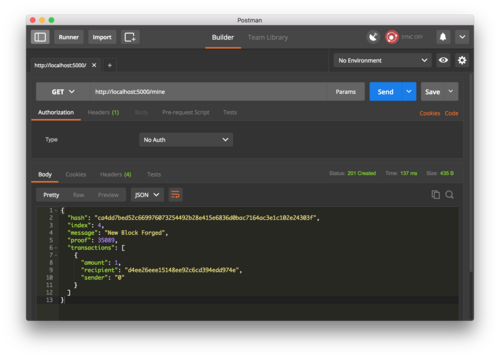
At this point I will refer you to the original post as you have what appear to be an interest. What I Wanted you to learn from this is the WAY to PROVE that a blockchain is reliable.
Cheers!
Will