x





 A big THANK YOU! to all of you who have joined my group!
Now that school is back in session and the summer is dwindling, it’s time to get down to brass tacks and concentrate on taking your business to the next level during the next four months of 2019.
In the first blog post, you read about what the purpose of this group is and what book we’re currently focusing on.
I promise you that there will be consistency with these posts and hopefully, you’ll pick up some great information that you can really follow and utilize to make your business journey a little smoother.
A little info on the posts: when I take direct quotes from the book, they’ll be in quotation marks. When I want to interject my own thoughts and experiences, it will be Green and Bold
Just to recap, I am currently providing a synopsis of the book entitled: Building A Story Brand by Donald Miller.
I gave you an overview of the Intro in the first post so now, we’re ready to move forward and delve into the first chapter.
There are 13 chapters in this book so we should wrap this one up in a little over six weeks based upon my review of two chapters a week.
However, in the event that a chapter is really long or there’s a lot of information to impart, I may have to break a chapter into two posts so as not to overload your brain!
If you have questions as we go along, please let me know.
I’d like this group to be as interactive as possible and eventually, we may move to a webinar format but for now, let’s see how well things go with this process.
I like the thought of collaborating on ideas for your endeavors, as we all know that multiple eyes and heads are better than one.
So without further adieu, let’s begin!
Chapter 1 – The Key to Being Seen, Heard and Understood
 According to Donald Miller, “WORDS” are what sell your product.
“Getting your message out there is the key to selling your product.”
“First Step – Clarify Your Message. Have a clear, concise picture of it.”
According to Don, “the Storybrand Framework has been just as effective for billion $ brands as it has for mom and pop businesses and just as powerful for American corporations as it has for those in Japan and Africa.”
He goes on to say that the reason being “is that the brain we humans think with is drawn towards clarity, not confusion, no matter where you reside.”
 “Communication is the key to snagging customers.”
“Why do they need your product?”
“Your message,” according to Don, “should be simple, relevant, repeatable and compelling.”
“Can everyone in your organization deliver your message in the same way?”
“5 seconds is all you have to catch a potential customer’s attention.”
“In other words, develop a simple sentence that tells the customer why they need your product.”
“Will it: change their life? Give them more time and make whatever it’s used for more efficient?”
Food for Thought: If you want to bring people into Markethive, what do you tell them in 5 seconds to make them want to learn more?
“Just how does marketing, story and behavior blend together?”
The Story Brand 7-Part Framework that Don has devised may help you answer those questions.
The Story: According to Mike McHangue, a friend of Don’s and a podcaster, fondly known as Science Mike, has been using science-based methodologies to help numerous companies delve into how their customers think.
His take is that the more simple and predictable the communication, the easier it is for the brain to digest.
“Simply said, Story helps make sense of things and put things in order.”
“Surviving and thriving is what the brain is really good at.”
Without going into a lengthy discussion on the whys and hows of the brain, let’s sum it up this way:
“Everything the human brain does all day involves helping that person and the people that person cares about get ahead in life.”
If you’ve taken any psychology courses, you’re probably already familiar with Abraham Maslow’s Hierearchy of Needs.
If you care to, you can read more about it here:
https://www.simplypsychology.org/maslow.html
In a nutshell, Maslow’s theory suggests that human needs – psychological, safety, love and belonging, esteem and self-actualization all need to be met.
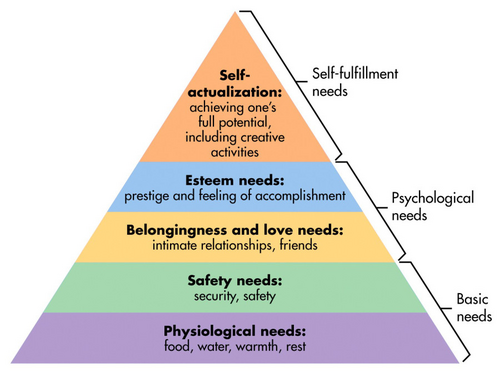 You can see on the Pyramid here that the most basic needs start at the bottom and then progress to the most evolved level at the top.
“Breaking it down even further – eating, drinking and surviving physically and holding a job with a dependable income is important (in most cases) to surviving.”
“Having a roof over one’s head (safety) and forming various relationships (sexual, romantic, along with friendships – people who have your back – and finally the greater psychological, physiological and spiritual relationships that give meaning to our lives.”
“Why is it important that you have a basic understanding of this?”
“We as humans are constantly on the lookout for information that will assist them with survival.”
“All the minutia that you throw at people isn’t helping them survive.”
With all that said, Mike goes on to say that there are Two Critical Mistakes that companies make when it comes to selling their products:
“No. 1 – Failure to focus on the aspects of their offer that will help people survive and thrive.”
Think about how your product can aid someone’s survival?
Don uses Mike’s example to explain this further:
“If we were to spend an hour in a giant ballroom, our brains would never think to count how many chairs are in the room but, we would always know where the exits are. Why? Because our brains don’t need to know how many chairs there are in the room to survive, but knowing where the exits are would be helpful in case there was a fire.”
“No. 2 – Causing customers to burn too many calories when it comes to understanding an offer.”
“Too much random information is like sudden death. You get ignored and tuned out by the customer.”
So again, back to basics – your message should help your customer survive and it should be understandable.
Think Practical Information – it’s Key!
“Communication is why the Storybrand Framework is so important.”
According to Don, “the Storybrand mantra is: If you confuse, you’ll lose!”
Food for Thought: I know this post is long but it’s super important to get all the meaning down so you have a foundation to understanding how this all comes together.
If you only have five seconds to get your message across to someone, you want to hit upon the high notes and leave out all the extraneous jargon that really doesn’t matter.
Trim the fat from your message and make it super lean!
Whatever marketing tools you use to sell your products might benefit from a reread from you, now that you know a little more about how the human psyche works.
Up next time, the continuation of Chapter 1 – Story to the Rescue