x



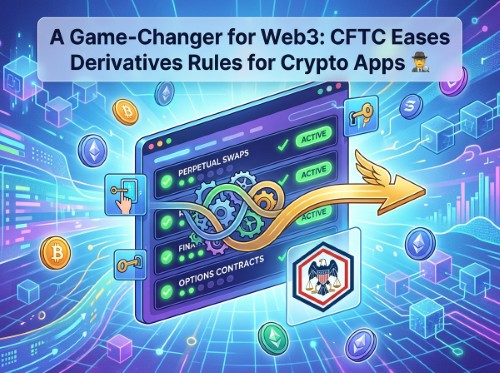
In what is being hailed as a pivotal shift for the digital asset industry, the United States Commodity Futures Trading Commission (CFTC) has issued a landmark no-action letter that paves the way for decentralised apps, Web3 wallets, and software developers to offer access to regulated derivatives markets.
Released by the agency’s Market Participants Division, the guidance confirms that passive software providers (PSPs) can connect everyday users to regulated derivatives products—including perpetual contracts and event contracts—without needing to undergo the complex, costly process of registering as introducing brokers (IBs).
This regulatory breathing room represents a momentous victory for non-custodial wallet developers and financial technology builders who have spent years navigating legal ambiguity in the crypto space.
Traditionally, any entity facilitating access to derivatives markets faced stringent registration requirements under US financial law. For developers building software interfaces, this created a daunting barrier to entry: registering as an introducing broker brings substantial capital, reporting, and compliance demands that simply do not fit the architecture of non-custodial tools or open-source front-ends.
The CFTC’s latest no-action position fundamentally changes this equation. Under the terms set out by the division, staff will not recommend enforcement action against qualifying passive software providers or their team members for failing to register as introducing brokers, provided their operational role is strictly limited to front-end interface functionality.
This announcement builds upon precedent established earlier in the year under Letter 26-09, which granted similar, bespoke relief to Phantom Technologies for its self-custody wallet. By broadening this standard to encompass all similarly situated software providers, the regulator has replaced one-off exemptions with a consistent policy framework.
To qualify under the CFTC’s criteria, a crypto app or software tool must function solely as a visual and technological bridge to registered market entities—such as Futures Commission Merchants (FCMs) or Designated Contract Markets (DCMs).
Covered software capabilities include:
By drawing a clear line between software that displays data and routes user orders and traditional brokers that handle funds and execute transactions, the CFTC is embracing a pragmatic, functional approach to technology oversight.
While the no-action letter removes the requirement for full broker registration, it is far from a free pass. Software developers wishing to leverage this safe harbour must adhere to strict compliance parameters designed to protect retail consumers and maintain market integrity.
To maintain immunity from enforcement, passive software providers must ensure:
The crypto and Web3 community has overwhelmingly welcomed the CFTC’s guidance, pointing to it as a pragmatic evolution in digital asset governance.
Cody Carbone, CEO of the Digital Chamber, highlighted how the decision removes barriers to technical progress:
"Software providers that build tools connecting users to registered FCMs/DCMs no longer have to register as brokers just for building the interface. This removes a major regulatory ambiguity that's chilled software innovation in derivatives markets."
Similarly, Summer Mersinger, CEO of the Blockchain Association, praised the agency for evaluating technical reality rather than relying on outdated legal labels:
"By extending its previous no-action relief to similarly situated passive software providers, the CFTC’s Market Participants Division is taking a more functional approach to regulation—one that looks at what a technology provider actually does rather than treating software itself as a traditional financial intermediary."
The timing of the CFTC's relief is particularly noteworthy. It arrived on the very same day the Securities and Exchange Commission (SEC) unveiled its own "Innovation Exemption" tailored for tokenized US equities.
Both regulatory actions followed a legislative impasse in the US Senate, where the Digital Asset Market Clarity Act stalled before advancing. In response to congressional delay, CFTC Chair Michael Selig and SEC Chair Paul Atkins took decisive steps to establish administrative clarity using existing statutory powers.
Coinbase Vice Chairman Ryan VanGrack captured the broader industry sentiment, noting that progress had arrived "gradually, then suddenly" after years of friction.
By separating the software layer from the execution and brokerage layer, regulators are finally establishing a sustainable roadmap for on-chain finance. For Web3 developers, Web3 wallet providers, and decentralised application builders, the message is clear: building user-friendly interfaces for regulated markets is no longer a legal minefield, provided transparency and proper disclosures remain at the heart of the product.
Disclaimer: This article is provided for informational purposes only, mistakes may be made, and it's not offered or intended to be used as legal, tax, investment, financial, or any other advice.