x






Image Source: Pixabay
ICICB Group Launches The Fastest Blockchain Platform in the World
ICICB Group partnered with Atari to create an Atari token – a decentralized cryptocurrency – with the goal of making it a token of reference in the entertainment industry. The Group is looking to further strengthen its hold in the cryptocurrency ecosystem, announcing the launch of the fastest blockchain in the world. The project will feature a series of tools that make it easier for users and developers to join the blockchain ecosystem. Dubai’s ICICB Group, one of the most renowned, diversified investment management companies in the world is launching the fastest blockchain in the world
The ICICB Group made possible the Blockchain Innovation Summit 2021 in Dubai. This is a networking, entrepreneurship, and innovation event for a new world centered on blockchain technologies, smart contracts, and the metaverse. The ICICB offered an experience with the potential to unleash a transformative goal in time. The Group’s main objective for launching the blockchain is to reinvent the entire user engagement experience across all industry domains – from decentralized blockchain payments, the entertainment industry, investments, engineering, and the medical system. Read More
Blockchain and the evolution of business models in the game industry
With the introduction of blockchain-based assets for games comes the possibility of entirely new business models and innovative development.
With the introduction of blockchain technology, native game assets go to global, non-permitted blockchain platforms, rather than being tied up and locked in the particular game's platform or in local environments controlled by video game development companies. We've talked about this before when we covered the role of blockchain in NFTs in this column.
Here, it is important to highlight how blockchain technology has enabled digital assets, such as nonfungible tokens, to be interoperable and immediately viewable across dozens of different wallet providers, tradable on other gaming platforms, and required in various virtual worlds of the Metaverse. And interoperability, in turn, has extended the negotiability of digital assets by enabling their free trade on other gaming platforms, thanks to blockchain technology. This puts users in direct ownership of their in-game items, giving them full and irrevocable control over their use.
That is, blockchain game players can access NFT marketplaces and crypto-active brokers and extract value from their in-game experiences by buying and trading digital assets obtained in games, 24/7, globally. In addition, tokenization of in-game assets opens up numerous other opportunities. Read More
Opera’s new launch Web3 Crypto Browser Is All Set For Your Device
Opera, the famous email browser, has introduced a beta version of its web3 crypto browser. The new beta version is more than just your average internet surfer. Along with features such as a built-in cryptocurrency wallet and shortcut for quickly switching between different crypto exchanges. They have also added decentralized apps support.
Opera Web3 crypto browser supports both cryptocurrency and blockchain technology. It can function in an environment where digital currencies are accepted and store your funds securely for use on the web or when making transactions through NFC templates (Sony).
Blockchain is a decentralized solution that reduces the need for third-party verification by providing trust in transactions through digital signatures. Furthermore, the blocks of this network are spread all over the internet, so it’s tough to hack. Read More
How Ethereum 2.0 Will Help the Crypto Community
Ethereum 2.0 is the next version of Ethereum blockchain technology to enrich the current blockchain with a new function. Ethereum 2.0 comes with many solutions related to the current crypto-verse.
Ethereum was developed in order to provide a platform that can facilitate immutable, programmatic contracts and applications via its own currency. However, it had certain limitations such as slow transaction processing and high transaction costs.
To provide more pleasing decentralized platforms, as well as handle multiplications of transactions, Ethereum developers have been updating the blockchain with new features and solutions. Ethereum 2.0 is a crucial development in the crypto space for users. Read More
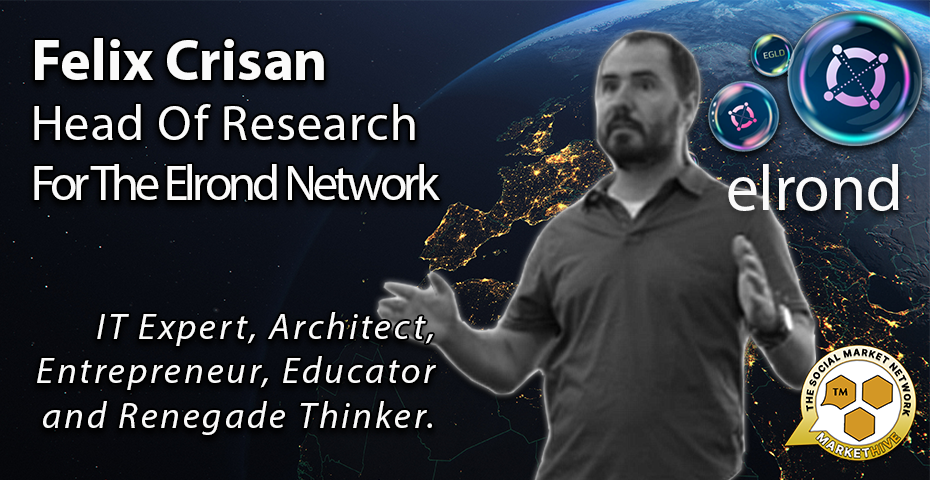
IT Expert, Architect, Entrepreneur, Educator, with a Renegade Mindset
Elrond's Head Of Research, Felix Crisan, is another feather in the cap of the evolving Romania-based Blockchain company. He is an integral part of a specialized team of hard-core engineers, entrepreneurs, and researchers, who have successfully redesigned the Blockchain infrastructure.
Collectively, the team, including Co-founders, CIO, Lucian Mincu, and COO, Lucian Todea, has significant technical experience at Microsoft, Google, Intel, NTT DATA, 2 PhDs in CS & AI, multiple math, CS and AI, Olympiad champions, and blockchain backgrounds, with the CEO of Elrond, Beniamin Mincu previously involved with the NEM core team. In this article, Felix Crisan is center stage.
Elrond is setting new standards for performance in the Blockchain space with an innovative network scaling technology called Sharding, but with a difference. Sharding is a well-known concept for horizontal partitioning of databases which several companies are applying it to public Blockchains to increase their throughput capacity.
Elrond has gone one better by developing a cutting-edge form of state sharding named Adaptive State Sharding. It enables the network to rival centralized cloud networks without sacrificing blockchains' security and decentralization advantages. This, along with their Secure Proof of Stake consensus, makes Elrond a leader in the next generation of high-throughput Smart Contract platforms flourishing in the Blockchain ecosystem. Read More

Decentralized and traditional finance tried to destroy each other but failed
Crypto to prevail over the traditional financial system, instead, competing industries started to adopt each other's technologies and cooperate.
The year 2022 is here, and banks and the traditional banking system remain alive despite decades of threatening predictions made by crypto enthusiasts. The only endgame that happened— a new Ethereum 2.0 roadmap that Vitalik Buterin posted at the end of last year.
Even though with this roadmap the crypto industry would change for the better, 2021 showed us that crypto didn't destroy or damage the central banks just like traditional banking didn't kill crypto. Why?
To be fair, the fight between the two was equivalently brutal on both sides. Many crypto enthusiasts were screaming about the coming apocalypse of the world's financial systems and described a bright crypto future ahead where every item could be bought with Bitcoin (BTC). On the other hand, bankers rushed to defend the traditional role of the banking system, accusing the blockchain technology of low performance and lack of compliance.
Both of the parties were wrong in their predictions. Read More
How should DeFi be regulated? A European approach to decentralization
The question for DeFi regulation: Is there an "owner" of the platform who can be held accountable for complying with the regulations?
DeFi is a set of alternative financial systems based on the blockchain that allows for more advanced financial operations than the simple transfer of value, such as currency exchange, lending, or borrowing, in a decentralized manner, i.e., directly between peers, without going through a financial intermediary (a centralized exchange, for example).
Schematically, a protocol called a DApp (for decentralized application), such as Uniswap or Aave, is developed in open source code on a public blockchain such as Ethereum. This protocol is powered by smart contracts, i.e., contracts that are executed automatically when certain conditions are met. For example, on the Uniswap DApp, it is possible to exchange money between two cryptocurrencies in the Ethereum ecosystem, thanks to the smart contracts designed to perform this operation automatically.
Users are incentivized to bring in liquidity, as they receive a portion of the transaction fee. As for lending and borrowing, smart contracts allow those who want to lend their funds to make them available to borrowers and borrowers to directly borrow the money made available by guaranteeing the loan with collateral (or not). The exchange and interest rates are determined by supply and demand and arbitrated between the DApps. Read More
Blockchain metaverse ecosystems gain traction as brands create digital experiences
Blockchain-based metaverse environments allow brands to offer more user benefits, such as increased interactivity and ownership of virtual items, but will it catch on?
To understand how and why brands are leveraging the Metaverse, it’s key to point out the role that NFTs, or nonfungible tokens, play within these ecosystems. While the year 2021 saw an influx of NFTs, the rise of the Metaverse is predicted to highlight the importance of utility behind NFTs.
Adrian Baschuk, founding partner at Ethernity Chain — an authenticated and licensed NFT platform — told Cointelegraph that every brand, company, and notable figure will eventually have a metaverse and NFT integration:
“This is the "Myspace days" of the NFT-metaverse interactivity layer. Just as every company and individual has adopted some form of social media, this will also be the case for NFTs and the Metaverse.” Read More
Bastyon Inventor Daniel Satchkov Explains the Importance of Using an Open Source Social Media Platform
Bastyon.com is a social platform built on the Bitcoin foundation. It is decentralized with no central server. Bastyon’s codebase is open source, and everything is governed by the users themselves. Bastyon’s core concept is censorship resistance. It can work even with domains are blocked by connecting directly to the nodes. Bastyon is powered by Pocketcoin (PKOIN), a Proof-of-Stake cryptocurrency that pays content creators and node operators who run the network.
Daniel Satchkov is the inventor of Bastyon (which was originally called Pocketnet). He recently joined the Bitcoin.com News Podcast to talk about the technology: Read More
Disclaimer: These articles are provided for informational purposes only. They are not offered or intended to be used as legal, tax, investment, financial, or any other advice.