x




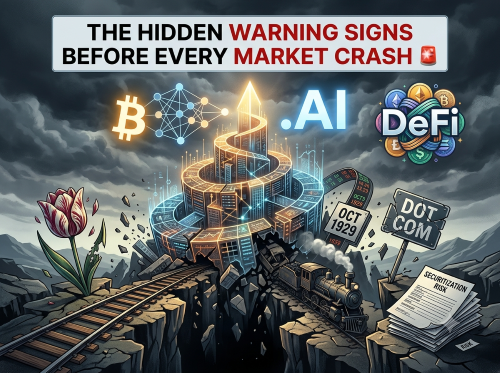
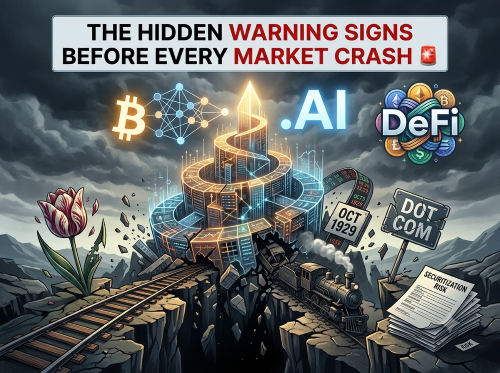
Financial markets are driven by human psychology, and while technology changes over time, human behaviour remains remarkably consistent. Every major market bubble throughout history—from the 17th-century tulip boom to the dot-com mania of the late 1990s—begins with a genuine, world-changing opportunity. Real innovation attracts early capital, rising prices attract speculation, speculation demands leverage, and eventually, total euphoria blinds investors to risk until the market collapses.
By examining the world’s most significant financial bubbles, investors can recognise recurring warning signs and better navigate today's fast-moving markets in cryptocurrency and artificial intelligence.
Every speculative bubble follows a distinct lifecycle. It begins with a compelling narrative or technological breakthrough that promises extraordinary returns. Early investors make substantial gains, creating fear of missing out among the broader public.
As money pours into the asset, prices detached from economic reality are no longer seen as a warning sign, but as proof that the trade is guaranteed to succeed. Financial markets then introduce leverage—borrowed capital—which accelerates gains on the way up, but creates catastrophic cascading liquidations on the way down. When the pool of new buyers finally runs dry, prices collapse far faster than they rose.
Tulip Mania (1600s)
In the Dutch Republic during the 1600s, tulips transformed from rare luxury items imported from the Ottoman Empire into intense financial instruments. Rare varieties with unique colour patterns became status symbols for the wealthy. Investors began trading futures contracts for bulbs still buried underground—speculating on flowers they had never seen and might never physically possess. When prices reached absurd heights, the market simply ran out of new buyers, leaving speculators holding worthless contracts.
The South Sea and Mississippi Bubbles (1720s)
A century later, both Britain and France experienced massive government-backed financial manias. The South Sea Company in Britain and John Law’s Mississippi Company in France combined government debt management with grand promises of vast riches from overseas territories. Respected political backers and royal connections gave these ventures an aura of absolute safety, convincing investors that traditional metrics did not apply. When profit figures failed to materialise, public confidence shattered overnight.
The Railway Mania (1840s)
Unlike tulip bulbs or vague overseas concessions, steam railways were genuinely transformative. Railways connected industrial hubs, moved goods at unprecedented speeds, and fundamentally reshaped British trade. However, early commercial success led parliament to authorise thousands of miles of competing tracks based on overly optimistic growth projections.
Investors paid only small initial deposits for their shares, unaware that railway operators could make call payments for the remainder of the capital at a later date. When construction costs mounted and credit tightened, many investors could not meet these demands, leading to widespread defaults. Notably, while investors were ruined, the physical railway network survived and laid the groundwork for modern industrial transport.
The Wall Street Crash of 1929
During the 1920s, the United States entered an era of rapid industrial expansion. Financial speculation exploded due to margin borrowing, which allowed individuals to purchase shares with as little as ten percent down while borrowing the remaining ninety percent from brokers.
When share prices began falling in October 1929, brokers issued margin calls demanding immediate cash top-ups. Unable to pay, investors were forced to sell their holdings, creating an automated cascade of selling that destroyed trillions in value and triggered the Great Depression.
Japan’s Asset Price Bubble (1980s)
In the late 1980s, Japan’s manufacturing dominance created a financial environment powered by cheap credit and soaring real estate values. A circular feedback loop emerged: rising land values allowed property owners to borrow more cash from banks, which was then funnelled into buying more real estate and Japanese equities. At its peak, Tokyo real estate held mythical valuations. When the Bank of Japan tightened monetary policy to kerb inflation, the asset price collapse wiped out balance sheets and required decades of financial repair.
The Dot-Com Boom (Late 1990s)
The emergence of the commercial internet created an unprecedented rush into tech stocks. Startups added the .com suffix to their names to command massive valuation premiums, despite having no clear pathway to profitability. Traditional measures like earnings per share were dismissed as outdated metrics, replaced by metrics like website traffic and user acquisition numbers. While core infrastructure like fibre-optic cables was successfully built out, hundreds of overvalued internet companies went bankrupt when capital dried up in 2000.
The 2008 Housing Crisis
Before 2008, low interest rates and loose lending standards fuelled a rapid rise in US housing prices. Lenders issued subprime mortgages to borrowers with poor credit, assuming rising house prices would allow endless refinancing. Investment banks bundled thousands of these risky loans into mortgage-backed securities, which were repackaged, rated as safe investments, and distributed globally. Extreme leverage across global banks meant that when housing defaults began, systemic credit froze, precipitating a worldwide banking crash.
Modern markets in cryptocurrency and artificial intelligence exhibit almost every historical warning sign playing out simultaneously:
Understanding financial history allows investors to recognise when a market is entering dangerous territory. Watch out for these four red flags:
While every boom claims that "this time is different," underlying human emotional cycles ensure that risk management, liquidity, and fundamental value remain the ultimate measures of financial survival.
Coin Bureau - The Warning Signs Before Every Market CRASH
"From flower bulbs to fiber-optic cables, the market’s wildest bubbles always start with a promising new idea. In this video, you’ll see how financial manias attract money, hype, and extreme risk until everything unravels.
Watch how fortunes are made and lost, what history teaches about warning signs, and why so many investors ignore the obvious. This is a lesson in spotting bubbles and protecting your future."
~ TIMESTAMPS ~
0:00 – Every market bubble starts with a real opportunity
2:16 – The South Sea Bubble: One of history's first financial manias
4:00 – Britain's railway boom became a devastating crash
6:01 – Why ordinary people always join bubbles near the top
8:01 – The Dot-Com boom: Revolutionary idea, disastrous investments
11:22 – The Nasdaq collapse—and why only a few companies survived
12:11 – The housing bubble that triggered the 2008 financial crisis
14:03 – What crypto bubbles have in common with every crash before them
17:06 – Is Bitcoin the next railway... or the next Pets.com?
Source 👉 https://www.youtube.com/watch?v=Ca1NV79sqbs
Disclaimer: This article is provided for informational purposes only, mistakes may be made, and it's not offered or intended to be used as legal, tax, investment, financial, or any other advice.