x




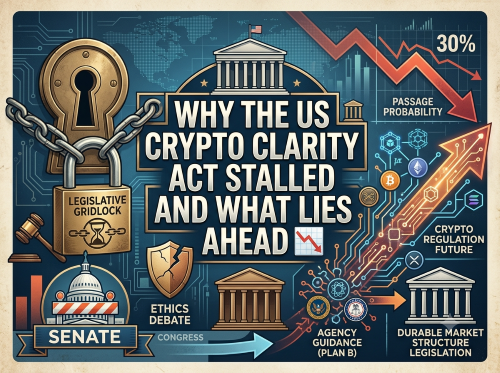
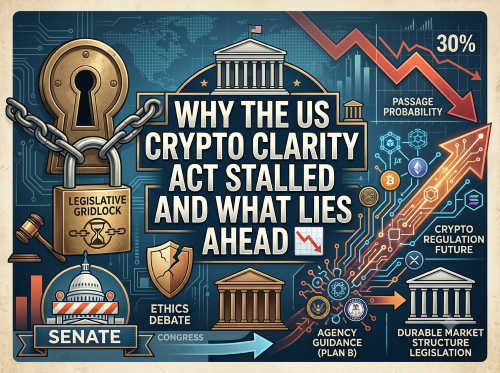
The digital asset landscape in the United States has hit an unexpected roadblock. For months, crypto investors and industry leaders anticipated the passage of the Clarity Act—a monumental piece of market structure legislation designed to bring definitive regulatory oversight to digital assets. However, as the US Senate prepares for its summer recess, momentum has dramatically stalled.
Prediction markets have reflected this abrupt shift. Probability metrics for the bill passing in 2026 dropped from over 80 per cent earlier in the year down to around 30 per cent. While the legislation is far from dead, administrative gridlock, ethical debate, and tight legislative calendars have pushed the bill off the Senate floor schedule. In response, financial regulators are stepping in with administrative guidelines, though this regulatory "Plan B" presents its own set of long-term vulnerabilities.
The immediate hurdle facing the Clarity Act is not a single dramatic vote defeat, but rather a severe squeeze on floor time. Legislative schedules ahead of the Senate recess are heavily congested, with priority given to foreign policy measures and executive nominations.
Passing major legislation in the Senate requires significant bipartisan co-operation. Although Republicans hold a 53-seat majority, initiating formal debate requires 60 votes, meaning at least seven Democratic senators must vote in favour. With only a handful of working days remaining before recess, and a brief autumn session prior to lawmakers adjourning for midterm campaigning, the window for floor debate has narrowed drastically. Unless Congress extends its working calendar, comprehensive statutory reform may be delayed until a new legislative session begins.
Beyond scheduling conflicts, substantive disagreements over ethics provisions have created deep friction among lawmakers. The 616-page draft of the bill included Section 604, an ethics clause intended to restrict senior government officials and members of Congress from issuing, sponsoring, or promoting commercial digital tokens for compensation while in office.
However, a specific carve-out within the clause allowed individuals to retain existing token investments and collect passive licencing or royalty income. Critics pointed out that this exception allowed prominent figures with existing commercial token arrangements to continue generating substantial revenue.
Consequently, key Senate Democrats who previously supported advancing the bill through committee withdrew their backing. Opponents argued that enforcement power should not rest exclusively with the Department of Justice, but should also empower state attorneys general to oversee potential conflicts of interest. This dispute effectively fractured the bipartisan coalition required to pass the bill.
As statutory progress stalls in Washington, regulatory agencies are taking matters into their own hands. The Securities and Exchange Commission (SEC) and the Commodity Futures Trading Commission (CFTC) have begun constructing an administrative framework under existing authorities.
Through initiative programmes like "Project Crypto", regulators have published guidance clarifying that activities such as token staking, validation, mining, and airdrops do not constitute securities transactions. Additionally, joint interpretive releases have categorised major digital assets—including Ether, XRP, Solana, and Chainlink—as digital commodities.
While this administrative approach provides much-needed immediate guidance, experts emphasise that agency rules are inherently temporary:
The sudden shift in legislative expectations sent shockwaves across digital asset markets. The repricing of regulatory risk triggered over 600 million dollars in long liquidations, alongside significant net outflows from spot exchange-traded funds (ETFs).
Furthermore, the delay highlights a growing divergence between the US and other major financial jurisdictions. Europe’s Markets in Crypto-Assets (MiCA) regulation is already fully operational, whilst Japan has recently updated its financial laws to reclassify crypto assets and implement a streamlined flat tax regime. Without durable statutory laws, the US risks relying on administrative guidance while competing global markets establish clear legal standards.
The path forward for US crypto regulation remains complex. Whilst administrative agencies are bridging the gap with temporary guidance, long-term market stability relies on statutory certainty that only federal legislation can deliver. Crypto market participants will be watching Congress closely to see if lawmakers can resolve ethical sticking points and restore momentum to market structure reform.
Coin Bureau - Congress Just KILLED Crypto's Biggest Bill
"The Senate just kicked the CLARITY Act, America’s biggest crypto bill, down the schedule with almost no time left before recess. Odds of passage have collapsed, and new ethics fights are making a 2024 floor vote look unlikely.
Meanwhile, the SEC and CFTC are moving ahead with new interpretive rules, but without a statute, everything could still change fast. Here’s where the bill stands, what’s holding it up, and how markets are reacting right now."
~ TIMESTAMPS ~
00:00 – The CLARITY Act Is Running Out of Time
02:29 – Only 8 Working Days Remain
04:58 – The Ethics Fight Stalling Everything
07:27 – The SEC and CFTC’s Crypto Backup Plan
09:55 – The Market’s Odds Have Collapsed
12:24 – Will the CLARITY Act Pass?
Source 👉 https://www.youtube.com/watch?v=A2VlNi3i248
Disclaimer: This article is provided for informational purposes only, mistakes may be made, and it's not offered or intended to be used as legal, tax, investment, financial, or any other advice.