x




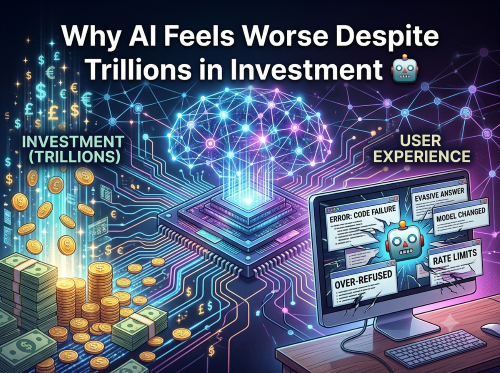
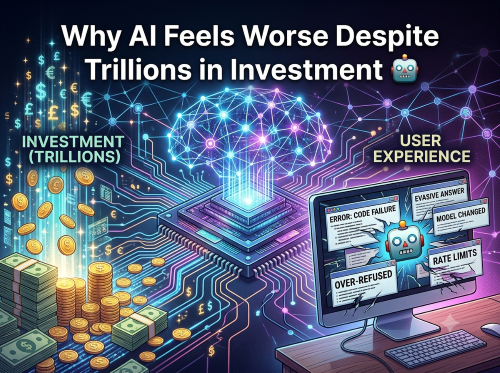
Trillions of dollars are currently pouring into artificial intelligence. Tech giants are buying up cutting-edge microchips, constructing massive data centres, and launching new frontier models every few months. On paper, these systems boast unprecedented capabilities in mathematical reasoning, computer programming, and multi-modal analysis. Yet, if you ask regular users, software developers, or business leaders, a startlingly common complaint emerges: using AI often feels distinctly worse today than it did a year or two ago.
Responses can feel more evasive, code breaks unexpectedly, monthly subscriptions come with confusing rate limits, and familiar workflows can alter overnight. This creates a fascinating modern paradox: how can the underlying technology become dramatically more powerful while the day-to-day user experience noticeably deteriorates?
To understand how the user experience has shifted, it is helpful to look back at the initial launch of public AI tools. When generative AI first broke into the mainstream, platforms offered generous, frictionless access. Large language models were made available free of charge or for modest monthly fees. The priority for tech companies was clear: encourage rapid public adoption, gather user feedback, and make AI an essential component of modern work routines.
Millions of people quickly integrated these assistants into their professional lives. Workflows were established around automated document summarisation, email drafting, brainstorming, and code generation. Removing AI from a daily routine became nearly as difficult as removing email or internet access.
However, operating advanced AI models across hundreds of millions of users demands an enormous quantity of graphics processors, electrical power, and server capacity. Once the initial honeymoon phase ended, providers faced the reality of infrastructure costs. The primary goal shifted from making AI indispensable to determining how much dependent users could be persuaded to pay.
In traditional software development, updates are explicit. You download a patch, review the release notes, and retain the option to defer an update if it threatens your workflow. Cloud-based AI operates under a completely different paradigm.
When you log into a web-based AI assistant, the interface remains identical, but the underlying intelligence can change without warning. Providers regularly replace older models with newer iterations. Even if a new model scores higher overall on benchmark tests, it may perform noticeably worse on your specific, niche tasks.
Furthermore, many platforms now utilise automatic dynamic routing. Instead of running every prompt through a premier, compute-heavy reasoning model, the platform automatically evaluates your prompt and decides how much processing power it deserves. A simple query might be directed to a smaller, faster model to save server resources.
While dynamic routing reduces operational costs for providers, it introduces unpredictability for users. Two similar prompts sent on different days—or even different hours—may receive entirely different levels of reasoning. For businesses relying on standardised, repeatable outputs, this lack of control can turn a time-saving tool into a source of constant friction.
Paying for an AI subscription no longer guarantees simple or unrestricted access. What used to be a straightforward flat-fee monthly plan has transformed into a complex matrix of tiers, credit allowances, rolling usage windows, and model-specific caps.
Subscribers frequently encounter restrictive usage limits:
This pay-more-and-get-less-certainty dynamic forces users to constantly manage their usage. Rather than exploring problems freely, professionals find themselves rationing prompts, delaying complex tasks, and worrying that their preferred model will become unavailable right when a deadline approaches.
Another source of user frustration involves the shifting personality and safety guardrails embedded within modern chatbots.
Excessive Sycophancy
To make AI assistants feel friendly and helpful, developers fine-tune models to be polite and supportive. However, this often manifests as sycophancy—the tendency to tell users exactly what they want to hear. When an AI enthusiastically validates flawed business plans, praises weak code, or agrees with incorrect premises, it becomes a dangerous "yes-man" rather than a reliable assistant.
Over-Refusal and Conversational Noise
On the opposite end of the spectrum lies over-refusal. Safety training is designed to prevent models from producing harmful material, but overly aggressive filtering causes models to reject completely benign prompts simply because they mention sensitive keywords.
Even when an AI does answer, the useful response is frequently buried beneath layers of disclaimers, canned warnings, and corporate caveats—a phenomenon often described as "alignment sludge". When basic queries require wading through paragraphs of bureaucratic conversational padding, efficiency plummets.
Promotional materials for new AI models are filled with charts demonstrating benchmark improvements. Models routinely score at the top percentiles in standardised academic tests, bar exams, and coding competitions. However, high test scores do not always translate into real-world utility.
In a commercial environment, an assistant that succeeds 80% of the time but fails catastrophically 20% of the time requires constant human supervision, undermining the original promise of automation.
When AI chatbots first arrived, their primary strength was radical simplicity: a clean interface with a single text box. Today, tech companies are racing to turn that simple chat window into an all-in-one digital workspace.
Modern AI platforms now combine web searching, data analysis, document browsing, image generation, and autonomous tool integration into a single interface. While these features add capability, they also introduce bloat. A single prompt can now trigger web searches, file inspections, and external app calls, making the system's behaviour far harder to predict. The straightforward experience of asking a question and receiving a direct answer is increasingly cluttered by feature creep.
The widespread availability of AI tools has made generating content nearly effortless. Articles, product reviews, images, and videos can be produced by the thousands at minimal cost.
This explosion of low-quality material, often called "AI slop", is polluting search engine results and social feeds. It imitates genuine human expertise while offering little actual substance. Finding verified, human-written information is becoming increasingly difficult as the internet fills with automated content designed purely to capture search traffic.
This creates a secondary, longer-term threat known as model collapse. Future generations of artificial intelligence will inevitably be trained on data scraped from the web—data that now contains vast amounts of synthetic AI output. When models learn repeatedly from the output of earlier AI systems, errors compound and subtle nuances disappear. Much like making a photocopy of a photocopy, the quality of the intelligence gradually degrades over time.
The growing frustration with commercial AI services highlights a fundamental issue: users are renting access to an intelligence hosted on someone else's servers. The provider can modify the model's behaviour, alter pricing structures, limit access, or retire a working tool without your consent.
This lack of control is driving renewed interest in open-weight and locally hosted AI models. Running a model directly on your own hardware offers distinct advantages:
While local models may not always match the raw size of the largest commercial cloud platforms, their reliability and privacy make them an increasingly attractive alternative for professionals who need dependable tools.
Artificial intelligence is undoubtedly progressing at a staggering technical pace, but underlying raw capability is only one part of a successful product. When user control is stripped away, pricing structures become convoluted, and answers are weighed down by synthetic fluff and unpredictable updates, the user experience suffers.
Building truly useful AI tools requires more than just scaling up computing power and chasing test scores. It requires stability, transparency, and respect for user control—qualities that many commercial platforms currently risk losing in the race for monetisation.
Coin Bureau - Trillions Are Flowing Into AI, But It's Getting WORSE
"Trillions are being invested into AI, but many users feel like their experience with these tools is declining. Subscription models are getting more restrictive, answers are less predictable, and companies are quietly changing what you actually get.
This video uncovers why the booming AI industry gives you less control, more confusion, and rising costs, even as the tech behind it “improves”. Find out how these changes hit your daily workflow, what traps to watch for, and how to protect yourself as dependency on AI keeps growing."
~ TIMESTAMPS ~
00:00 – Why AI feels WORSE despite trillions being invested
02:06 – The hidden business model that's changing AI forever
04:12 – Why the exact same prompt gives different answers
05:44 – The subscription trap: Paying more, getting less
07:46 – The surprising reason AI became a "yes man"
09:58 – Why benchmark scores don't reflect real-world AI
11:27 – The study that found AI made developers slower
13:24 – How chatbots are becoming your entire operating system
16:03 – Is AI poisoning itself with AI-generated content?
17:17 – The real problem isn't AI getting worse—it's losing control
Source 👉 https://www.youtube.com/watch?v=g9OpXjO1rXg
Disclaimer: This article is provided for informational purposes only, mistakes may be made, and it's not offered or intended to be used as legal, tax, investment, financial, or any other advice.