x



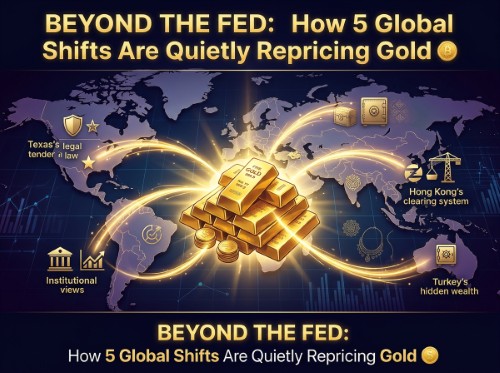
While mainstream financial media remains preoccupied with the US Federal Reserve’s latest interest rate decisions, a far deeper, structural transformation is quietly unfolding across global monetary markets.
Rather than waiting for signals from central bankers in Washington, a diverse array of actors—ranging from state legislatures and sovereign governments to institutional fund managers and traditional households—are actively re-anchoring wealth into precious metals.
Below is an in-depth analysis of five major international developments that demonstrate how gold and silver are reclaiming their status as foundational money outside federal monetary policy.
While Utah pioneered the modern recognition of gold and silver as legal tender back in 2011, Texas has taken the concept to an unprecedented scale. Under House Bill 1056, which officially came into effect on 1 September 2026, the Lone Star State formally recognised gold and silver specie with stamped weight and purity as legal tender for debts.
However, the real breakthrough lies in what comes next. By May 2027, Texas plans to launch a fully integrated, state-backed payment system anchored by the Texas Bullion Depository.
Why This Matters for Investors
On Wall Street, the prevailing explanation for gold’s momentum has long been the "debasement trade"—the argument that investors are fleeing fiat currencies due to mounting sovereign debt and inflation concerns.
However, Jan van Eck, Chief Executive of VanEck Funds, offered a striking counter-perspective in a recent interview with Bloomberg Businessweek. Managing some of the world's largest gold and mining exchange-traded funds, Van Eck stated that he is neither losing sleep over the $40 trillion US national debt nor viewing domestic inflation as the primary catalyst behind gold’s trajectory.
A Deeper Look at Institutional Strategy
Van Eck’s stance highlights a fundamental rift among sophisticated market participants. While retail commentary often reduces gold’s performance to a simple reaction against domestic inflation, elite asset managers recognise that global capital flows, central bank accumulation, and geopolitical realignment play equally crucial roles.
When institutional leaders disagree on the core mechanics of an asset class, it underscores that precious metals are being driven by broad structural forces rather than temporary consumer price index fluctuations.
In Turkey, a longstanding financial cultural tradition known as yastık altı altın—literally "gold under the pillow"—has reached a dramatic tipping point. Turkish Finance Minister Mehmet Şimşek recently highlighted that an estimated $640 billion in physical gold and foreign currency remains stored completely outside the formal banking system.
Two Divergent Perspectives
This ongoing tension illustrates a universal monetary truth: when confidence in fiat stability erodes, physical gold functions as indispensable financial insurance for individual households.
In Asia, Hong Kong is aggressively positioning itself as a premier global hub for precious metals clearing and settlement. Chief Executive John Lee confirmed in the city’s latest five-year strategic plan that Hong Kong will formally launch a centralised clearing and settlement system for gold in the first quarter of 2027.
This announcement transitions the project from an initial trial phase into a firm sovereign policy commitment, closely linked with integration efforts across mainland China’s Greater Bay Area.
Key Infrastructure Upgrades
By embedding precious metals into its core financial strategy, Hong Kong is ensuring that physical gold remains central to Eastern liquidity and institutional trade settlement.
In India—the world's second-largest consumer of gold jewellery—physical demand is experiencing a robust resurgence ahead of major cultural events such as Dhanteras and Diwali.
According to data from the World Gold Council, total Indian gold demand rose 1.8% year-on-year to 281.5 tonnes during the period. More strikingly, consumer expenditure in rupee terms surged by 72.5%, reflecting how strongly Indian buyers prioritise gold despite significant price appreciation.
The Power of Cultural Accumulation
Unlike Western markets, where precious metals buying is often treated as a speculative trade, Indian gold acquisition is deeply woven into cultural tradition and generational wealth preservation.
As the single largest recurring demand event on the global physical calendar, the annual festival season demonstrates that baseline physical consumption remains resilient regardless of broader macroeconomic headlines.
When analysed together, these five developments reveal a distinct global pattern. While market headlines remain fixated on daily interest rate speculation from central banks, the fundamental value of precious metals is being systematically re-established across every level of the global economy:
The trajectory is clear: gold and silver are actively reassuming their historic role as the universal anchor of true monetary value.
Disclaimer: This article is provided for informational purposes only, mistakes may be made, and it's not offered or intended to be used as legal, tax, investment, financial, or any other advice.