x




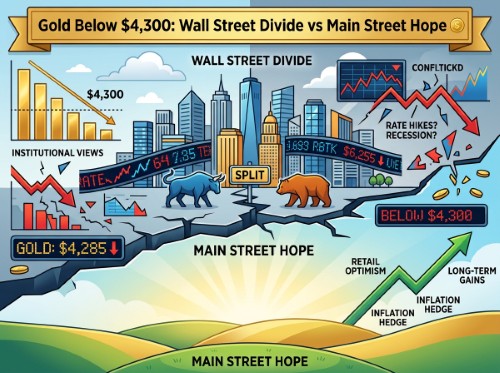
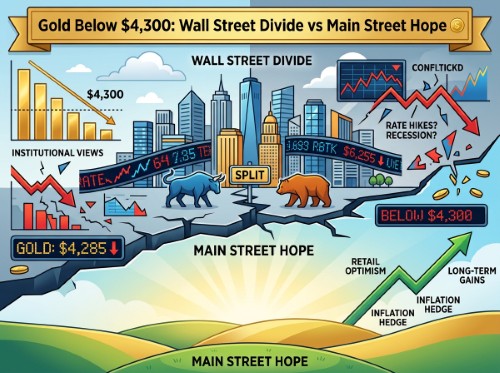
Gold prices experienced a turbulent week as early momentum above $4,350 per ounce quickly vanished under pressure from soaring Treasury yields, hawkish Federal Reserve expectations, and sticky energy-driven inflation. After dropping to a weekly low of $4,244.63 per ounce, spot gold staged a minor Friday recovery to finish around $4,285, marking a weekly decline of over two per cent.
Despite this sharp pullback, a clear division has opened up across the financial landscape. While institutional Wall Street analysts are deeply split on gold’s immediate trajectory, retail investors on Main Street remain steadfastly bullish.
The yellow metal began the week on solid ground near $4,383 per ounce, supported by elevated geopolitical risk premiums connected to Middle East diplomacy and the crucial Strait of Hormuz transit route. However, selling pressure quickly built as broader market conditions shifted against non-yielding assets.
Several factors converged to push spot gold below key support levels:
Although dip-buyers emerged near the $4,245 support level on Thursday and Friday as oil prices cooled, the rebound lacked enough strength to reclaim $4,300 before the market close.
The divergence between retail market sentiment and institutional forecasting is rarely as pronounced as it is following this latest price action.
Wall Street Split into Three Camps
In the latest market surveys, financial analysts revealed a complete lack of unanimous conviction:
Many institutional analysts point out that while the long-term thesis for precious metals remains fully intact, the short-term environment is dominated by quantitative algorithms and yield-driven trading mechanics.
Main Street Maintains Bullish Resolve
Retail traders, on the other hand, appear untroubled by short-term technical blips. Over 57 per cent of surveyed retail investors anticipate a price surge in the coming week.
For many individual investors, the primary driver for owning gold is not short-term yield mechanics, but rather structural debt issues. With the US government facing an unprecedented $1.6 trillion annual debt servicing burden on $40 trillion in total national debt, many retail buyers view sustained monetary tightening as unsustainable over a longer horizon.
While rising interest rates typically act as a drag on precious metals, the current macroeconomic cycle is defying traditional playbooks.
The Sovereign Debt Paradox
A growing argument among market strategists is that higher yields are no longer purely a symptom of robust economic growth; rather, they reflect growing anxiety over sovereign debt levels. When corporate entities like Microsoft achieve higher credit ratings than the sovereign government issuing the world's reserve currency, traditional market dynamics begin to break down.
Congress's persistent overspending means central banks may eventually be forced back into a accommodative posture to prevent debt servicing costs from overwhelming public budgets. This underlying reality continues to provide a structural floor under gold prices.
Relentless Central Bank Accumulation
Even as institutional hedge funds trim exposure during periods of rising yields, official sector buyers continue to accumulate physical reserves. Central bank diversification away from fiat paper assets remains a dominant macro theme, providing consistent buying pressure on dips.
From a charting perspective, gold has slipped below its 50-day moving average and broken its short-term uptrend support line established earlier in the summer. Technical analysts highlight two key perspectives on the current setup:
Traders often describe these structural digestions as the market "eating its vegetables"—a necessary, if unglamorous, period of base-building that precedes genuine structural breakouts.
The coming trading sessions bring a dense economic calendar dominated by labour market data, central bank statements, and inflation metrics. Market participants will be parsing these releases to gauge whether monetary policy expectations have swung too far.
Critical updates to monitor include:
While short-term macroeconomic headwinds—namely five per cent yields, dollar strength, and hawkish monetary policy—have forced gold back below $4,300, the underlying drivers of the precious metal's secular bull market remain firmly in place.
Geopolitical risks surrounding energy infrastructure and the Middle East, coupled with unmanageable sovereign debt trajectories and central bank buying, continue to offer a strong long-term foundation. For patient investors, periods of yield-driven consolidation often present strategic re-entry opportunities before macroeconomic fundamentals reassert themselves.
Disclaimer: This article is provided for informational purposes only, mistakes may be made, and it's not offered or intended to be used as legal, tax, investment, financial, or any other advice.