x




Despite silver's current struggle to maintain support at $36 an ounce while gold consolidates below $3,300, Natixis's Precious Metals Analyst Bernard Dahdah maintains a bullish outlook for silver, anticipating it to outperform gold in the latter half of the year. He forecasts silver prices to reach approximately $38 an ounce by year-end, even as gold stabilizes near $3,250. Dahdah's optimism is rooted in the significant divergence of silver's price from gold, noting a historical correlation of around 0.8 that has recently dropped to 0.55 since the start of the year. This weakening relationship suggests silver is less susceptible to gold price fluctuations, offering reassurance even with shifts in gold's value.
The primary driver for silver's anticipated performance is the robust industrial demand, which now accounts for 59% of global consumption, up from 51.5% in 2019. A significant portion of this increase stems from the growing requirements of the renewable energy sector, particularly solar, where silver demand has risen from 6% in 2015 to nearly 20% in 2024. However, Dahdah also cautions that the green energy transition presents the biggest risk to silver's outlook. Potential setbacks in copper or the broader energy transition narrative, along with a proposed U.S. Senate tax on wind and solar projects using Chinese components, could lead to rapid declines in silver prices. Source
According to Joseph Wu, Vice President and Portfolio Manager at RBC Wealth Management, gold's long-standing inverse relationship with real interest rates has broken down, indicating a "regime change" where new factors are driving its price. Historically, gold's appeal decreased when real interest rates rose, as it doesn't generate cash flow and incurs storage costs. However, since 2022, gold prices have remained resilient and even rallied despite rising or flat real yields. Wu attributes this to shifting demand dynamics, emphasizing the increasing importance of identifying the "marginal buyer" and their motivations, given that global mine production has grown modestly, keeping supply relatively inelastic.
Wu highlights central banks as a significant and price-insensitive source of demand, having purchased over 1,000 net tons of bullion annually for three consecutive years—double the average from 2010 to 2021. This trend is largely driven by geopolitical considerations, such as the freezing of Russia's foreign-currency assets in 2022, prompting emerging market central banks to diversify their reserves with gold. Additionally, portfolio diversification and gold's role as a store-of-value alternative are structural factors supporting demand. Wu suggests that the retreat of U.S. global leadership and concerns over elevated government debt and the U.S. dollar's long-term role contribute to gold's appeal as a diversifier against heightened uncertainty. He concludes that gold is best viewed as a long-term strategic allocation, offering protection and diversification, rather than a tactical investment. Source
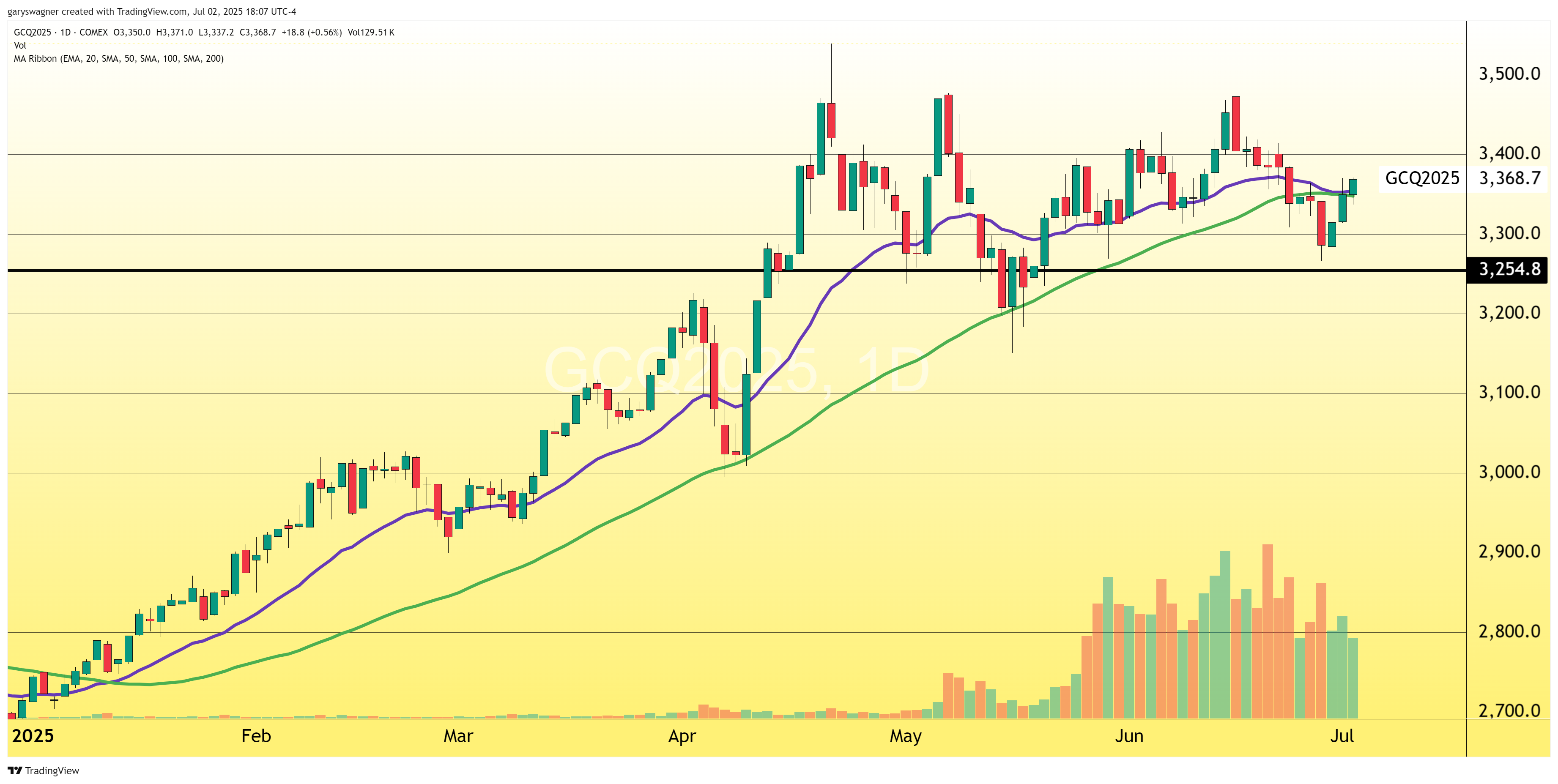
Image Source: Kitco News
Gold futures saw an $18.80 gain, or +0.56%, closing at $3,368.70 per troy ounce, extending its rally to a third consecutive session. This sustained upward momentum suggests further potential gains for gold as July trading progresses. The primary catalyst for gold's recent strength is growing anxiety over the deterioration of the U.S. labor market and employment concerns. Market participants are adopting defensive positions ahead of Thursday's ADP private sector jobs report, anticipating continued employment weakness, which historically supports precious metals as safe-haven assets.
Technically, gold's price action indicates a breakout, signalling the end of its recent correction. The metal opened above its 50-day simple moving average and near its 20-day exponential moving average, then decisively breached both levels. This technical validation, coupled with fundamental support from a weakening labor market and expansionary fiscal policy (including a potential $4-5 trillion increase in the federal debt ceiling for spending on border security and military enhancement), creates favourable conditions for continued strength in precious metals. Silver also performed strongly, advancing 1.47% and testing the upper boundary of its $35.90-$36.60 trading range, with technical analysis pointing to potential targets of $40 or higher by month-end. Source
Precious metals, led by gold, have seen significant price surges in the first half of 2025, building on a 20% increase in 2024, according to World Bank analysts Jeetendra Khadan and Kaltrina Temaj. Gold approached all-time highs in mid-June due to escalating geopolitical tensions and elevated economic uncertainty, with a sharp resurgence in gold exchange-traded fund (ETF) inflows pushing investment demand to its highest level since 2022. Central bank purchases also continued to support prices, reflecting ongoing reserve-management strategies. The World Bank projects gold prices to rise by about 35% in 2025 year-over-year, with some moderation expected in 2026 as uncertainties potentially recede, though prices are forecast to remain significantly above historical norms.
Silver and platinum have also demonstrated strong gains, with silver climbing nearly 20% in the first half of 2025. The World Bank anticipates robust demand for silver due to its dual role as an industrial input and a safe-haven asset, expecting prices to increase by 17% in 2025 and an additional 3% in 2026, supported by expanding mine production. Platinum, too, saw a nearly 30% surge in the first half of 2025, reaching over a decade high, primarily driven by tightening supply as mine production is projected to decline to a five-year low. Despite expected declines in automotive and industrial demand for platinum, supply constraints are set to support prices, with a 10% rise predicted in 2025 and a further 2% gain in 2026. Source
According to Saxo Bank analysts, gold, silver, and platinum continue to hold significant roles in investment portfolios, evolving from traditional safe-haven assets to respond to new market dynamics, geopolitical tensions, and industrial trends. Gold remains the benchmark for safe-haven assets, preserving wealth during systemic risks due to its monetary function and non-consumption. Central banks continue to stockpile gold for diversification and protection against currency volatility, and it performs best for private investors during periods of low real interest rates, fiat currency pressure, or market sell-offs. However, gold is not a growth asset, with its price influenced more by sentiment, real yields, and dollar strength than by supply-demand fundamentals.
Silver, in contrast, balances its safe-haven appeal with substantial industrial applications, particularly in solar energy and clean tech, which account for over 50% of its global usage. This dual role makes silver more volatile than gold but also more responsive during reflationary periods and economic expansion. Platinum, the rarest of the three, is primarily driven by industrial demand, with about 40% going to the automotive sector for catalytic converters, and also finds use in petroleum refining and medical devices. Despite supply vulnerabilities due to concentrated mining in South Africa and Russia, and expected supply deficits, platinum offers speculative opportunities linked to technological advancements and supply-demand imbalances. Saxo Bank recommends allocating 2-5% of total assets (primarily gold) for conservative portfolios and up to 10% for balanced portfolios, especially during monetary instability. Source
The gold market experienced renewed safe-haven demand, causing prices to jump, after private-sector payrolls processor ADP reported a significant weakening in the U.S. labor market in June. ADP indicated a loss of 33,000 private-sector jobs, marking the first contraction since February 2022 and sharply missing consensus forecasts for gains of 99,000 jobs. Furthermore, May's data was revised down to 29,000 jobs from an initial 37,000. Despite facing initial selling pressure, spot gold reversed its losses in response to this disappointing data, last trading up 0.34% at $3,348.39 an ounce.
Beyond the job losses, the report also highlighted elevated wage inflation, with pay for those who stayed in their jobs growing 4.4% over the past year and those who changed jobs seeing a 6.8% increase in June. This weakness in the labor market is prompting some economists to suggest that a Federal Reserve interest rate cut is becoming more likely, with markets nearly fully pricing in a cut by September. Analysts warn that this ADP data could indicate downside risk for the upcoming official government employment report, potentially leading to lower yields and increasing the odds of multiple Fed rate cuts this year, further bolstering gold's appeal. Source
Global central banks collectively added a net 20 tonnes of gold to their reserves in May, marking an increase from April's purchases but remaining below the 12-month average of 27 tonnes. This continued accumulation underscores gold's strategic appeal amid ongoing geopolitical tensions, as central banks seek to safeguard their reserves. Kazakhstan's National Bank was the largest buyer, adding 7 tonnes, bringing its year-to-date accumulation to 15 tonnes. Other significant purchasers included the Central Bank of Turkey and the National Bank of Poland, each acquiring 6 tonnes. The People's Bank of China and the Czech National Bank also contributed to the net increase, each adding 2 tonnes to their respective gold holdings.
The World Gold Council's Central Bank Gold Reserves Survey 2025 further reinforces this trend, revealing that 95% of central bankers anticipate a continued increase in official gold reserves over the next 12 months, with a record 43% expecting their own central bank to increase holdings. This strong sentiment highlights gold's enduring role as a diversifier, a hedge against inflation and geopolitical stress, and an anchor in diversified portfolios. While some central banks, notably the Monetary Authority of Singapore, recorded sales in May, the overall trend points to a sustained strategic interest in gold, driven by the desire for financial credibility and protection against currency volatility. Source
Gold and silver prices both saw gains as traders awaited the critical U.S. June employment situation report from the Labor Department, which was due on Thursday morning—a day earlier than usual due to the Fourth of July holiday. The non-farm payrolls figure for June was anticipated to show a gain of 110,000 jobs, a decrease from the 139,000 jobs added in May. This major economic data point is a primary focus for markets, influencing expectations around monetary policy and, consequently, precious metals.
Beyond the jobs report, the market's attention was also drawn to global trade negotiations, specifically U.S. trade deals, as a July 9 deadline for some countries approached. The article cited a Wall Street Journal headline indicating the difficulty in striking these trade agreements. In the broader market, the U.S. dollar index was slightly up, Nymex crude oil futures were trading higher around $66.75 a barrel, and the yield on the benchmark 10-year U.S. Treasury note was approximately 4.3%. Technically, August gold futures demonstrated a near-term advantage for bulls, with an upside objective of $3,400.00 and support at $3,200.00. September silver futures also showed a near-term technical advantage for bulls, despite recent choppy, sideways trading, with an upside target of $37.73 and support at $35.00. Source
According to Fawad Razaqzada, Market Analyst at City Index and FOREX.com, gold's remarkable rally in the first half of 2025, which saw prices surge 25% and surpass $3,000, is expected to give way to a period of consolidation in the second half. This anticipated slowdown is attributed to a cooling in safe-haven demand, though U.S. trade policy and equity market volatility are projected to remain significant drivers of gold prices. Razaqzada notes that while the long-term bullish trend for gold remains intact, the rapid ascent and "deeply overbought" technical indicators suggest that a healthy consolidation or even a correction is both necessary and likely, especially with a recovery in risk appetite seen in the S&P 500.
Razaqzada's analysis also highlights the influence of the U.S. dollar, concerns over the sustainability of U.S. fiscal policy with soaring debt and deficits, and renewed trade frictions as factors impacting gold's trajectory. Despite these concerns, central bank buying, led by the People's Bank of China, continues to be a strong pillar of support for gold, as institutions diversify away from the U.S. dollar. However, at current elevated prices, central bank demand might moderate, and if retail and ETF demand doesn't compensate, it could cap gold's upside. Technically, while gold remains in a strong long-term uptrend, indicators like the monthly Relative Strength Index (RSI) are showing extreme overbought conditions, historically signaling a potential pause or correction. Razaqzada suggests key support levels around $3,170 and $3,000-$3,100, which he considers a critical "line in the sand" for the bullish outlook. Source
Gold and silver prices are exhibiting upward momentum, with gold trading above $3,300 an ounce and silver consolidating above $36, signaling potential for further gains, according to Ryan McIntyre, Senior Managing Partner at Sprott. While maintaining a bullish stance on gold, McIntyre expresses a particular near-term interest in silver, noting that the gold/silver ratio has declined significantly. This optimistic outlook for both metals is supported by easing global recession fears and reduced trade tensions, which bolster silver's industrial demand. McIntyre expects both precious metals to continue their upward trend as retail investors increasingly seek assets to preserve wealth and purchasing power amidst growing economic uncertainties.
McIntyre emphasizes silver's attractive value proposition as a monetary metal, even though it's not a central bank reserve asset. He points to rising government debt and sovereign risk as key drivers pushing investors away from traditional government bonds and towards hard assets. With the U.S. government debt surpassing $37 trillion and a new budget bill potentially adding another $3 trillion to the deficit, McIntyre believes that the unsustainable financial situation will eventually prompt a significant capital shift from equities into precious metals. He anticipates that while gold may consolidate around $3,300, its continued rally will likely pull silver higher, regardless of industrial demand fluctuations. Source
According to Robert Minter, Director of ETF Strategy at abrdn, gold's current consolidation above $3,300 is fully justified, and $3,000 should be considered the new normal for the precious metal. Minter argues that gold's value is validated by the global surge in government debt, citing that U.S. Treasury debt has increased by roughly 900% since 1993, mirroring gold's own appreciation over the same period. He emphasizes that with major nations engaging in similar deficit spending, currency devaluation is effectively hidden in inter-currency comparisons but becomes evident through gold, which is not tied to any government's debt and consistently trades near record highs against all major global currencies.
Minter anticipates that central banks will continue their gold accumulation, albeit potentially at a slower pace. While acknowledging some near-term risks like a potential unwind of economic pessimism that could dampen gold's safe-haven appeal, he views any short-term corrections as buying opportunities. He also suggests that the next significant rally for gold will likely be triggered by traditional investment demand as the Federal Reserve is compelled to cut interest rates. Minter predicts that if the Fed eases rates by at least 50 basis points this year, gold could see another $300 rally, potentially pushing prices towards $3,700 an ounce, driven by renewed ETF investor interest. Source
Disclaimer: These articles are provided for informational purposes only. They are not offered or intended to be used as legal, tax, investment, financial, or any other advice.
Featured Image generated with Google AI Studio















