x




Silver is holding above 58 an ounce as tight physical supply, strong demand and a favourable macro backdrop continue to drive prices higher. Supply-chain disruptions that accelerated in October drained already thin stockpiles in London and pushed lease rates to record levels, signalling intense competition for available metal. Stockpiles in Shanghai have now fallen to their lowest level in a decade, while U.S. inventories remain largely untouched amid uncertainty over potential industrial tariffs. The sharp rally also caught many speculative investors off guard, as leveraged funds had reduced long positions ahead of the surge, leaving them underexposed when prices rebounded.
Expectations of continued Federal Reserve rate cuts through 2026 are supporting investment demand by reducing the opportunity cost of holding silver. Institutional buyers have increasingly stepped in as concerns about persistent deficits, a softer labour market and long-term debt risks boost interest in hard assets. At the same time, silver’s role as a critical industrial metal is expected to reinforce a strong price floor, providing further support for the market’s upside potential. Source
A rapidly expanding green energy economy valued at more than 5 trillion and projected to exceed 7 trillion annually by 2030 is set to reinforce long-term industrial demand for silver. Solar technology remains a central driver as photovoltaic panels require silver, and despite reduced silver loading per panel, soaring global installations are expected to maintain substantial consumption. The sector’s growth is supported by sharply declining costs for solar photovoltaics, batteries and wind power, along with China’s dominant role in manufacturing and deployment. Even as the U.S. retreats from some renewable incentives, analysts note that the green transition is broad and resilient, with global investments continuing to break records.
The Silver Institute expects the solar sector to consume 195.7 tonnes of silver this year, only a slight decline because of efficiency gains, while overall demand remains strong due to expanding capacity. Analysts foresee structural supply deficits for years, with alternative materials like copper still unproven at scale. Combined with silver’s climb above 58 an ounce and its 100 percent yearly gain, these forces suggest that the metal’s industrial role in the green transition will continue, supporting elevated prices and sustained long-term demand. Source
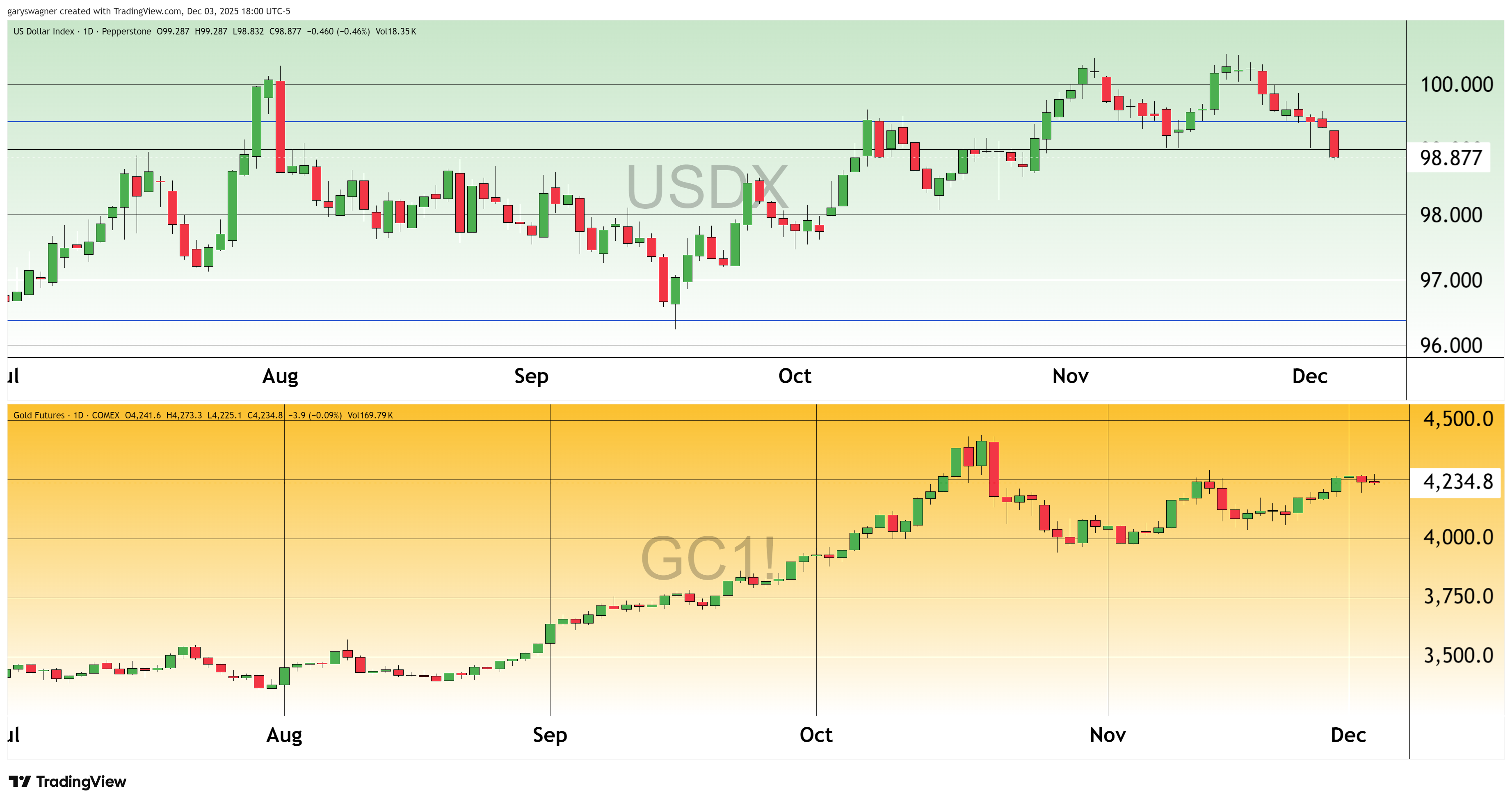
Image Source: Kitco News
Gold is consolidating near 4,220 after recovering from early-week profit-taking, while silver has surged to new nominal record highs above 58. Silver has doubled since January, sharply compressing the gold/silver ratio toward 73 with expectations for a continued move toward 65. Both metals are trading far above key moving averages, with gold showing room for further upside and silver displaying more stretched technicals, including an overbought RSI and bullish chart structures. Market momentum is supported by weakening US economic data, including a major jobs miss and continued manufacturing contraction, which has driven expectations of a December rate cut close to 89 percent and pushed the dollar and Treasury yields lower.
Institutional demand is strong for both metals, with gold ETFs seeing record inflows and silver ETFs adding hundreds of tonnes as warehouse stocks fall to decade lows. Major banks continue raising long-term price targets, citing tightening supply conditions and persistent deficits, particularly in silver. Near-term movement now hinges on upcoming US employment data and Federal Reserve guidance, with a dovish stance likely to push gold toward fresh highs and potentially send silver toward 65, though recent rapid gains leave both markets vulnerable to bouts of profit-taking. Source
Retail traders continue to dominate activity in the precious metals market, as CME data shows metals-related trading volume surged in November. Smaller contract sizes fuelled much of the increase, with Micro Gold futures rising 235 percent year-over-year to an average of 476,000 contracts traded daily. Silver also saw heavy participation, with standard futures up 22 percent and micro silver futures up 238 percent compared to last year. This surge in retail interest coincided with silver’s powerful rally, including an 18.6 percent monthly gain and a sharp 14.5 percent jump in the final week of November that pushed prices above 55 for the first time. Even a 10-hour trading halt failed to slow momentum, and silver has since climbed above 59, more than doubling since January.
Analysts note that silver’s strong uptrend remains supported by the combination of robust demand and tightening supply, even as volatility increases near record highs. Silver is also seen as undervalued relative to gold, with the current gold/silver ratio near 74 compared to a long-term average around 68. Some analysts see room for silver to catch up, implying potential upside toward 65 per ounce if the ratio normalizes. Source
Oil and gold are moving in opposite directions this year, with Brent Crude down nearly 17 percent while gold is up almost 60 percent. Oil faces pressure despite OPEC+ maintaining its production pause, as markets remain unconvinced that supply risks in Venezuela or Ukraine will materialize. Traders also fear weaker demand if the US economy slows or if the AI-driven boom loses steam, raising the possibility of oil dipping below 60. Overall, sentiment suggests limited upside for crude in the near term unless geopolitical or economic conditions shift unexpectedly.
Gold, on the other hand, continues to benefit from strong central bank buying, increasing ETF inflows and expectations of ongoing Federal Reserve rate cuts. Deutsche Bank now projects gold to reach 4,450 in 2026 and 5,150 in 2027, reflecting confidence in sustained demand. Additional support comes from Tether, which has accumulated around 116 tons of gold to back its gold-linked token and may acquire another 100 tons by late 2025. With steady investment flows, potential dollar weakness and expanding institutional interest, gold still appears to have meaningful upside, while oil remains more vulnerable to downward pressure. Source
Gold is approaching new highs as weak US employment data and rising geopolitical tensions strengthen expectations of a Federal Reserve rate cut. Investors are positioning for a more dovish policy outlook following signals that President Trump will appoint a new Fed chair early next year, a move markets believe could reinforce lower-rate policies. With real yields expected to fall and the dollar under pressure, demand for gold as a hedge is increasing. The latest ADP report showing a 32,000 job loss and mixed PMI data have added to the case for easing, making upcoming NFP figures even more pivotal for confirming the labour market’s trajectory.
Geopolitical tensions, especially involving Venezuela and broader regional instability, are adding to safe-haven demand. At the same time, gold’s technical setup remains strongly bullish, with prices trading above key moving averages and momentum indicators showing room for further gains. Traders see supportive conditions for continued upside as both fundamentals and market sentiment align toward higher prices. Source
Gold moved higher as new ADP data showed the U.S. private sector shed 32,000 jobs in November, sharply missing expectations for small job gains. The weakness was broad-based, with small businesses pulling back the most amid cautious consumer behaviour and uncertainty in the wider economy. Gold, already supported by recent momentum in silver, climbed to about 4,220 an ounce as traders reacted to the softer labor backdrop and rising expectations that the Federal Reserve will cut interest rates next week, with market odds near 90 percent.
The ADP report also pointed to a deterioration in wage growth, with pay gains slowing for both job stayers and job changers. Hiring has remained flat through the second half of 2025, with notable weakness across manufacturing, professional and business services, information, and construction. Attention on private-sector data has increased because the Federal government will not release November labor figures following the prolonged shutdown, adding weight to ADP’s weaker readings and further fuelling bullish sentiment in precious metals. Source
The U.S. services sector showed modest improvement in November, as the ISM Services PMI rose to 52.6, a touch higher than October and above expectations. Business activity and new orders continued to expand, while supplier deliveries slowed and inventories returned to growth. Price pressures eased slightly, with the Prices Index falling to its lowest level since April 2025, although it remained elevated after a year of readings above 60. Despite signs of resilience, employment stayed in contraction for the sixth straight month, highlighting continued labor market softness within the sector.
Gold prices initially set a double-top near 4,240 before firming again following the release of the PMI data, with spot gold last trading around 4,214 for a small daily gain. The broader services sector continues to reflect long-term cooling, as the 12-month average PMI remains near multi-year lows despite incremental monthly improvements. Still, steady expansion in business activity, new orders, and a rebound in backlogs suggest the potential for gradual recovery even as tariffs and the recent government shutdown weigh on demand and costs. Source
Gold and silver advanced through midday trading, with silver reaching a new record high near 60 and gold extending its overnight strength. The move was fueled by a weaker-than-expected ADP report showing a loss of 32,000 jobs in November, raising expectations for earlier Federal Reserve rate cuts as official government data remain delayed. Treasury yields steadied around 4.08 percent, the dollar index slipped to a three-week low, and crude oil hovered near 59.50, all contributing to a supportive environment for precious metals. Market sentiment also leaned dovish as investors anticipated the likely nomination of Kevin Hassett as the next Fed chair, given his preference for faster rate reductions.
Futures markets reflected strong technical momentum, with February gold near 4,251 and bulls targeting a break above the record 4,433 level while holding support around 4,200. Silver futures at 59.06 maintained a pronounced bullish posture, with traders eyeing a push above 60 and strong support near 55. Liquidity dynamics favored the actively traded December gold contract, and speculative buying played a visible role as both metals continued to benefit from weaker labor data, shifting rate expectations, and firm technical setups. Source
Silver is trading near record highs around 58 after doubling in price this year, but its sharp rise has stirred warnings about elevated risk. Mike McGlone of Bloomberg Intelligence highlighted that silver’s rally is parabolic and historically such extreme moves have often been followed by deep corrections, noting past cycles where major peaks were not revisited for decades. With prices sitting far above their five-year average and annual volatility near 30 percent, a typical swing could push the metal as high as 75 or back toward 40 next year.
Despite overbought signals, strong fundamentals continue to underpin the market. Industrial demand has driven five consecutive years of supply deficits, shrinking available stockpiles, while potential tariffs and supply-chain strain add further pressure. Investment demand has surged amid economic uncertainty, expectations for aggressive Federal Reserve easing, and persistent inflation, creating a supportive backdrop for hard assets. Although volatility is likely to remain high, analysts see ongoing tightness in supply as a key factor keeping prices elevated. Source
Central banks recorded their strongest month of gold purchases in October, acquiring a net 53 tonnes, driven largely by a handful of active buyers such as the National Bank of Poland and the Central Bank of Brazil. Poland returned to the market after a pause since May, adding 16 tonnes and raising its gold reserves to 531 tonnes, while Brazil added 16 tonnes following a 15-tonne purchase in September. Other buyers included Uzbekistan, Indonesia, Turkey, the Czech Republic, Kyrgyzstan, Ghana, China, Kazakhstan, and the Philippines, with Russia being the only central bank to report a decline, reducing its holdings by 3 tonnes to 2,327 tonnes. Overall, reported net purchases through October totaled 254 tonnes for 2025, slightly slower than previous years, likely reflecting higher gold prices.
Emerging-market central banks continue to drive demand, with purchases viewed as strategic rather than opportunistic amid ongoing macroeconomic uncertainty. Looking ahead, several central banks have signaled intentions to further increase gold holdings, including Serbia, which plans to nearly double its reserves to 100 tonnes by 2030, and other countries like Madagascar and South Korea expressing interest in future acquisitions. The trend aligns with survey findings showing that 95 percent of central bank respondents expect their gold reserves to rise in the coming year, reinforcing gold’s status as a strategic asset in reserve portfolios. Source
Gold continues to trade near fair value despite falling short of October’s record highs above 4,360 an ounce, supported by ongoing economic uncertainty and expectations of Federal Reserve interest rate cuts. Nitesh Shah of WisdomTree noted that the market has established higher support levels with each breakout, with recent consolidation around 4,200 providing a strong floor. Selling pressure remains limited, and even in a bearish scenario, gold is unlikely to drop below 3,800 without significant shifts in interest rates and economic conditions, which he considers improbable given current circumstances.
Investor sentiment remains positive as declining yields and a weaker U.S. dollar reinforce gold’s appeal as a safe-haven asset. Disappointing economic data has shifted market expectations toward nearly a 90 percent chance of a Fed rate cut, providing additional support for prices. Shah also highlighted the role of central bank policies and potential political influence on the Federal Reserve, suggesting that any perceived threat to the Fed’s independence could drive further demand for gold and encourage other central banks to diversify reserves away from the U.S. dollar. Source
Silver’s record-breaking rally is being driven primarily by physical demand, particularly from India, rather than speculative activity, creating unprecedented stress in the market. Phil Baker, a former U.S. mining executive, highlighted that India imported around 60 million ounces of silver in October alone, up from 15 million the prior year, making the country the central driver of global silver demand. Industrial buyers are also changing behavior, stocking up to avoid shortages amid tight inventories, while investment demand in the U.S. and other Western markets continues to grow, creating a long-term, generational holding pattern for the metal.
Supply constraints exacerbate the pressure, with global silver production running deficits for five consecutive years and mines unable to increase output quickly due to regulatory and logistical delays. Peak mine production was reached in 2016, and recycling cannot bridge the gap, leaving physical silver already in the market as the primary source to meet demand. Baker emphasized that the combination of insatiable Indian demand, growing industrial usage, generational investor accumulation, and slow mine supply has fundamentally shifted the market, giving physical silver unprecedented influence over pricing. Source
Disclaimer: These articles are provided for informational purposes only. They are not offered or intended to be used as legal, tax, investment, financial, or any other advice.
Featured Image - Source: Unsplash















