x



Gold has experienced an extraordinary surge, climbing nearly $1,000 in just three months to approach record highs near $4,400. The rally unfolded in two main stages, beginning with a steady advance from around $3,350 to $3,680, followed by a much sharper ascent of more than $700 in only 22 days. Technical analysis of this movement, particularly through Fibonacci retracement theory, highlights consistent alignment across multiple key levels, suggesting that recent price behaviour reflects meaningful market structure rather than coincidence. The 61.8% retracement level, situated just below $4,000 at approximately $3,942, has become a crucial support zone, as trading patterns over the past week indicate consolidation and accumulation around this area.
This support level could serve as the foundation for gold’s next upward move, provided that the macroeconomic conditions fuelling the rally remain unchanged. Persistent factors such as global trade tensions, ongoing central bank purchases, weakening confidence in fiat currencies, rising U.S. debt levels, and expectations of further interest rate cuts continue to reinforce bullish momentum. In current trading, gold has gained about 1.31% to reach $3,993, with analysts expecting short-term sideways movement between $3,942 and $4,029 as the market stabilizes. This consolidation is viewed as a healthy phase that could enable gold to build strength before setting new record highs. Source
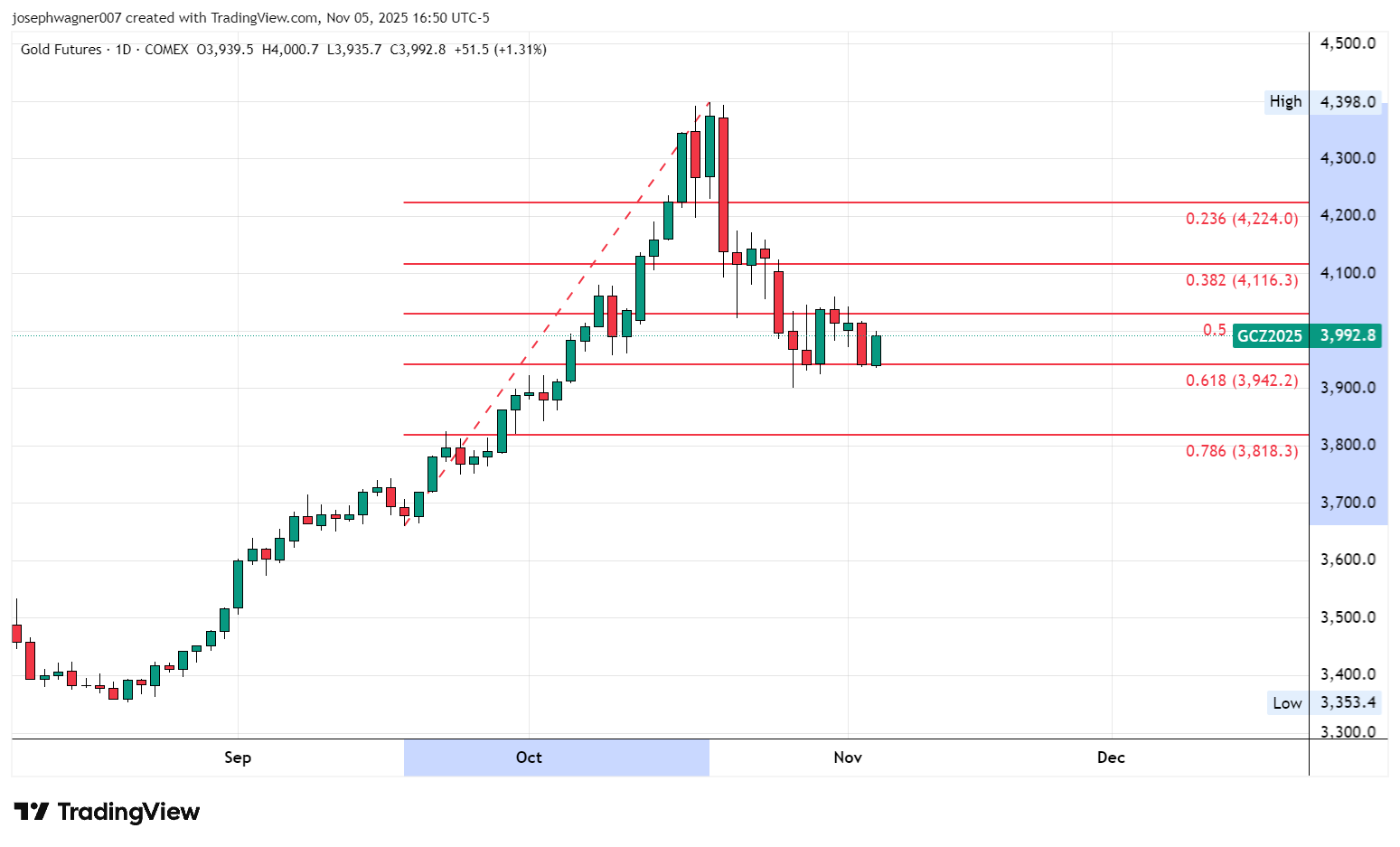
Image Source: Kitco News
Coeur Mining has announced a $7 billion all-stock acquisition of New Gold, marking the largest gold-sector merger of 2025 and forming a major North American-focused precious metals producer. The merger reflects the industry's accelerating drive for scale and jurisdictional safety as gold prices remain above $4,000 per ounce. Under the agreement, New Gold shareholders will receive 0.4959 shares of Coeur for each of their own, a 16% premium based on recent market prices. The combined company will be valued at around $20 billion, with Coeur shareholders owning 62% and New Gold shareholders 38%. This move underscores a broader trend among mid-sized miners consolidating to compete more effectively and appeal to investors seeking stability amid global uncertainty.
The merged firm will control seven producing mines, including key assets such as Rainy River in Ontario, New Afton in British Columbia, and Coeur’s U.S. operations, and is projected to generate $3 billion in EBITDA and $2 billion in free cash flow in 2026. Analysts view the merger as a strategic response to inflationary pressures and a move to secure access to capital and index fund inclusion. Coeur’s CEO, Mitchell Krebs, described the deal as an opportunity to build a North American powerhouse at a pivotal moment for the industry. The transaction is expected to close in the first half of 2026, pending shareholder and regulatory approval, with Coeur maintaining a dual presence in Chicago and Toronto. Source
Aakash Doshi, Head of Gold Strategy at State Street Investment Management, believes gold’s next major move will be higher, despite an expected short-term consolidation phase. He anticipates gold prices will hover below resistance near $4,000 through the end of 2025, as November and December typically bring weaker performance for gold-backed ETFs. While SPDR Gold Shares has seen an 8-tonne decline in holdings since prices peaked around $4,360, Doshi views the current pause as healthy within a long-term bull market. He expects new record highs in early 2026, potentially driving prices toward $5,000 per ounce, supported by sustained investor demand and underlying market strength.
Doshi emphasized that the current rally remains fundamentally supported by strong physical demand and steady central bank purchases, which are projected to total between 750 and 900 tonnes this year. Even with recent ETF outflows, he noted that gold is “overbought but not overowned,” suggesting further upside potential as investors continue to view the metal as a reliable store of value. He also highlighted macroeconomic conditions—particularly falling interest rates, elevated inflation, and declining real yields—as key drivers that will keep gold attractive relative to other assets. The ongoing dedollarization trend, marked by central banks diversifying away from the U.S. dollar, further reinforces gold’s role as an alternative global currency and a cornerstone of financial stability. Source
Gold’s recent rally has paused after two consecutive weekly declines, signalling a shift from exuberance to consolidation, according to Ole Hansen of Saxo Bank. He noted that traders are reassessing how much of the 2025 bullish narrative—encompassing rate cuts, fiscal concerns, and strong central bank demand—has already been priced in. Seasonal factors, such as the end of India’s festival-driven jewelry buying, and China’s removal of a VAT exemption for certain retailers, have also contributed to near-term softness, though the overall macro impact is limited. Hansen highlighted that investment channels like bars, coins, and ETFs remain unaffected and continue to underpin robust physical demand. Powell’s comments downplaying a December rate cut and a firmer dollar have cooled sentiment, but Hansen stressed that these developments represent a natural reset rather than a reversal.
Technically, gold’s pullback appears healthy, with strong support forming near $3,835–$3,878, aligned with key Fibonacci and moving average levels. ETF holdings remain firm, and central bank purchases—totalling 634 tonnes year-to-date—continue to limit downside risk. Hansen believes the current phase represents consolidation rather than capitulation, similar to the mid-2025 correction that preceded a major breakout. He expects the same fundamental drivers—rising fiscal debt, inflation, and diversification demand—to reassert themselves in early 2026, setting the stage for gold’s next significant upward move. Until then, the market may experience periods of volatility and shifting sentiment as it builds a base for renewed strength. Source
Silver has once again climbed above $50 per ounce in 2025, reaching $54.41 in October—levels last seen during the dramatic peaks of 1980 and 2011. In both earlier cases, the metal’s price collapsed soon after reaching record highs, but the context surrounding each rally was unique. In 1980, speculation by the Hunt brothers drove an artificial surge, followed by a crash when authorities raised margin requirements. The 2011 peak, reaching $49.47, came amid a broader commodity boom but ended abruptly due to deliberate price suppression in thin trading, later confirmed through legal cases. In contrast, the 2025 rally has been more gradual and technically sound, supported by strong demand, ETF inflows, and renewed investor interest following years of stagnation.
While past silver highs led to multi-year bear markets, current conditions appear different. Adjusted for inflation, silver remains far below its 1980 equivalent value, and long-term sentiment remains moderate, with investors still underexposed to precious metals compared to previous bull cycles. Unlike in earlier eras, there is no evidence of large-scale market manipulation, and global macroeconomic conditions—including elevated debt levels, persistent deficits, and central bank buying—provide fundamental support. Analysts suggest that although short-term corrections are possible, a sustained downturn is unlikely. Instead, silver’s 2025 consolidation may serve as a platform for further gains in the years ahead. Source
Gold prices edged higher on Wednesday as global stock markets showed signs of weakness amid growing concerns that U.S. equities are overvalued and potentially caught in an AI-driven bubble. December gold futures rose $12.70 to $3,972.90, while December silver held steady at $47.285. Traders cited renewed safe-haven demand as investors sought stability amid volatility in risk assets. The U.S. government shutdown, now in its 36th day and the longest in history, continues to weigh on economic confidence, with analysts estimating weekly costs to the economy of up to $30 billion. The ADP private-sector payrolls report, due later in the day, is being closely watched for clues on labor market resilience, as expectations of a potential Federal Reserve rate cut in December influence market sentiment.
Global developments also supported gold’s modest strength. Cambodia announced plans to store part of its gold reserves in China, highlighting Beijing’s ambition to become a key global bullion hub. Meanwhile, political news in the U.S. added to the complex backdrop, with Democrats winning several key state elections. In other markets, crude oil traded lower at $60.25 a barrel, the U.S. dollar index weakened slightly, and the 10-year Treasury yield hovered near 4.08%. From a technical standpoint, December gold faces resistance at $4,000 and $4,043, with support levels around $3,935 and $3,900. For silver, resistance lies at $48 and $48.50, with downside support at $46.52 and $46.00. Overall, gold remains moderately bullish, with a market rating of 6.0, suggesting near-term consolidation within a broader uptrend. Source
Gold prices held firm on Wednesday even after U.S. labor data showed stronger-than-expected job growth, suggesting resilience in the economy. According to ADP, private employers added 42,000 jobs in October, surpassing forecasts of 32,000. While this marked the first increase since July, overall hiring remains modest, with gains concentrated in education, health care, and trade sectors, while professional and leisure industries continued to shed jobs. Spot gold traded around $3,971.20 per ounce, up 1% on the day, supported by safe-haven demand and bargain hunting after holding above key technical support at $3,900. Analysts noted that although the data shows some labor market stability, the subdued pace of growth aligns with the broader slowdown in hiring seen throughout 2025.
Market participants suggested that the employment data could reinforce Federal Reserve Chair Jerome Powell’s cautious stance, indicating that a December rate cut is not guaranteed. Still, economists see growing signs of labor market softening that could prompt the Fed to continue easing in 2026. LPL Financial’s Jeffrey Roach pointed out that both ADP and BLS job reports show a gradual cooling trend despite short-term volatility. With inflation still elevated but momentum in employment fading, gold appears to be forming a base near current levels, positioning itself for potential strength if monetary conditions loosen further. Source
Gold prices held steady on Wednesday after the release of stronger-than-expected U.S. service sector data. The ISM Services PMI rose to 52.4 in October from 50 in September, signaling renewed expansion in business activity and new orders, which reached their highest level in a year. However, the employment component remained in contraction for the fifth consecutive month, underscoring lingering weakness in the labor market. The Prices Index jumped to 70 percent, marking its first reading at or above that threshold since 2022, suggesting that inflationary pressures in the services sector remain elevated. Despite the mixed signals, markets interpreted the data as broadly positive for economic momentum heading into year-end.
Spot gold traded at $3,973.67 per ounce, up 1.06% on the day, showing resilience as investors weighed rising price pressures against a still-fragile employment backdrop. Analysts said gold’s sideways movement reflected a balancing act between stronger economic data and persistent inflation risks, which could keep real interest rates low if the Federal Reserve maintains a cautious policy stance. With the Services PMI signaling modest expansion and the broader economy still navigating uneven growth, gold continues to find support near the $3,950–$3,975 range as traders look ahead to further labor and inflation data for clearer direction. Source
Ryan McIntyre of Sprott Inc. believes that gold’s recent price consolidation below $4,000 an ounce is a natural and beneficial pause following its rapid rise to record highs. He argues that despite short-term profit-taking and cooling momentum, the broader conditions that have supported gold’s rally—such as geopolitical tensions, economic uncertainty, and rising sovereign debt—remain strong. McIntyre views temporary dips as buying opportunities, emphasizing that even at current levels, gold offers attractive risk-adjusted returns compared to other asset classes.
He further notes that U.S. government debt, now exceeding $38 trillion, reinforces the case for a 10% strategic allocation to gold as a hedge against currency debasement. While the U.S. dollar has recently gained strength, McIntyre does not see it as a major obstacle for gold, given that most global currencies are simultaneously weakening. He also highlights increasing institutional interest, citing Harvard Management Company’s $100 million investment in SPDR Gold Shares and a sharp rise in institutional ownership. McIntyre expects more institutional inflows as investors seek protection from global fiat currency erosion. Source
Russ Mould of AJ Bell highlights that gold is currently experiencing its third major bull run since 1971, with historical cycles showing significant pullbacks did not prevent substantial long-term gains. He notes that previous surges, such as the 1971-1980 and 2001-2011 runs, included multiple corrections and bear markets, yet gold ultimately reached new highs due to factors like rising inflation, geopolitical tensions, and monetary policies. Mould emphasizes that despite periodic declines, the underlying drivers supporting gold—government debt, central bank policies, and economic uncertainty—remain robust, suggesting the current rally may have further room to grow.
Mould also examines gold’s affordability as a measure of potential upside, noting that it currently represents around 6.5% of the average US household’s annual disposable income, below historical peaks, indicating there is still capacity for additional buying. He argues that ongoing inflationary pressures, rising debt levels, and geopolitical risks could continue to propel gold prices higher, while past corrections serve as reminders of the volatility inherent in these extended bull markets. Overall, the historical perspective implies that gold’s present rally is likely part of a multi-year cycle with the potential for further gains. Source
The Perth Mint reported a surge in precious metal sales in October, with gold products reaching their highest level in three years and silver sales jumping 83% month-over-month. Gold coin and minted bar sales rose to 85,603 ounces, up from 36,595 ounces in September, representing a year-over-year increase of approximately 186%. Silver sales reached 1.061 million ounces, marking a two-year high, driven in part by the launch of the 2026 Silver Kangaroo coin. The rising gold price and strong global retail demand, particularly in the United States and Europe, contributed to the robust sales figures.
The Mint’s position as Australia’s largest refiner and a leading processor of newly mined gold underscores its influence in the global market. Record high spot prices in October, including $4,381 per ounce for gold and $54.47 per ounce for silver, further fueled interest from investors. Industry observers, such as Phil Baker, have highlighted that physical demand has reached unprecedented levels over the past five years, and recent expansions at the Perth Mint demonstrate that the strong trend in precious metals demand is expected to continue. Source
China is extending its influence in the global gold market as several countries, including Cambodia, show interest in storing part of their gold reserves in Shanghai Gold Exchange vaults. Cambodia’s central bank, which holds about 54 tons of gold—roughly 25% of its foreign exchange reserves—is expected to be among the first to use SGE vaults in Shenzhen’s bonded zone. This move aligns with China’s growing economic role in Cambodia, including major infrastructure projects and substantial debt holdings, and reflects a broader strategy to offer vault storage to other central banks while expanding the reach of yuan-denominated precious metals products.
The shift comes amid rising global interest from emerging-market central banks seeking to diversify away from the U.S. dollar, with official gold purchases averaging around 1,000 tons per year over the past three years. While most gold is still held in traditional hubs like London, New York, and Switzerland, China’s push to attract official reserves and expand offshore vaults highlights its efforts to reshape the global gold market amid trends of deglobalization and currency diversification. Source
Former Congressman Ron Paul warned that the United States is facing moral and financial bankruptcy, describing the $1.9 trillion deficit as a “debt spiral” likely to be resolved by printing money. Speaking amid emergency liquidity measures from the Federal Reserve and a government shutdown, Paul suggested that conflicting policy moves may be intentional to create chaos and push citizens to demand government intervention. He highlighted a “K-shaped” economy, with rising payrolls contrasting with declining consumer spending among lower-income households, and pointed to stagflationary signals in key economic indices, framing the U.S. financial system as dependent on repeated injections of liquidity to sustain itself.
Paul criticized the legal and constitutional framework, noting that the executive branch has increasingly bypassed Congressional authority, exemplified by the use of emergency powers to impose tariffs. He expressed deep scepticism about U.S. gold reserves, questioning whether Fort Knox holdings truly belong to the public and warning that gold is often used as leverage. On investment, he emphasized gold as a hedge against a failing fiat system, framing the $4,000 gold price not as a triumph but as a warning of a looming currency crisis. Watch the interview
Disclaimer: These articles are provided for informational purposes only. They are not offered or intended to be used as legal, tax, investment, financial, or any other advice.
Featured Image - Source: Unsplash















