x




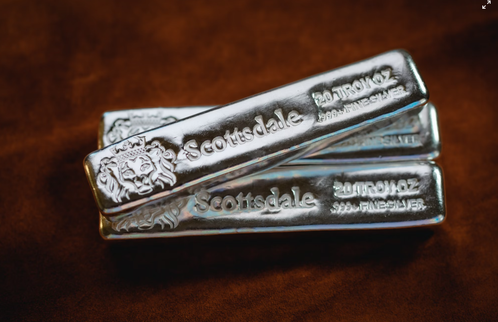
Silver prices remained steady just below $30 an ounce, after experiencing volatility earlier in April due to concerns over US tariffs. The prices fluctuated between $29.68 and $30.57 an ounce on Tuesday, maintaining a calm after the market was affected by the wider economic impact of the trade tensions, which had caused global stock market declines. The trade dispute raised concerns about a slowdown in global growth, which could reduce industrial demand for silver, a key factor in the metal's price dynamics. The White House also mentioned that 70 countries were engaging in negotiations to address trade tariffs, which could potentially lead to more balanced agreements and a reduction in market uncertainty.
From a technical perspective, silver's price drop last week resulted in a weakening Relative Strength Index (RSI), which suggests that the metal could be positioned for a rebound if favourable news emerges regarding US trade negotiations. Silver’s current price is significantly below its 20-day moving average, and should prices continue to decline, support levels around $28.95 and $28.58 an ounce are seen as potential points where the price could stabilize. Investors are closely monitoring these developments, as any progress in trade discussions could lead to a recovery in silver prices. Source
Gold prices experienced modest gains on Tuesday, trading near $3,000 an ounce as markets assessed the damage from recent equity market losses. Prices reached a high of $3,023 an ounce before falling back to $2,972 an ounce by the end of the day. This followed a sharp decline on Monday, when gold fell to its lowest level in three weeks, dipping below $3,000 for the first time since mid-March. The decline was driven by market uncertainty surrounding US tariffs, with investors liquidating gold positions to cover margin calls in the wake of the tariffs announced by President Trump.
Despite recent volatility, gold remains a favoured safe haven amid the ongoing trade tensions between the US and China. The US is set to impose 104% tariffs on certain Chinese goods, further escalating the trade war between the two largest economies. These uncertainties are keeping gold prices relatively buoyant, as investors seek protection from the potential fallout. Looking ahead, traders are focused on upcoming US inflation data and initial jobless claims, as these will provide insights into the future direction of interest rates and the broader economic outlook. Source
Gold has regained its status as a safe-haven asset as global trade tensions intensify, driven by President Trump's tariffs. Gold prices surged above $3,050 an ounce, rising more than 3% on the day, as U.S. long-dated bonds and equities saw significant sell-offs due to escalating trade conflicts. The U.S. has engaged in a tit-for-tat trade battle with China, imposing an 84% import tax, while the European Union has also implemented retaliatory tariffs on U.S. imports. The trade war, coupled with rising U.S. bond yields, has contributed to a historic sell-off in the bond market, creating an uncertain investment environment. Despite the rising yields on U.S. Treasury bonds, analysts have noted that gold remains a preferred safe-haven investment as concerns about U.S. fiscal stability and inflation grow.
The sharp rise in bond yields, which has reached its fastest pace in two decades, has prompted fears of forced liquidations in the bond market and highlighted the risks to financial markets. In contrast, gold's recovery is seen as a long-term trend, with central banks diversifying away from the U.S. dollar. Analysts expect continued safe-haven demand to support gold prices, with some predicting that gold could reach new all-time highs. As geopolitical tensions and economic instability persist, gold is expected to remain a key asset for investors seeking protection against market volatility. The potential for further market interventions by the Federal Reserve, such as quantitative easing and rate cuts, could also pave the way for gold to reach record highs in the near future. Source
Gold prices saw a significant surge on Wednesday, with gains exceeding $100 as safe-haven buying drove the market amid concerns over the stability of the U.S. Treasury market. June gold futures climbed to $3,106.10, while silver also saw a rise to $30.40. This surge was fuelled by anxiety surrounding the ongoing U.S.-China trade war and worries about the potential instability in the U.S. Treasury market. There were reports that large hedge funds had to unwind significant interest rate swap positions tied to U.S. Treasuries, particularly after expectations that the Trump administration would relax regulations on Treasury holdings, which did not materialize. Additionally, concerns over U.S. Treasury market leverage and potential selling by China and Japan due to trade tensions contributed to gold's appeal as a safer alternative.
The broader market dynamics were influenced by a weaker U.S. dollar and falling oil prices, alongside a spike in U.S. Treasury yields. Analysts noted that gold, traditionally competing with Treasuries for safe-haven status, could see continued support if concerns over U.S. Treasury stability persist. The technical outlook for gold indicates that the bulls are in control, with resistance levels around $3,125 and $3,150. Meanwhile, silver showed signs of a near-term price bottom, with a potential for further upside if prices surpass technical resistance at $32.00. The ongoing geopolitical and economic uncertainties are expected to continue driving demand for gold as a hedge against market volatility. Source
Gold prices surged over 3% following President Donald Trump's announcement to temporarily suspend the implementation of reciprocal tariffs, which were initially set to take effect at midnight. The unexpected move, which included a 90-day pause and a significantly reduced 10% tariff rate (down from previously planned higher rates), sparked a positive market reaction. Gold saw a substantial rally during New York trading hours, with June futures closing at $3,099.80 per ounce, recovering a portion of the losses incurred earlier in April due to escalating trade tensions. This policy shift also led to a dramatic rebound in U.S. equities, with the Dow Jones Industrial Average soaring by 2,900 points and the S&P 500 gaining 9.52%, marking its largest single-day percentage increase since 2008.
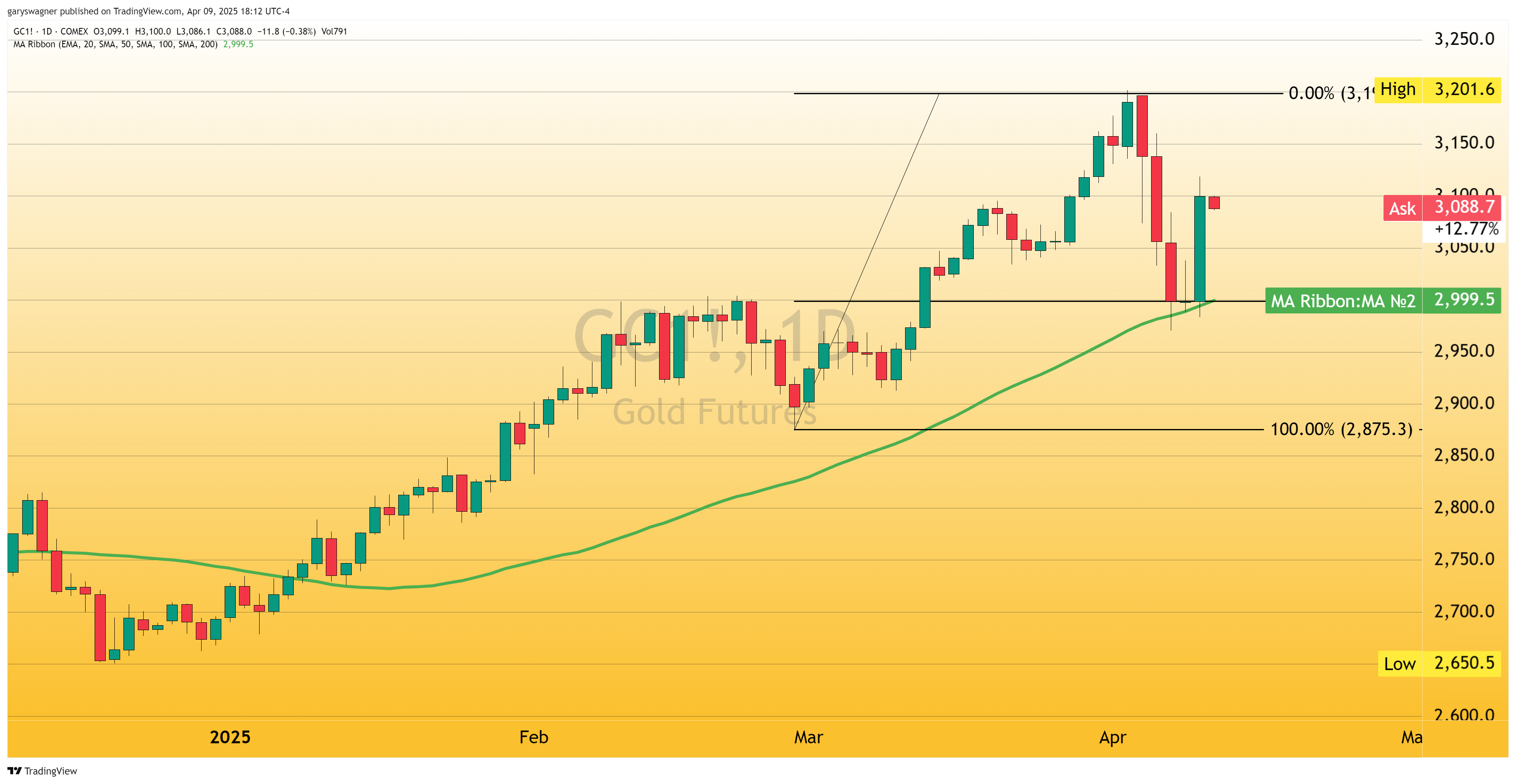
Image Source: Kitco News
The pause in tariff implementation provided temporary relief to global markets, which had been under significant pressure due to trade war fears. U.S. Treasury Secretary Scott Bessent clarified that most countries, except China, would see their tariff rates return to a 10% baseline, with sector-specific tariffs remaining unchanged. This announcement helped gold recover from a previous decline, with the World Gold Council reporting a notable increase in investment interest during the first quarter of 2025. Despite the short-term market gains, analysts caution that uncertainty remains regarding the long-term trajectory of U.S. trade policy, with investors closely watching the upcoming negotiations and their potential effects on inflation, supply chains, and global economic stability. Source
The minutes from the Federal Reserve’s March meeting indicate that the central bank is in no rush to cut interest rates, despite ongoing economic uncertainties and inflation pressures. Fed participants highlighted the high level of uncertainty regarding the effects of government policies on the economy and noted that inflationary pressures could persist longer than initially expected. While the U.S. economy and labor market remain solid, the Fed believes that its current restrictive monetary policy positions it well to wait for further clarity on inflation and economic activity before making any rate cuts. Despite these cautious comments, markets have largely focused on other economic concerns, especially the impact of President Trump’s broad import tariffs.
Gold prices have continued to hold solid gains, pushing above $3,000 per ounce, as investors remain focused on the economic chaos stemming from the tariffs rather than the Fed's minutes. The gold market saw a 2% increase in value, partly due to rising concerns about the impact of tariffs on the U.S. economy, including reduced business sentiment and a potential slowdown in consumer spending. While Trump's recent announcement of a 90-day pause on many tariffs helped to ease some market fears, analysts warn that the ongoing selloff in long-dated U.S. Treasury bonds could have a more lasting impact on the economy and may push the Fed to adopt more aggressive rate cuts or quantitative easing measures. This bond market volatility could continue to support gold prices as a safe-haven asset. Source
Nicky Shiels, Head of Research and Metals Strategy at MKS PAMP, has revised her outlook for precious metals, forecasting that gold will continue to outperform silver due to increasing global uncertainty and economic volatility. Shiels raised her gold price forecast for 2025 to an average of $2,950 per ounce, up from her previous estimate of $2,750. She cited the impact of recent tariff announcements, which have solidified the uncertain environment, driving demand for gold as a safe haven. While acknowledging that gold prices may experience higher volatility, Shiels believes that wealth destruction from economic slowdowns and rising inflation will ultimately drive gold prices higher, especially as stagflation pressures build and tariff uncertainties persist.
In contrast, Shiels downgraded her silver price forecast to an average of $34.50 per ounce, down from $36.50, as silver's industrial demand faces significant headwinds from a slowing global economy and ongoing trade tensions. While silver investment demand is expected to remain strong, it is likely to be overshadowed by these economic factors, limiting silver’s potential for significant price increases. Shiels sees silver fluctuating in the $28-$35 range unless a major catalyst, such as a shift in trade policies or a more dovish Federal Reserve, emerges later in 2025. The gold:silver ratio has reached a five-year high, reflecting gold’s stronger performance amid market instability. Source
Gold prices remain elevated above $3,000 an ounce, despite a temporary 90-day pause in global import tariffs announced by President Donald Trump. Spot gold was trading at $3,082 an ounce, showing a 3% increase on the day, while silver also saw a 4% rally. Analysts suggest that gold continues to be a strong safe-haven asset due to ongoing economic uncertainties, including recession fears in the U.S. and expectations for multiple Federal Reserve rate cuts. Even with improving sentiment in broader markets, driven by the tariff pause, gold's appeal as a hedge against volatility and market instability is likely to persist.
Although the tariff pause provides temporary relief, economists caution that the underlying trade tensions, particularly with China, remain unresolved. The U.S. will maintain baseline tariffs of 10% on several nations and impose a 125% duty on Chinese imports. This continued uncertainty is expected to weigh on global investment and economic growth, potentially leading to weaker decision-making in the coming months. Analysts foresee elevated market volatility and a slower economy, regardless of the tariff reprieve, keeping demand for gold high as a safe-haven investment. Source
Markets experienced a significant rally across multiple asset classes following President Donald Trump's announcement of a 90-day pause on non-China tariffs, sparking a broad recovery. The news triggered a sharp rise in equities, with the S&P 500 and Dow gaining 6% in just 15 minutes, while the Nasdaq saw a 6.5% jump. Bitcoin also benefited from the announcement, increasing by 3.34%. Precious metals, including gold and silver, had already been performing well before the news, with gold reaching an all-time high of $3,099 per ounce. After a brief dip in response to the announcement, gold quickly recovered to hover near $3,100 by the end of the session. Silver surged more than 4%, surpassing $31 per ounce.
In his announcement, Trump outlined a 10% baseline tariff for most countries, excluding China, which would face an escalated 125% tariff due to ongoing trade tensions. Treasury Secretary Scott Bessent emphasized that the move was a negotiating tactic aimed at bringing more than 75 countries to the table for trade talks. Despite the pause on tariffs for non-China nations, analysts noted that the U.S. would continue to target China with higher tariffs. The tariff changes sparked a positive market sentiment, reversing previous sell-offs and driving significant price movements in gold, silver, equities, and Bitcoin. Source
Disclaimer: These articles are provided for informational purposes only. They are not offered or intended to be used as legal, tax, investment, financial, or any other advice.
Featured Image - Source: Unsplash















