x



Image Source: Unsplash
Silver Price News: Silver Continues to Tread Water Despite Bullish Outlook
In contrast to the clear upward trajectory for gold, its precious metal peer continues to largely tread water at around $24 an ounce.
Given the typically close correlation between the two precious metals, these contrasting moves are particularly difficult to fathom considering the same factors that are supposedly boosting gold (a weaker US dollar and the prospect of rate hikes ending soon) should also be supportive for silver.
Add in the fact that silver’s fundamental outlook is also bullish, with demand currently outstripping supply, then silver’s lack of price movement is even more puzzling still. Read More
The ‘Golden Cup’ Revisited
A massive “cup/handle” chart pattern has formed in the gold market, with the “cup” extending from late 2011 to August 2020 and the subsequent “handle” forming between late 2020 and the present.
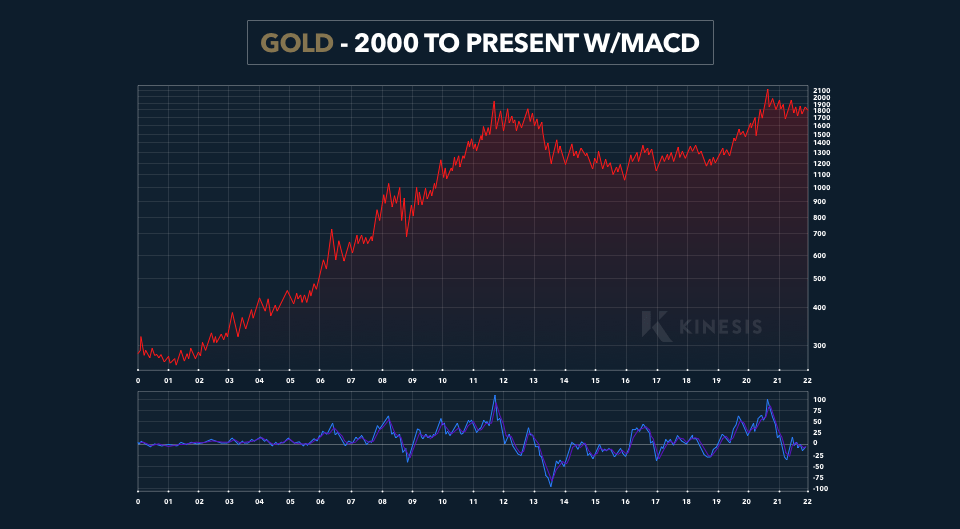
Image Source: Kinesis
Gold price($/oz) from 2000-present – with Moving Average Convergence/Divergence Indicator
The cup/handle technical pattern generally occurs over much shorter time periods and is regarded as a bullish continuation pattern that marks a consolidation period followed by a breakout.
In the chart above, the Moving Average Convergence/Divergence (MACD) momentum indicator is slightly oversold because the way it is set up reinforces the technical argument for a prospective move higher in gold.
The cup/handle pattern which has formed over a 10-year time frame is likely to be extraordinarily bullish. A colleague of mine, who is well-schooled in technical analysis explains:
“the psychology underlying the cup/handle formation is that investors who buy on the left side of the cup, only to see their investment decline in value, will hold until the right side is formed; they sell in the handle because they ‘got back to even.'” Read More
Gold, silver see two-sided trade ahead of U.S. CPI
Gold prices are a bit higher and silver prices are a bit lower in midday U.S. trading Wednesday. Gold prices did score a seven-month high overnight. Positioning ahead of a key U.S. inflation report was featured at mid-week. February gold was last up $3.40 at $1,879.80 and March silver was down $0.10 at $23.57.
Traders are awaiting the U.S. data point of the week, due out Thursday morning: the consumer price index report for December. The CPI headline number is expected to come in at up 6.5%, year-on-year, which compares to the 7.1% rise reported in the November report. A bigger miss to the upside or downside on the CPI headline number would very likely significantly move many markets.
Technically, February gold futures prices hit a seven-month high again today. Bulls have the solid overall near-term technical advantage. A two-month-old uptrend is in place on the daily bar chart. Bulls’ next upside price objective is to produce a close above solid resistance at the $1,900.00. Bears' next near-term downside price objective is pushing futures prices below solid technical support at $1,800.00. First resistance is seen at today’s high of $1,890.90 and then at $1,900.00. First support is seen at this week’s low of $1,869.30 and then at $1,850.00. Wyckoff's Market Rating: 8.0.
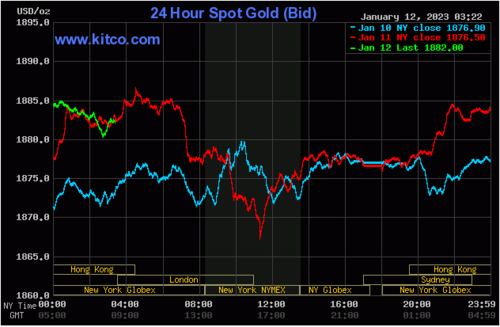
Image Source: Kitco News
March silver futures bulls have the firm overall near-term technical advantage. However, a four-month-old uptrend on the daily bar chart has stalled out again. Silver bulls' next upside price objective is closing prices above solid technical resistance at $25.00. The next downside price objective for the bears is closing prices below solid support at $22.00. First resistance is seen at $24.00 and then at this week’s high of $24.285. Next support is seen at the January low of $23.26 and then at $23.00. Wyckoff's Market Rating: 7.0. Read More
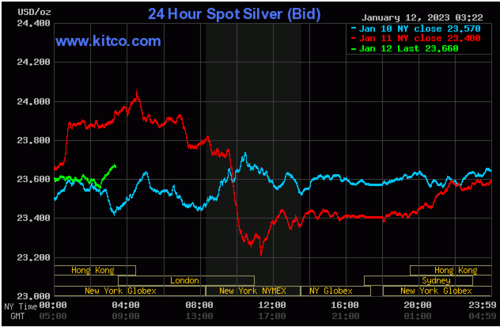
Image Source: Kitco News
Nouriel Roubini says gold may be your best protection as the mother of all debt bombs & nine other megathreats are looming
Ten “megathreats” are hurtling towards the world including war, debt crises, and a demographic “time bomb” will make investors flock to gold, hence causing the yellow metal’s price to rise to $3k by 2028, according to Nouriel Roubini, CEO of Roubini Macro Associates and Professor Emeritus at NYU Stern School of Business.
“Over the next few years, I would expect that gold could have high single-digits into low double-digits rates of return,” he said. “I expect… rates of return around 10 percent per year over the next five years.”
Inflation, stagflation and a trend towards ‘de-dollarization’ will be the main drivers.
“If the rivals of the U.S. have to diversify away from dollar assets because we weaponize the dollar and sanctions can be imposed, then the only international reserve asset that cannot be seized by the U.S. and the West is not the dollar, Euro, yen, or pound,” he said. “It can only be gold.”
He forecast gold to rise by 10 percent per year over five years, resulting in a gold price of over $3,000 per ounce, an overall return of 60 percent.
Roubini, also known as ‘Dr. Doom’ for his grim economic forecasts and for correctly predicting the 2008 financial crisis before it occurred, said that a “stagflationary depression” could begin in 2023, which would cause both stocks and bonds to decline.
“If I am right, that we will have a hard landing, that inflation is going to be persistent, and that central banks are in a dilemma, [then] both equities and bonds will do poorly,” he predicted. “Gold should do better because… it is a hedge against inflation. It is also a hedge against financial instability, and a hedge against social, political, and geopolitical stability.”
Roubini spoke with Michelle Makori, Editor-in-Chief and Lead Anchor at Kitco News. Read More
Billionaire 'Bond King' Jeff Gundlach: time to own gold, yield curve 'screaming' recession
DoubleLine Capital CEO Jeffrey Gundlach turned bullish on gold after it crossed the $1,800 an ounce level and believes it is a good time to purchase and hold the precious metal.
Gold did well in non-dollar terms last year, but recently gold started to perform in U.S. dollar terms as well, Gundlach said during his 'Just Markets' webcast Tuesday.
"Over the past two and a half years, you haven't had much action in gold other than sideways. In other currencies, gold has done quite well. And now, as the dollar is weakening, gold is back, and it is above its 200-day moving average," Gundlach said.
Gold is one of Gundlach's recommendations for assets to own in 2023. "It's a reasonably good time to buy gold and own gold. One of my recommendations … to own was gold, which I turned bullish on back at about $1,800 or so. We're not very far above that right now," he said.
February Comex gold futures were last trading at $1,873.60, down 0.15% on the day.
Helping gold out this year will be a lower U.S. dollar, which has already peaked in 2022, according to Gundlach, who does not see the U.S. dollar index returning to 115. At the time of writing, the index was at 103.30. Read More
Cooling U.S. CPI could push gold prices above $1,900, but now is not the time to chase the market - analysts
After gold's strong start to the year, momentum is beginning to fade as the $1,880 level has proven to be stubborn resistance.
However, sentiment remains reasonably bullish in the marketplace as some analysts expect weak inflation data to drive prices above $1,900 an ounce by the end of the week.
Thursday, U.S. Labor Department will release its much-anticipated Consumer Price Index and economists expect that prices significantly cooled in December. Annual inflation is forecasted to rise 6.5%, down from 7.1% reported in November.
"A further cooling in prices in December and lower bond yields would be a welcome development for zero-yielding gold. Looking at the technical picture, bulls remain in a position of power with the next key level of interest found at $1900," said Lukman Otunuga, senior research analyst at FXTM.
In an email to Kitco News, Ole Hansen, head of commodity strategy at Saxo Bank, said that while gold has a chance of popping above $1,900 an ounce ahead of the weekend, he does see some downside risks starting to emerge.
Hansen explained that a soft CPI print could already be priced into the market. Read More
Gold will hit new highs in 2023, but the stock market will suffer for years - Peter Grandich
Peter Grandich, who correctly predicted the market crashes for both crypto and stocks in 2022, just shared his predictions for 2023 with Kitco News. The veteran investor said that while he sees weakness across most markets for the foreseeable future, there are still undervalued assets that he expects to outperform.
Grandich told Kitco News anchor David Lin that as far as the stock market is concerned, he sees a bear market lasting many years. "I'll go far to say that I don't think we'll ever make a new high in my lifetime now," Grandich said. "I really think it's going to be very difficult for several years for the stock market to have double digit gains." Read More
Market participants pause as they wait for tomorrow's inflation report
It is a given that the potential for inflation to decline in the December report. The assumption that inflation continues to diminish and has for the most part been factored into market pricing. Tomorrow's Consumer Price Index will occur after the strong and hawkish speech by Chairman Powell delivered yesterday at a central bank conference in Sweden.
Powell's speech did not contain new insights or flexibility that was not already addressed. It did serve to reinforce the steadfast commitment that has only strengthened over the last few months. One nuanced topic he has avoided until yesterday was that the Fed must make unpopular decisions to stabilize prices. While the words, for the most part, were different, the message continues to be the same, "The Fed is committed to maintaining interest rates at an elevated level." This idea is etched in stone.
One topic that has been absent until yesterday was that the pressure from politicians will not influence Fed policy. During his speech Chairman Powell said, "The absence of direct political control over our decisions allows us to take these necessary measures without considering short-term political factors".
There has been no change by the Federal Reserve to deviate from its current objective which is to take its benchmark rate to just above 5% and maintain an elevated level throughout the entire year. Read More
.png)
Disclaimer: These articles are provided for informational purposes only. They are not offered or intended to be used as legal, tax, investment, financial, or any other advice.















