x




The global economic outlook for 2025 appears challenging, with the World Bank projecting a slowdown in growth for 70% of economies worldwide. This widespread deceleration is attributed to factors like policy uncertainty and fragmentation in trade relations, including heightened tariff actions. The World Bank has specifically cut its forecast for global GDP growth in 2025 to 2.3%, a significant decrease from its earlier January estimate of 2.7%. If these conditions persist, the average global growth in the first seven years of the 2020s could be the slowest since the 1960s, indicating a protracted period of economic headwinds.
Despite the gloomy global economic forecast, precious metals such as gold, silver, and platinum are expected to defy this trend, with the World Bank predicting an increase of over 30% in their prices during 2025. This divergence is likely driven by their traditional role as safe-haven assets amidst economic uncertainty and geopolitical conflicts. While India is projected to maintain the fastest growth rate among major economies, even its growth forecast for FY26 has seen a slight dip due to subdued industrial growth and export demand, highlighting the pervasive nature of the global economic slowdown. Source
Despite a potential summer holding pattern, the gold market is positioned to retest and surpass its April all-time highs by year-end, according to Chantelle Schieven, Managing Director at Capitalight Research. While the U.S. economy and labor market have shown resilience and inflation has been relatively contained, underlying factors suggest an impending shift. Schieven highlights that U.S. consumers and the broader economy have been sustained by surplus inventories, accumulated in anticipation of escalating global trade conflicts, particularly with President Donald Trump's tariff policies. As these inventories are rapidly depleting, consumers are expected to increasingly feel the impact of higher tariffs, contributing to economic uncertainty that historically benefits gold.
The bullish outlook for gold is further reinforced by a confluence of factors beyond just U.S. economic conditions. Global trade tensions and the ongoing trend of de-dollarization are significant drivers for gold's appeal as a safe-haven asset. Moreover, persistent central bank demand for gold, which has been consistently strong, acts as a critical price floor and dampens downside volatility. With global debt levels reaching record highs and the Federal Reserve still anticipated to implement interest rate cuts, gold's attractiveness as a non-yielding asset is enhanced. These combined tactical and structural factors suggest that gold's price floor has fundamentally shifted higher, with some analysts forecasting the metal could even approach $4,000 per ounce under certain macroeconomic conditions like stagflation and accelerated de-dollarization. Source
Gold prices are projected to reach a new high of $3,600 per ounce by the end of 2026, according to Wells Fargo's mid-2025 outlook report. The financial institution attributes this bullish forecast to the ongoing geopolitical conflicts and persistent economic uncertainty around the globe. Wells Fargo analysts believe that recent corrections in commodity prices have created attractive opportunities for investors to position themselves for an improved economic environment later in 2025 and into 2026, with an anticipated increase in U.S. economic activity driving demand for commodities. This reinforces gold's traditional role as a safe-haven asset during periods of instability.
Wells Fargo anticipates that these uncertainties will continue to drive significant gold purchases by both private investors and global central banks over the next two years. Central banks alone are expected to account for a substantial 21% of global gold demand by 2026, highlighting their pivotal role in supporting gold prices. While the report suggests a mild pullback in gold prices to the $3,000-$3,200 range by the end of 2025, a strong rebound is expected to propel the precious metal to $3,600 per ounce by the close of 2026. The bank also points to lower short-term U.S. interest rates and a mild rebound in the U.S. dollar as factors that will further reinforce price uptrends in precious metals, though they caution investors to be patient and buy on price dips due to elevated market optimism. Source
Gold prices surged to a session high after the release of U.S. Consumer Price Index (CPI) data for May showed a cooler-than-expected inflation rate. Headline inflation rose 2.4% year-over-year, slightly below the 2.5% forecast and a decrease from April's 2.3%. Core CPI, which excludes volatile food and energy prices, remained at 2.8%, missing expectations of a rise to 2.9%. On a monthly basis, both CPI and core CPI increased by just 0.1%, significantly undershooting previous estimates. This subdued inflation outlook immediately boosted demand for non-yielding assets like gold, as lower inflation typically leads to expectations of lower interest rates, making gold a more attractive investment.
However, some of gold's initial gains were tempered by optimistic news regarding U.S.-China trade relations. President Trump's statements about a "done deal" on a trade agreement, which includes the removal of China's export restrictions on rare earths, lifted overall market risk sentiment. While the softer CPI data strongly supported gold due to the increased probability of a Federal Reserve interest rate cut, the positive trade developments partially offset this by reducing safe-haven demand. Despite this, gold found support around the $3,340 per troy ounce level, indicating that while market sentiment is balancing various factors, the underlying macroeconomic conditions still favour the yellow metal. Source
Silver has achieved a significant technical breakout, pushing above its 13-year resistance level of $35 per ounce and recently touching $37. David Erfle, founder of Junior Miner Junky, notes that this weekly close above $35 is a crucial technical signal, turning that price into a key support level. He draws a historical parallel to 2011, when silver broke above $35 on a weekly basis and rapidly reached its all-time high of $50 in less than six weeks, emphasizing silver's characteristic for "very quick" and "very violent" moves. A sustained quarterly high close above $37.50 this month could pave the way for $40 and a potential test of the $50 all-time high later this year. The gold-silver ratio, which recently soared to triple digits, is also seen as a strong indicator for much higher silver prices to come.
Crucially, silver miners have been leading the metal higher, a trend that Erfle highlights as typical, where miners often foreshadow the movement of the commodities they produce. Ahead of silver's price breakout, the silver miner ETF (SIL) registered a multi-year closing high, signalling the imminent breach of the $35 resistance. Following the breakout, the higher-risk silver junior miner ETF (SILJ) surged above its multi-year resistance at $14 with substantial volume, a performance described as "very encouraging for silver stocks," with many hitting 52-week highs. The article also discusses turnaround stories at America's Gold and Silver and McEwen Mining, alongside developments like Taseko's New Prosperity project and a significant drill discovery by Power Metallic Mines, all contributing to a bullish sentiment in the silver and precious metals mining sector. Watch the podcast
Gold has officially surpassed the euro to become the second-largest reserve asset held by central banks globally, a significant shift highlighted by new data from the European Central Bank (ECB). In 2024, central bank gold holdings reached 20% of global official reserves, exceeding the euro's 16% and nearing levels last seen during the Bretton Woods era. This unprecedented surge in demand, with central banks acquiring over 1,000 tonnes of gold for the third consecutive year in 2024 (twice the average of the 2010s), is primarily driven by their need for portfolio diversification, a hedge against economic risks like inflation and cyclical downturns, and increasingly, as protection against geopolitical risks. The ECB's report underscores that gold is now seen as an ultimate safe-haven asset, offering liquidity, freedom from counterparty risk, and less susceptibility to sanctions.
The sustained and robust central bank demand for gold is expected to significantly impact the future growth of the global gold supply and its price. Nations are increasingly turning to gold to reduce their reliance on the U.S. dollar amid rising geopolitical tensions and the weaponization of finance, a trend accelerated since the 2022 invasion of Ukraine. Countries like China, India, and Turkey have been among the largest buyers, contributing to the substantial increase in global gold reserves, which are now near their 1965 peak. While gold purchases for jewelry and investment still constitute the majority of global demand, the consistent official sector buying provides a strong floor for gold prices, reflecting a fundamental shift in its status within the international monetary system. Source
Australian gold producers are strategically leveraging record-high gold prices, even if it means a short-term reduction in overall output, according to a recent report from Surbiton Associates. In the March quarter of 2025, Australia's gold mine production saw a 7% decrease from the previous December quarter, settling at 73 tonnes. However, this still marks a 4% increase when compared year-on-year to March 2024. Dr. Sandra Close, a director at Surbiton Associates, clarified that this production dip is a direct consequence of the elevated gold prices. Producers are actively lowering their cut-off grades, enabling them to process lower-grade ore that was previously uneconomical. This strategy allows them to maximize the recovery of gold from existing ore bodies and blend in more low-grade material from stockpiles, even if it results in a lower average head grade and, consequently, less gold produced in the immediate term.
Despite the reduced production figures, Australian gold producers are enjoying substantial financial gains and robust margins. The value of the gold produced in the March quarter exceeded A$12 billion, underscoring the high profitability driven by current gold prices. While an immediate surge in production from new projects might be expected with higher prices, many existing treatment plants are already operating at near full capacity, limiting immediate expansion. Nevertheless, the sustained high gold prices are anticipated to stimulate increased investment in exploration, particularly greenfield exploration, which is crucial for the long-term health and growth of the mining sector. The report concludes that the Australian gold industry remains in a strong position, benefiting from significant margins and adapting its operational strategies to optimally capitalize on the ongoing high gold prices. Source
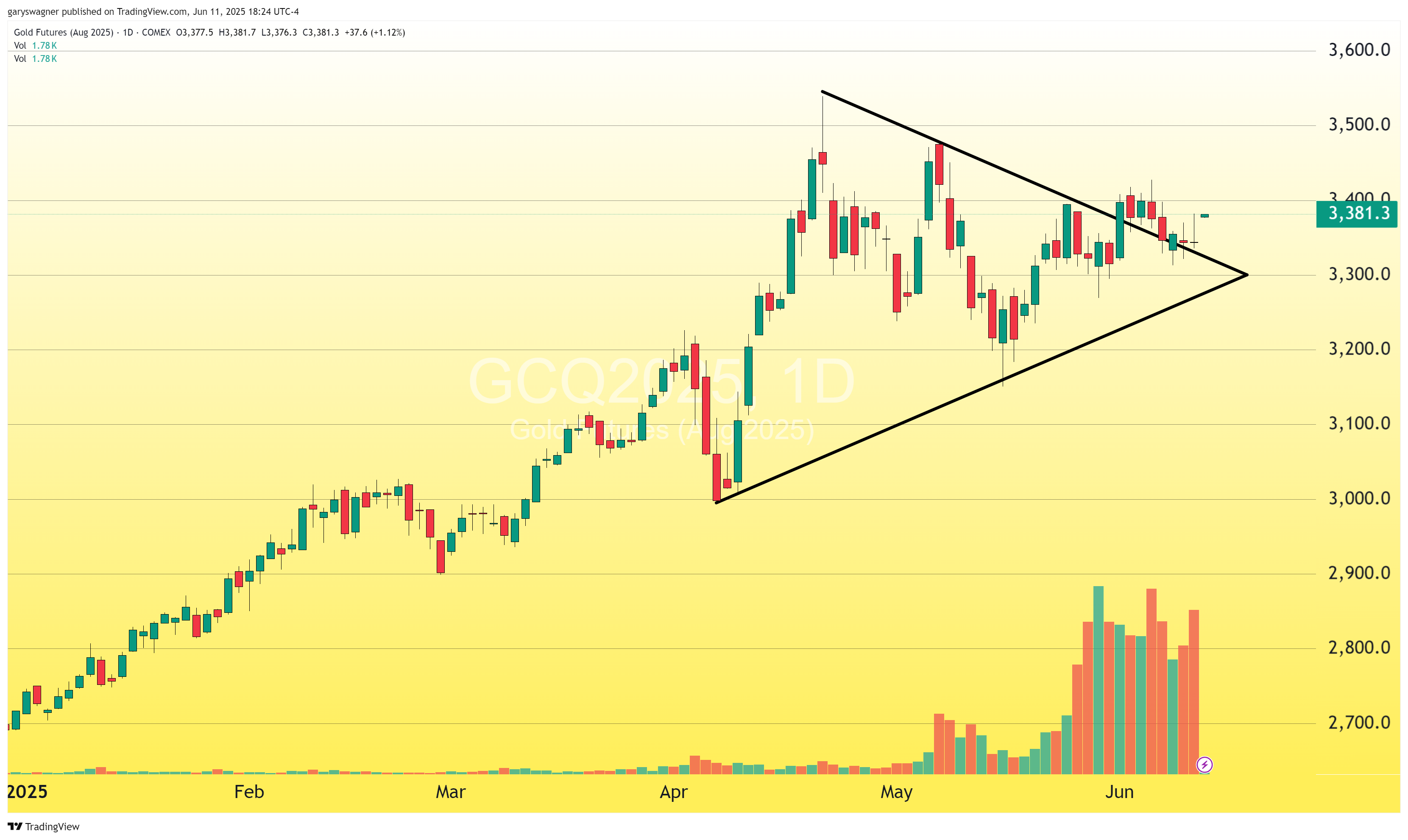
Image Source: Kitco News
Gold prices demonstrated significant strength on Wednesday, with the August contract climbing to $3,378 per troy ounce, reflecting a persistent global demand for the safe-haven asset. This rise occurred even as notable diplomatic progress was made, particularly President Trump's announcement of a provisional trade agreement with China following negotiations in London. The deal aims to alleviate protracted trade tensions by easing export controls on strategic materials, with China lifting its rare earth restrictions and the U.S. relaxing semiconductor export limitations. However, the trade environment remains complex due to Beijing's concurrent imposition of a six-month limit on rare-earth export licenses for U.S. automakers, sending mixed signals to investors.
The rally in gold was further propelled by a weakening U.S. dollar and more subdued inflation data. The U.S. Consumer Price Index (CPI) for May registered a lower-than-expected month-over-month increase of just 0.1%, leading to heightened expectations of potential interest rate cuts by the Federal Reserve. While lower inflation typically diminishes gold's attractiveness as an inflation hedge, its continued ascent highlights its growing role as a hedge against geopolitical uncertainty and currency volatility. Analysts from Saxo Bank emphasize that gold's upward trajectory, even with easing trade tensions, is being driven by factors such as strong investor interest in U.S. 10-year notes, sustained central bank demand, and ongoing demand for investment metals, indicating that the market recognizes persistent risks beyond immediate diplomatic breakthroughs. Source
Gold prices saw mild gains on Wednesday, though retreating from their daily highs, after the release of the U.S. Consumer Price Index (CPI) for May, which showed inflation cooling more than expected. The headline CPI rose 2.4% year-on-year, aligning with market expectations and only slightly up from April's 2.3%. Crucially, core CPI, excluding volatile food and energy, remained at 2.8% year-on-year, consistent with April's figure and not signaling problematic price inflation down the road. This tame inflation report fueled expectations that the Federal Reserve might adopt a more dovish monetary policy, potentially leading to interest rate cuts, which generally supports non-yielding assets like gold.
However, the rally in gold was somewhat mitigated by news of a potential framework for restoring U.S.-China trade relations following two days of negotiations in London. While no specific details were provided, the news somewhat lifted trader and investor spirits, reducing immediate safe-haven demand for gold. Despite this, gold bulls maintain a near-term technical advantage, with August gold futures finding support around key levels. The article also touches upon the broader economic context, noting that the World Bank has cut its forecast for U.S. economic growth in 2025 by half due to tariffs and trade wars, forecasting 1.4% growth for the U.S. and 2.3% for global economic growth, down from earlier predictions. Source
The silver market is on the cusp of experiencing "mini-squeeze events" that could drive its price to $40 per ounce this year, primarily due to an unresolved structural imbalance between the London and New York trading centers, according to Daniel Ghali, Senior Commodity Strategist at TD Securities. Ghali explains that the London market is facing a critical shortage of physical silver that is freely available for purchase, with less metal accessible than is typically traded on a given day. Conversely, New York holds an oversupply of silver. This unusual disparity, which has been exacerbated by concerns over tariffs earlier in the year that prompted a shift of silver from London to New York, is creating a scenario ripe for price dislocations. Ghali notes that while prices in London don't accurately reflect this shortage, the market structure strongly supports future "mini-squeeze events" to correct this imbalance.
Ghali elaborates that such mini-squeezes could be necessary to force physical silver prices in London to rise more significantly than those on the U.S. futures market, ultimately balancing the two regions. He points out that silver has recently broken through the $35 per ounce level, a resistance point that has been difficult to overcome in recent years, and past instances of such breakouts have led to rapid price surges. The ongoing market instability and the critical scarcity of physical silver in London, coupled with an oversupply in New York, are setting the stage for these squeeze events. These dynamics, alongside the broader excitement in the silver market following its recent price action, lead Ghali to predict that silver prices will continue to increase by about 10% in 2025, potentially reaching $40 per ounce by year-end. Source
Disclaimer: These articles are provided for informational purposes only. They are not offered or intended to be used as legal, tax, investment, financial, or any other advice.
Featured Image - Source: Unsplash















