x



Image Source: Unsplash
Hawkish Comment From the Fed is Curbing Gold Recovery
Every time that stock markets try to rebound, new fears about a hawkish Fed curb the bullish impulse, while the U.S. Dollar remains strong against all the major currencies.
This has been the main story of the last few weeks, which is also having a negative impact on the precious metal sector. Indeed, the gold price, after having rebounded above $1,730 in the first few days of October, has slowed down to $1,670. Note that in the early trading this morning, there was an interesting rebound to $1,680. Read More
Silver Suffers Strength of Dollar but Remains Trading Above $19
After the rally posted earlier this month, the silver price has slowed down, returning to the support zone of $19-19.20. Silver has shown a positive correlation with the stock markets and an inverse one with the greenback.
Indeed, the decline of silver is related, once again, to the strength of the U.S. Dollar and expectations for a further rate increase from the Federal Reserve.
From a technical point of view, after having reached a peak above the $21 mark on the 4th of October, silver has lost ground, and tested again the key level of $19-19.20, where the prices seem to have found solid support. Indeed, in the early trading this morning the precious metal rebounded to $19.30, showing buyers’ interest in silver. Read More
U.S. economy is slowing, but the Fed will continue to raise rates, keeping gold prices down - Heraeus
The U.S. economy continues to lose momentum and the threat of a recession continues to grow; however, the Federal Reserve will continue to tighten its monetary policies, which could keep gold prices lower for longer, according to one precious metal firm.
Although gold prices have managed to bounce off their recent two-year lows, the precious metal remains trapped around $1,700 an ounce. December gold futures last traded at $1,686.10 an ounce, up 0.66% on the day.
In their latest precious metals report, commodity analysts at Heraeus Precious Metals warned investors that the gold market could continue to struggle through year-end as rising interest rates support the U.S. dollar.
"The longer the Fed continues on its current path, the longer that a strong dollar will depress the gold price," the analysts at the European precious metals firm said. Read More
New bill introduced to bring the U.S. back to the gold standard to control gov't spending and inflation
One American politician proposes bringing stability back to the U.S. economy and its currency by introducing a new gold standard.
Last week, U.S. House Representative Alex Mooney (R-WV) introduced the Gold Standard Restoration Act. The bill looks to peg the U.S. dollar to gold to address the growing inflation threat, massive deficit spending and instability within the U.S. monetary system.
"The gold standard would protect against Washington's irresponsible spending habits and the creation of money out of thin air," said Rep. Mooney in a statement.
"Prices would be shaped by economics rather than the instincts of bureaucrats. No longer would our economy be at the mercy of the Federal Reserve and reckless Washington spenders," Mooney added.
The bill noted that the dollar, referred to as the Federal Reserve note, has lost more than 30% of its purchasing power since 2000. At the same time, the U.S. has lost 97% of its purchasing power since the Federal Reserve Act was passed by congress in 1913.
The proposed legislation would require the Federal Reserve and the U.S. Treasury to disclose all records pertaining to the government's gold reserves and gold-related transactions over the last 60 years. Read More
Gold, silver down on technical selling, bearish outside market elements
Gold and silver prices are lower in midday U.S. trading Wednesday and feeling the heat of recently bearish outside markets that include rising U.S. bond yields and a strong U.S. dollar index. Lower crude oil prices today added to the bearish cocktail for the metals. The near-term technical postures for gold and silver have turned more bearish recently, which is also inviting the shorter-term chart-based sellers. December gold was last down $11.30 at $1,674.70 and December silver was down $0.627 at $18.865.
Today’s U.S. producer price index report for September came in a bit hotter than expected at up 0.4% from August and up 8.5%, year-on-year. The metals markets showed no major reactions to the PPI report. The U.S. consumer price index on Thursday morning is expected to come in at up 8.1%, year-on-year, following a rise of 8.3% in August.
Technically, the gold futures bears have the solid overall near-term technical advantage. Bulls’ next upside price objective is to produce a close above solid resistance at the October high of $1,738.70. Bears' next near-term downside price objective is pushing futures prices below solid technical support at the September low of $1,622.20. First resistance is seen at Tuesday’s high of $1,691.30 and then at $1,700.00. First support is seen at this week’s low of $1,667.50 and then at $1,650.00. Wyckoff's Market Rating: 2.5.
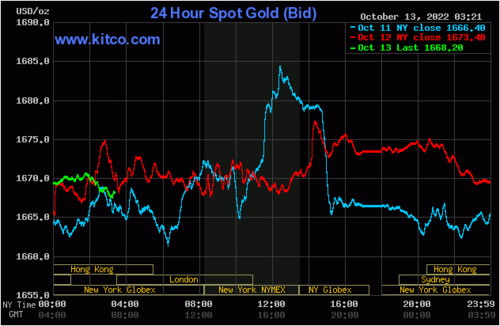
Image Source: Kitco News
The silver bears have the solid overall near-term technical advantage. Silver bulls' next upside price objective is closing prices above solid technical resistance at $20.00. The next downside price objective for the bears is closing prices below solid support at $18.00. First resistance is seen at today’s high of $19.31 and then at Tuesday’s high of $19.725. Next support is seen at $18.50 and then at $18.00. Wyckoff's Market Rating: 2.5. Read More
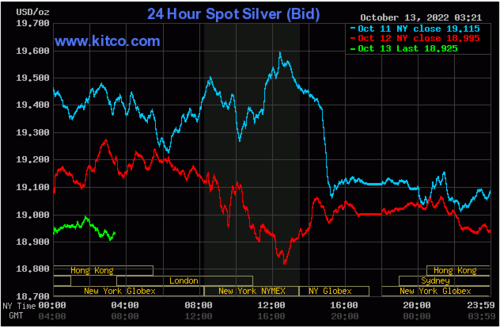
Image Source: Kitco News
U.S. dollar is not letting gold go as Yellen endorses greenback's rally, Biden downplays recession risk
The surging greenback is keeping gold on a very tight leash. And with U.S. Treasury Secretary Janet Yellen giving a nod of approval to the dollar rally, more gains could be in store, while gold analysts warn of another significant move down in the short term.
Gold is now stuck below $1,700 an ounce, and there is a growing risk of a drop below $1,600. The main drivers suppressing gold's price action include the aggressive tightening by the Federal Reserve and the U.S. dollar index trading near 20-year highs. December Comex gold futures were last at $1,675.00, down 0.65% on the day.
On top of the already immense gains of 18% year-to-date, the U.S. dollar advance received a further endorsement from Yellen, who described it as a "logical outcome" in light of what the Fed is doing compared to other central banks.
"A market determined value of the dollar is in America's interest," Yellen told CNBC Tuesday. "The currency movements are a logical outcome of different policy stances."
Yellen was responding to whether U.S. officials needed to intervene to halt the greenback's move higher. She also described the current U.S. dollar strength as "appropriate." Read More
Gold prices remain down as Fed stays committed to reducing inflation even as economy slows - FOMC minutes
The gold market remains under pressure but is not seeing any new price action as the Federal Reserve remains committed to tightening its monetary policy to cool down the growing inflation threat.
Although the U.S. central bank sees growing downside risks to the economy, the minutes of the September monetary policy meeting show that the committee remains focused on bringing inflation down by raising interest rates.
“Participants reaffirmed their strong commitment to returning inflation to the Committee’s 2 percent objective, with many stressing the importance of staying on this course even as the labor market slowed,” the minutes said.
According to some market analysts, the latest minutes did not reveal much new information on U.S. monetary policy. Read More
Fed minutes reveal high inflation concern only one year too late
The primary driver influencing pricing on multiple asset classes including gold is the fact that inflation remains persistent at a 40-year high. The circumstances that brought the global economy to its knees during the beginning of 2020 was a black swan event. It began as a global pandemic that effectively shut down the world’s economy and led to a major global recession.
By definition, a black swan event is an unpredictable event that is beyond what is normally expected and has potentially severe consequences. However, the actions following the event specifically by central banks and the Federal Reserve absolutely had a predictable effect and outcome.
While the Federal Reserve could not control what happened, its actions and policies exacerbated the problem. They created an environment that let us get to a level of inflation not seen in 40 years. The current level of inflation is so high that 30% of the world’s population (those 40 years are under) have never witnessed a diminished purchasing power of their wages to this extent. Currently, inflation has affected the entire global economy with the Consumer Price Index in the United States at 8.3%, and in the Eurozone at 10%.
Today the Federal Reserve released the minutes from last month’s FOMC meeting revealing the obvious; inflation is not falling as fast as they had expected. The minutes highlighted their concern that the current level of high inflation is unacceptable making their current aggressive monetary policy the best strategy which will contain less risk to the economy than doing too little. Read More
Gold is a 2023 story, but these are the currencies to buy it in right now
Gold is down 8% year-to-date, and there might not be enough momentum to reverse course this year. But that's only the case for gold priced in U.S. dollars, according to Pepperstone's head of research Chris Weston. Here are the currencies that should be on your radar.
There's been a big debate about gold as an inflation hedge, especially after it pulled back from the $2,000 an ounce level posted in March. But the disappointing price action does not mean that gold failed, Weston told Kitco News. It is all about inflation expectations for gold, which have been low, while the CPI numbers have been at 40-year highs.
"Gold is a hedge against expected inflation rather than realized inflation," Weston said Tuesday. "Gold's held up pretty well relative to real rates. People are looking at the wrong type of inflation. It's more about inflation expectations and breakeven rates. If you look at five-year breakeven rates, they reached a high of around 3.76% in March and then came back to 2.43%."
Using this correlation between gold and breakeven rates, Weston sees gold's fair value below $1,600 an ounce. At the time of writing, December Comex gold futures were trading at $1,679.70, down 0.37% on the day. Read More
.png)
Disclaimer: These articles are provided for informational purposes only. They are not offered or intended to be used as legal, tax, investment, financial, or any other advice.















