x





US banks borrowed 6.5 billion from the Federal Reserve's Standing Repo Facility on Wednesday, marking the largest daily usage outside of quarter-end periods since the COVID-19 pandemic, signalling a tightening of funding availability, likely due to a large volume of US Treasuries settlements due this week. The SRF provides overnight cash loans against collateral like Treasuries and serves as a liquidity backstop. Concurrently, the general collateral repo rate, the cost of short-term cash borrowing, rose to a high of 4.36% on Wednesday. This rise in repo rates is considered unusual by traders for a mid-month period, suggesting that overall market liquidity is gradually decreasing. Analysts point out that the aggressive issuance of shorter-term debt by the Treasury, leading to large settlement payments to the government, drains cash from the private sector and reduces available reserves, consequently making cash more expensive to borrow in the repo market and driving rates higher.
This developing funding pressure comes as Federal Reserve Chair Jerome Powell has indicated that the central bank's program of quantitative tightening, which aims to shrink its asset holdings, may be approaching its conclusion soon. The Fed has acknowledged that liquidity conditions are gradually tightening, evidenced by the firming of repo rates and temporary pressures on certain dates. Strategists suggest that the continuous tapping of the SRF facility should prompt the Fed to pay closer attention to market conditions and consider announcing the end of quantitative tightening, potentially as early as the October meeting. Source
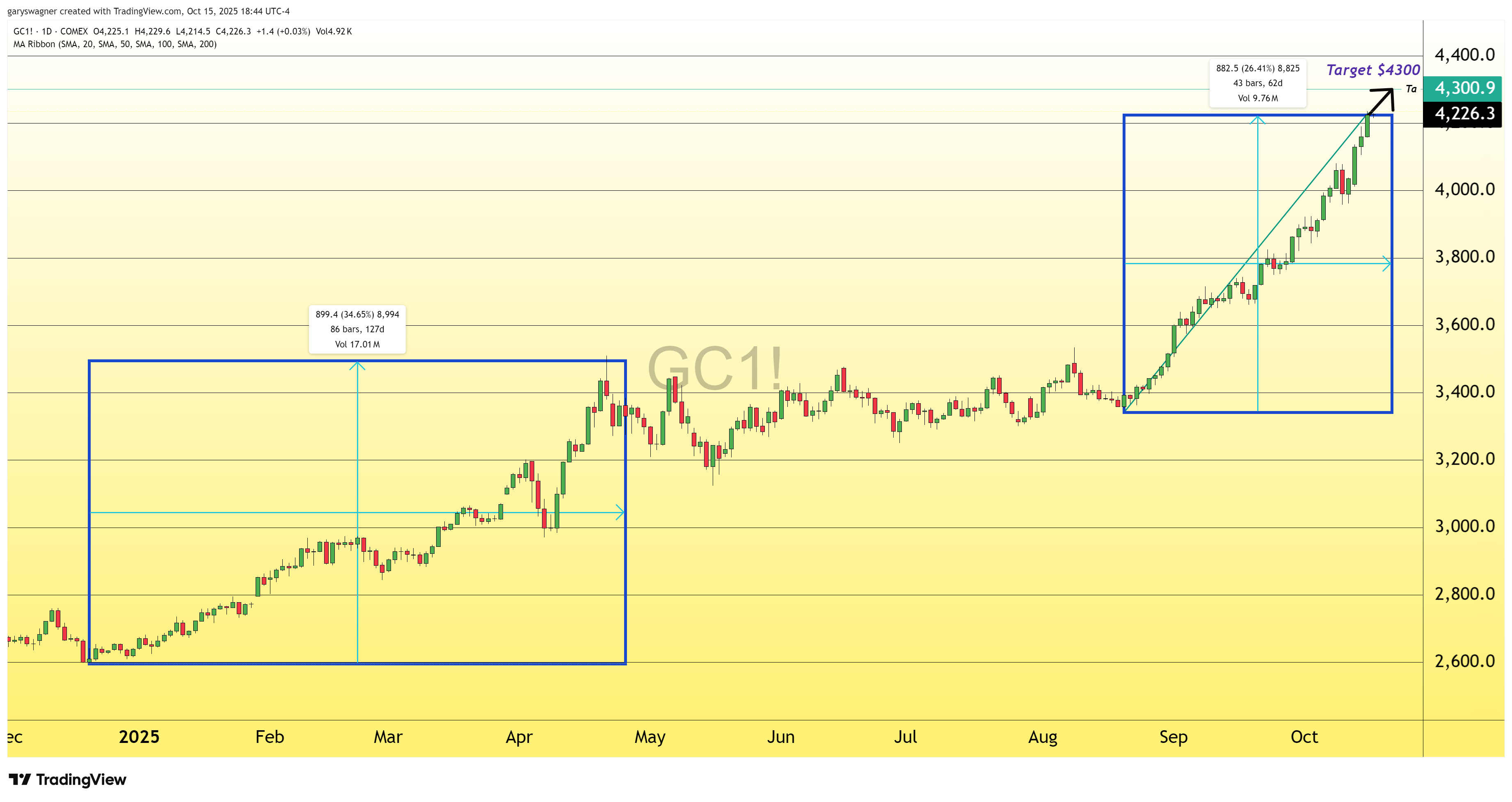
Image Source: Kitco News
Precious metals experienced a significant rally, with gold and silver reaching new record high prices on Wednesday, due to increasing political and economic uncertainty centred in Washington. Gold futures rose by $65.30 to settle at $4,249.90, an increase of 1.57%, while silver saw an even more dramatic surge of 4.33%, gaining $2.18 to close at $52.52. This exceptional performance of safe-haven assets is driven by growing investor anxiety stemming from escalating trade tensions between the U.S. and China, particularly after President Trump's threat of a 100% reciprocal tariff, despite a subsequent partial reversal of the position.
These trade concerns are compounded by the persistent federal government shutdown, which is now in its third week with no resolution in sight; a key funding resolution failed to pass the Senate due to partisan gridlock. Further escalating the situation, President Trump threatened to permanently close certain "Democrat programmes" as a result of the shutdown. These political and fiscal dysfunctions, combined with market expectations for interest rate cuts at the next two Federal Open Market Committee meetings, create a favourable environment that is likely to sustain the ascent of precious metals, offering a traditional refuge during times of high risk and volatility. Source
Silver prices are facing extreme volatility due to significant supply chain issues, with physical supply struggling to meet strong demand, despite the price pulling back slightly from an all-time high of $53.62 an ounce to trade around $50.68. The current volatility, which saw prices sharply fall as metal flowed into the London over-the-counter market, is not seen by analysts as a long-term fix to the ongoing supply deficit. Nitesh Shah, Head of Commodities and Macroeconomic Research at WisdomTree, contrasts the current rally with the 1980s attempt by the Hunt brothers to corner the market, stating that today's surge is based on robust and diverse industrial demand, not manipulation, making it fundamentally different. He believes the outlook for supply and demand for silver is unlikely to be easily fixed, predicting that the silver supply deficit is forecast to be near 187.6 million ounces, one of the largest on record.
Shah expects industrial demand to continue driving prices higher, forecasting silver could reach $56 an ounce by September 2026, with significant upside risk given the market's momentum. This momentum is supported by the growing importance of silver in the electrification of the global economy, highlighted by the U.S. Geological Survey adding silver to its draft list of critical minerals, which is expected to be finalized soon. Complicating the market further is the ongoing trade war, which has led to fears of U.S. tariffs on silver, causing inventories to become elevated in New York as traders seek to avoid potential taxes. Shah does not expect tariffs to be imposed, but the uncertainty keeps the London physical market tight and in backwardation. He notes that a global recession is the biggest risk to silver's price, as it would weaken industrial demand, though he sees this as unlikely given expected Federal Reserve rate cuts, favouring instead a period of slow growth and higher inflation to support prices. Source
Evy Hambro, global head of thematic and sector investing at BlackRock, suggests that even as gold approaches 4,200 per ounce, it could rise significantly higher, and he sees even greater upside potential in mining equities than in the metal itself. While gold companies are currently earning "fantastic" margins, Hambro argues this doesn't mean gold is overvalued when compared to certain real-world assets. He notes that gold has preserved its purchasing power for some low-value goods but has lagged when measured against more expensive items like a Ford F-150 pickup or Manhattan property. This, along with a massive, long-term trend of overprinting paper currency and growing social liability, suggests to him that the current movement in gold is "bigger than a cycle" and could continue for some time as paper currency is repriced relative to real assets.
Despite some gold mining stocks doubling in value this year, Hambro believes they remain profoundly undervalued due to the "staggering" profitability and enormous margins they are currently generating. He points out that the average long-term gold price used by analysts to value these miners, ranging from 2,200 to 2,400 per ounce, is a massive discount to both today’s spot price and the futures curve. He argues that this discounted valuation, which prices in a substantial retracement from current spot prices, means that if the current gold price level holds for the next one to two years, these companies will significantly overearn relative to market expectations. He also briefly touched on the silver market, distinguishing it as an industrial commodity with different dynamics than gold’s monetary role, dismissing the current physical lease market squeeze as a temporary shortage issue. Source
Federal Reserve chair Jerome Powell stated that despite the federal government shutdown delaying some official statistics, the central bank is monitoring the health of the U.S. economy using its own contacts and a wide array of public- and private-sector data. Speaking to the National Association for Business Economics, Powell said that based on the available information, the outlook for both employment and inflation does not seem to have changed much since the previous Fed meeting four weeks earlier. However, data available before the shutdown indicated that economic activity growth might be on a somewhat stronger path than initially anticipated. He also noted that while the unemployment rate remained low, payroll gains have significantly slowed down, likely due to a decline in the labor force growth, suggesting that downside risks to employment have increased, although evidence points to layoffs and hiring both remaining low.
Powell also addressed inflation, noting that 12-month core PCE inflation rose to 2.9% in August, driven by increasing core goods inflation which has overcome continued disinflation in housing services. He suggested that data and surveys indicate these goods price increases mainly reflect the impact of tariffs rather than broader inflationary pressures, with near-term inflation expectations rising while most longer-term measures are still aligned with the Fed's 2 percent target. This shift in the balance of risks, particularly the increasing downside risks to employment, led the central bank to cut rates at the September meeting. Powell concluded by stressing that there is no risk-free path for policy and that the Fed will continue to set policy based on the evolving economic outlook and the balance of risks, rather than adhering to a predetermined course. Source
Bank of America (BofA) maintains a highly bullish outlook on precious metals, forecasting that gold will climb to $5,000 an ounce and silver to $65 an ounce by 2026, even while acknowledging a risk of short-term price consolidation. The bank projects average prices for 2026 to be $4,438 for gold and $56.25 for silver. This aggressive forecast follows the successful realization of BofA’s previous target of $4,000 for gold. Analysts attribute the continued upward trend to the White House's policy framework, citing factors such as persistent fiscal deficits, rising national debt, and governmental intentions to reduce current account deficits and encourage capital inflows. They also note that a push to cut interest rates while inflation remains near 3% provides strong fundamental support for gold's valuation.
The primary catalyst for gold reaching the $5,000 mark is an expected 14% increase in investment demand, though analysts also see a potential, albeit challenging, path for prices to reach $6,000 if investment purchases rise by 28%. However, the bank cautions that markets could consolidate in the near term due to the unprecedented surge in recent investment activity, noting that ETF purchases rose by 880% year-over-year in September, and overall physical and paper gold investment nearly doubled. Regarding silver, BofA anticipates solid potential despite projecting an 11% decline in overall demand for the metal next year, expecting the market to still run a deficit that will support prices. The main risk to silver prices is identified as shifting consumption patterns within the solar power industry, with silver use in photovoltaic solar panels expected to peak next year. Source
Gold prices are maintaining an unrelenting rally in record territory near $4,200 an ounce, largely ignoring the release of better-than-expected manufacturing data from the New York Federal Reserve. The regional central bank's Empire State Manufacturing Survey for October climbed to 10.7, a significant increase from the previous month's negative 8.7 reading and substantially beating economist expectations of negative 1.8. Despite this surprisingly solid economic news, the precious metal remains near its session highs, trading recently at $4,188.30 an ounce, marking a gain of more than 1 percent for the day.
The New York Fed's survey, which marks the third positive reading in the past four months, offers some reassurance about the economy's health at a time when a U.S. government shutdown has obscured the broader financial outlook. The report indicated broad-based strength across various components, suggesting that concerns over slowing economic growth may be easing. Specifically, the New Orders Index increased to 3.7 from negative 19.6, the Shipments Index rose to 14.4 from negative 17.3, and the regional labor market improved, with the Number of Employees Index climbing to 6.2 from negative 1.2. This improved activity, however, is coupled with rising costs, as the Prices Paid Index also increased to 52.4 from 46.1. Source
JPMorgan CEO Jamie Dimon, a historical skeptic of gold ownership, made a significant concession by stating that it is "semi-rational" to hold the metal in a portfolio given the current market conditions. While noting the cost of ownership, Dimon suggested that gold could easily rise to $5,000 or $10,000 in this environment, as he views valuations across almost all asset classes as currently high. This sentiment is echoed by other senior voices at the bank, including Chief Global Strategist David Kelly, who forecasts a rise in United States inflation and anticipates the Federal Reserve will implement rate cuts despite continued economic growth. Kelly warns that these preemptive rate cuts, which he expects to total 50 basis points this year and 75 basis points next, could further inflate asset prices, hurt confidence in the financial system, and necessitate portfolio diversification into alternative assets such as gold.
Kelly also highlighted a discrepancy between consumer price increases and asset price inflation, noting that while the Consumer Price Index rose 26 percent over six years ending in June 2025, the median single-family home price rose 51 percent and the S&P 500 climbed 111 percent, creating asset bubbles. He argues that the Fed should not add to this asset inflation. Further supporting the gold outlook, Grace Peters, global head of investment strategy at JPMorgan, stated that the bank still favors gold and expects it to outperform, setting a new 12-month price target north of $4,000. Her rationale is based on resilient structural changes in gold trading, expected positive global growth and earnings, and diversification needs. The key drivers for this increased price target are anticipated buying from emerging market central banks and retail exchange-traded fund purchases, alongside steady demand from the jewelry and technology sectors. Source
Investor interest is returning to the gold and silver mining sector as both metals continue to set record high prices, which is expected to drive sustained record earnings for mining companies. Chris Mancini, co-Portfolio Manager of GOLDX at Gabelli Funds, noted that mining companies are in a strong position due to disciplined balance sheets and relatively low costs, with all-in sustaining costs around $1,600 an ounce compared to gold trading near $4,200 an ounce. Although gold producers' gains, as measured by the VanEck Gold Miners ETF (GDX), have started to outpace gold itself—rising over 130% year-to-date versus gold’s nearly 60% gain—Mancini believes the sector remains cheap. He highlights that miners offer exposure and leverage to the gold price plus income, generating significant free cash flow, with a major company like Newmont trading at only 10 times earnings.
Mancini also observed a continued focus on capital return among company executives, with boards prioritizing share buybacks and increased dividends over unnecessary growth, adhering to shareholder wishes. Regarding the outlook for gold, he finds it difficult to see what could derail the current robust uptrend, even if the market appears a little overbought. Mancini credits the rising price to the narrative that the world needs an alternative to the US dollar, with gold being the only viable option, and falling interest rates in the US providing an additional tailwind. For building a precious metals portfolio, Mancini suggests a 15% allocation, with 10% in the physical metal and 5% in mining equities. Source
Gold prices experienced solid gains near midday on Wednesday, with December futures reaching a new record high of $4,235.80 overnight, while silver prices also rose sharply. This upward movement is driven by safe-haven demand and technical buying amidst rising U.S.-China trade tensions and the ongoing uncertainty of the U.S. government shutdown. The silver market, specifically, is seeing a "short squeeze" due to extremely short supplies in London, causing its prices to trade significantly above those in New York. While not a gold buyer himself due to ownership costs, JP Morgan chief Jamie Dimon acknowledged that it is "semi-rational" to hold some gold in a portfolio in the current environment, suggesting it could potentially rise to $5,000 or $10,000.
Further supporting the precious metals, Federal Reserve Chairman Jerome Powell hinted at an easy U.S. monetary policy, suggesting the Fed is on track for another quarter-point interest-rate cut this month due to concerns about a weakening job sector. This backdrop of easy money is generally favorable for precious metals pricing. Technically, both gold and silver futures bulls maintain a strong near-term advantage, though both appear to be nearing exhaustion, with gold looking to close above $4,300.00 and silver aiming for a close above $55.00. The broader market shows the U.S. dollar index is weaker, crude oil prices are slightly down near $58.25 a barrel, and the 10-year U.S. Treasury note yield is at 4.032%. Source
Federal Reserve Governor Stephen Miran asserts that the recent escalation in trade tensions between the US and China has introduced new downside risks and uncertainty to the economic outlook, making it more urgent for policymakers to quickly lower interest rates. He views the increased uncertainty, following President Trump's threat of additional tariffs on China and potential controls on critical software sales, as a "new tail risk" that policy must reflect. While not advocating for lower rates than previously, Miran believes the shift in the balance of risks makes a rapid move toward a more neutral policy stance crucial. He reiterated his long-standing call for looser monetary policy, having previously advocated for a larger 1.25 percent reduction by the end of 2025 and dissenting from the September Fed meeting's quarter-point cut in favor of a 50-basis-point reduction.
Miran, who is on leave from his role as chair of the White House Council of Economic Advisers, has faced criticism regarding his independence, but he defended his appointment as part of a long-standing practice. He remarked that two more rate cuts this year "sounds realistic," though he did not specify the size, and also suggested it would be appropriate to stop shrinking the central bank’s balance sheet soon, questioning the benefit of further reductions. He also shared a feeling of "severe FOMO" after news of the China trade tensions broke, imagining the high-level discussions he was missing while dealing with more mundane regulatory matters at the Fed. Source
The gold market is demonstrating strong fundamentals, sustaining record-high prices near $4,200 an ounce, with little selling pressure as investors are holding positions to capitalize on the momentum. John Merrill, CIO of Tanglewood Total Wealth Management, currently holds an overweight 12% allocation to gold in his portfolio, up from an initial 5% to 6% in 2023. Despite the metal's unprecedented gains and necessary rebalancing, Merrill sees no immediate reason to sell, planning to review his gold holdings during the traditional year-end rebalance. He stresses that gold will remain a core holding in his portfolio long-term, asserting that nothing can replace its role in wealth preservation amidst evolving global economic risks.
Merrill attributes the surging demand for gold primarily to escalating global sovereign debt, which is driving investors to seek refuge from the diminishing purchasing power of fiat currencies and the growing risks associated with long-term Treasuries. He views gold's role as having shifted beyond a "disaster hedge" to a crucial "currency hedge," a trend rooted in the aftermath of the 2008 financial crisis and compounded by subsequent government stimulus. Furthermore, the weaponization of the US dollar and global trade tensions are eroding trust in the dollar as the world's reserve currency, positioning gold as the most viable alternative. Despite gold's significant year-to-date gain of nearly 60% and appearing overbought against major currencies, Merrill believes it remains undervalued compared to equity markets, indicating potential for continued investment demand. Source
Steven Schoffstall from Sprott suggests a significant portfolio shift from the standard 60% equities and 40% fixed income to a 60/20/20 model, allocating 20% to gold and silver. This recommendation comes amidst substantial investor inflows into precious metals ETFs this year, driven by gold and silver reaching new highs. Gold is traditionally seen as a safe haven during economic and geopolitical instability, and falling interest rates generally benefit its price. Schoffstall notes that prominent economists are increasingly advocating for a gold allocation, and while most investors should hold 5% to 15% of physical gold, a 20% allocation is ideal. The metal offers a hedge against the broader investor universe due to its low to moderate correlation with most other asset classes and an inverse correlation to the US dollar, which investors are currently uneasy about. Gold prices, already above $4,000 per ounce, are expected to have significant room to run, supported by ongoing macroeconomic factors, central bank buying for de-dollarization and repatriation, and continued geopolitical and economic risks.
To achieve the suggested 20% precious metals allocation, Schoffstall points out that investors can look beyond physical metals to mining equities, which offer operational leverage and tend to outperform in bull markets. He highlights that gold and silver miners currently make up the majority of the top-performing ETFs in the US, with some returning 120% to 130% this year, double the returns of physical gold. Despite this superior performance, investor movement into miners is still low, indicating a substantial opportunity. The bull run for gold would likely end only if geopolitical and economic risks significantly abate, which seems unlikely in the near term. For silver, while a slowdown in the global economy or AI investments could cause a pullback due to its industrial component, it is considered underinvested for so long that there is still considerable room to run, though it may experience more volatility than gold, which benefits from central bank buying demand. Source
Disclaimer: These articles are provided for informational purposes only. They are not offered or intended to be used as legal, tax, investment, financial, or any other advice.
Featured Image - Source: Unsplash















