x




Gold has become one of the best-performing major assets in 2025, surging past $4,000 per ounce, which Invesco analysts attribute to a decline in confidence in the U.S. dollar and rising systemic risks. This sentiment is echoed by financial leaders who view gold as a superior safe haven during monetary debasement and a signal of anxiety over the greenback's global role, reflecting macroeconomic concerns like U.S. policy turbulence and challenges to the Federal Reserve. A crucial factor driving demand is the accumulation of gold by central banks as official reserves, a shift from fiat currencies into gold because they see no viable fiat alternative to the dollar, with gold having even surpassed the euro in reserve holdings. This rapid price increase is noteworthy because it has occurred without a weakening dollar or falling long U.S. Treasury yields, which typically correlate with a gold rally.
The gold rally initially happened without significant participation from exchange-traded funds, which saw declining holdings in 2023 and 2024 despite double-digit returns. However, the strong performance in 2025 has finally reversed this trend, leading to positive ETF inflows, which strategists believe will provide a powerful tailwind for future prices. Invesco asserts that the rally has room to grow from its current record highs, expecting central banks to continue buying and seeing gold as the best hedge against U.S. risks, despite the metal looking expensive based on normal valuation drivers. Crucially, the strategists warn against the common belief that gold is a consistent hedge against inflation, noting that historical data shows stocks generally provide stronger real returns when inflation is below approximately 6%. They conclude that gold's outperformance is concentrated only in rare periods of elevated or extreme inflation, meaning investors should size their allocation mindfully. Source
MarketGauge's Chief Market Strategist, Michele Schneider, advises investors to take profits on their gold and silver positions due to signs of an overextended market and increasing volatility, having personally exited her holdings since early October when gold surpassed $4,000 an ounce and silver broke $50. The article notes gold recently experienced its largest one-day decline since May, and silver its steepest drop since February 2021, with spot gold last trading down 4.6% on the day at $4,152.40 an ounce, and silver down over 7% at $48.50. Schneider suggests the recent parabolic move in gold, coupled with record ETF inflows and widespread media attention, echoes the market highs of 2011, making her concerned that investors might be piling in at the top. She is even more cautious about silver, whose rally past $50, partly fuelled by supply chain issues and liquidity in London, reminds her of the 1980 market top.
Schneider suggests that while the strong run has been incredible, market exuberance and growing concerns over a potential disinflationary environment could create headwinds, especially as she believes the U.S. economy remains relatively robust, lowering the risk of a deep recession that would typically benefit precious metals. She outlines a "trifecta" of conditions that would signal a time to re-enter the market: she would need to see the gold-silver ratio drop below 79 points, a sign that silver is leading the rally, a return to commodity inflation evidenced by a rise in sugar prices, and renewed weakness in the U.S. dollar. If these conditions align, particularly a drop in the gold-silver ratio, she believes silver could surge past $50 to potentially reach $60 or $70 an ounce. Source
Following a record high last week, silver prices have fallen sharply, breaking below the $50.91 support level and risking a potential drop toward the 50-day moving average near $43.85, according to analyst James Hyerczyk. This aggressive sell-off was driven by profit-taking and the decisive turn against bullish momentum. A major factor in the pullback was the easing of a severe liquidity squeeze in London, which had previously fuelled the price surge. This easing was a result of a massive and unusual influx of over 1,000 tons of silver shipments, primarily from the U.S. and China, which alleviated physical shortages and contributed to lowering both spot price premiums and short-term borrowing rates in the London market.
While the London physical shortage has softened, tightness persists in other major global markets. India, the world's top silver consumer, is actively competing for shipments, resulting in historic premium levels and increased reliance on air freight due to strong festive season demand and domestic shortages. Furthermore, the Shanghai Futures Exchange recorded its largest weekly outflow in over a decade, and U.S. Comex warehouses have seen hundreds of tons exit since early October. In the near term, the technical picture suggests a bearish bias, given the breached support levels and accelerating profit-taking. Hyerczyk notes that while long-term fundamentals remain strong, attention will now turn to the upcoming U.S. CPI report and the Federal Reserve's rate decision next week, with a rate cut offering potential stabilization, though a continued drop toward the $47 to $44 price zone remains a possibility. Source
Extreme volatility has hit the gold and silver markets, with both metals experiencing their worst single-day drops in four and five years, respectively, though analysts maintain that their long-term uptrends are still strong. Spot gold fell by nearly 5.5% to trade at $4,121.50 an ounce, yet it remains up over 56% for the year. Silver faced even stronger selling pressure, dropping 7.5% to $48.37 an ounce, but still boasts a year-to-date gain exceeding 67%. The sudden decline began with the opening of the London market and continued through the North American session, with potential triggers cited as improving sentiment regarding the U.S.-China trade war, record highs in the Japanese Nikkei 225 index, and significant technical selling following a parabolic bullish run.
Experts largely view the consolidation as a function of profit-taking after the massive rally this year, noting that market positioning had become extremely stretched. Analysts are monitoring key support levels for gold around $4,100, $4,080, and $4,060, with a potential dip to $4,000, while silver could fall to $47.80 without disrupting the long-term bullish outlook. Despite these short-term risks, the fundamental backdrop for both metals remains robust, driven by persistent themes like a re-pricing of trust in global finance, continued central bank accumulation, strong investment demand from the West, and sustained interest from Chinese households, all suggesting that traders will continue to view price dips as buying opportunities. Source
Former Federal Reserve advisor Danielle DiMartino Booth is cautioning that a systemic liquidity crisis is currently underway, a development that she believes will eventually force the Federal Reserve to stop its quantitative tightening (QT) program and abandon its current fight against inflation because the overall financial system is beginning to break. This stark assessment stands in sharp contrast to the apparent optimism in the stock market, where major indices have recently shown gains and approached all-time highs, which Booth considers an unsustainable market contradiction. She argues that the dramatic one-day sell-off in gold, which saw the metal drop over five percent, is a key distress signal indicating a market-wide "dash for cash," a dynamic last observed during the severe dislocations at the start of the COVID-19 pandemic, where investors are compelled to sell their most liquid and successful assets to raise necessary capital.
The core of Booth's warning focuses on the private credit markets, a rapidly expanding sector valued at over 1.7 trillion dollars that operates with minimal regulatory oversight. She views defaults in this market as evidence of systemic problems stemming from the lax underwriting standards prevalent during the period of near-zero interest rates, drawing parallels to the 2007 subprime crisis. This risk is compounded by rising delinquencies in U.S. household debts, credit card, and auto loans, alongside high 401(k) hardship withdrawals, all of which suggest a consumer under significant financial pressure and a weaker real economy than headline figures suggest. Booth concluded that the definitive public sign that this hidden credit crisis is fully spilling over would be a sharp widening of spreads in the Collateralized Loan Obligation (CLO) market, which would signal that investors are demanding a much higher premium to hold corporate debt, reflecting a broad loss of confidence. Source

Image Source: Kitco News
The precious metals market recently experienced a dramatic downturn, with gold plummeting $235, a 5.39% decline, and silver retreating $3.72, a 7.2% drop, marking the steepest single-day declines in years for both metals. While gold's sharp correction was anticipated by seasoned traders due to its extended, parabolic rally, the most notable feature of this sell-off was the divergence between the two metals. Historically, silver's percentage losses would typically double those of gold, but its proportionally modest decline this time suggests an underlying strength in the white metal's market structure, contrasting sharply with gold's overextended technical conditions. Gold’s unprecedented run invited this swift reversal, whereas silver’s advance has been characterized as more measured and methodical, indicating a greater sustainability.
This divergence highlights a significant valuation gap, as silver's price recently traded less than 10% above its 2011 record high, while gold had surged more than 128% beyond its 2011 benchmark, suggesting silver remains substantially undervalued relative to its sister metal. Following gold's correction, market attention is expected to shift toward silver due to its attractive risk-reward profile and compelling supply-demand fundamentals. Silver is facing an increasingly precarious supply situation, with a structural deficit driven by mine production unable to satisfy surging demand. This tightness is evident in extraordinary physical premiums globally, such as the 10% to 25% markups commanded in the Indian market, positioning silver favorably for continued gains and a potential rebalancing of valuations. Source
Gold prices are experiencing a sharp pullback, registering their steepest fall in over six years and correcting nearly $300 off recent peaks, with spot gold now trading just below $4,050 an ounce after peaking at $4,380. This significant selloff represents an intense unwinding of speculative positions accumulated during the recent rally, driven by both technical exhaustion and a shift in wider macro dynamics. The uninterrupted advances of the past few months, which pushed the price to 48 record highs this year, had created an extremely overbought situation signalled by technical gauges, leading fast profit-taking once the trend reversed. This technical pressure is compounded by a recalibration of risk sentiment, particularly following statements by President Trump that calmed fears over Chinese tariffs, which catalyzed a rally in risk assets and a rebound in the US dollar—directly contributing to gold's loss of value since it's dollar-denominated.
Beyond technical factors, the market is factoring in a milder geopolitical tone and expects the current US government shutdown to resolve before the Federal Reserve's meeting, reducing the uncertainty premium that had supported gold. Furthermore, increasing bets on a mild U.S. Consumer Price Index (CPI) have heightened expectations for a Federal Reserve rate cut, which, ironically, is fuelling a risk-on rotation into bonds and equities, diverting flows from gold. The strong dollar index, holding above 103, exacerbates the pressure, as gold remains highly sensitive to currency shifts. Despite the speculative selling, core investment demand remains resilient, with physical gold ETFs still recording net inflows and central banks continuing to be annual net buyers to diversify reserves, suggesting a soft floor to the current correction. Source
The incoming Chair of the London Bullion Market Association, Peter Zoellner, is proposing the reintroduction of gold futures trading in the United Kingdom to capitalize on London's leading position in the global physical bullion market, which sees approximately $35 trillion in annual trading. Zoellner suggests that previous unsuccessful attempts to launch gold derivatives contracts in the UK, such as the ones by the London Metal Exchange in 2017 and the London Gold Futures Market from 1982 to 1985, may have been premature, and that the current market conditions might be more favorable for establishing a successful contract. This move is seen as a way to potentially offer an alternative to the dominant US exchanges, particularly the CME Group’s Comex in New York, which currently has the world's most liquid gold futures contract, and to benefit the global gold market by having multiple centers with strong liquidity.
Beyond the push for futures trading, Zoellner also indicated the LBMA is exploring ways to increase market transparency by potentially sharing more of its pricing data, including real-time and forward contract prices. He suggested that developing a robust benchmark for a forward price would be beneficial for the gold market's infrastructure and all participants. The LBMA, which represents bullion trading banks and oversees the 'good delivery' standard for gold, currently collects data on forward contracts and oversees the twice-daily auction that sets the 'Loco London' benchmark price. Zoellner also foresees continued gold price appreciation driven by ongoing central bank purchases, concerns over sovereign debt levels, and geopolitical shifts, emphasizing that the market still prioritizes safety and trustworthiness despite its traditionally less-innovative nature compared to other markets. Source
Gold prices are experiencing solid selling pressure, extending huge losses from the previous day, while silver prices have stabilized but remain precarious. This bearish movement for the safe-haven metals is attributed to improved risk appetite across the general marketplace. The article notes the December gold contract was recently down $56.00 at $4,052.00, and December silver was up $0.191 at $47.88. The author believes the major bull runs for both gold and silver are nearing their end, comparing the current market phase to the ninth inning with two outs.
The most important factor determining the future price direction for both gold and silver is whether silver can hold above the critical $50.00 price level. Price history over the last 50 years shows silver has only briefly traded above this milestone, and if it fails to sustain a move above $50.00 in the coming weeks, it would suggest an extended downside correction and a potential bear market. Technically, both gold and silver bulls are fading fast. For gold, the next key resistance is $4,200.00 and support is $3,900.00. Silver's outlook is also weak, marked by a recent bearish "key reversal" down, with technical objectives set at $50.00 resistance and $45.00 support. The daily trading action for the rest of the week is considered especially crucial for setting the trajectory for the coming weeks and months. Source
The significant one-day drop in gold and silver prices is attributed by MKS PAMP's Head of Research and Metals Strategy, Nicky Shiels, to the unprecedented speed of their recent rally. She notes that the gold market's rise from $3,000 to $4,000 an ounce took only 30 weeks, which is ten times faster than previous $1,000 cycles. This puts prices in the "stratosphere" where an irrational market can fall for no specific reason. The severity of the selloff was evident in the SPDR Gold Shares, which experienced a four-standard-deviation drop in price, an extremely rare event. While gold is facing technical selling, it has managed to hold initial support above $4,000 an ounce, last trading at $4,030.
Shiels suggests it may take longer than expected for the precious metals to stabilize, and it is unclear if this is a market crash or a correction. The usual "buy-the-dip" investor sentiment may be less effective with prices at $4,000, as gold's volatility has increased significantly, potentially hindering "wealth preservation" flows and leading to tighter risk parameters that constrain liquidity. Despite the uncertainty, Shiels hopes to see gold consolidate in a near-term range of $4,000 to $4,500 an ounce, a period she believes is necessary for markets to regain stability, liquidity to return, and fundamental value floors to be established. Source
Despite the sharpest gold and silver price declines in years, Robert Minter of abrdn believes the market remains fundamentally strong and that the selloff merely helped alleviate previously overheated conditions. He suggests that investors should anticipate ongoing volatility, particularly in the silver market, which he expects to continue grappling with substantial supply deficits. Minter notes that silver has been in a significant supply deficit for the past four years due to increasing industrial demand, but only now are above-ground stockpiles becoming depleted, meaning there is insufficient physical metal to meet current demand, which has led to a rapid revaluation and profit-taking by some investors.
Minter explains that the silver market has been under stress this year, partly due to global trade war fears, which saw large stockpiles built in the US to avoid potential tariffs, ultimately depleting London's physical market inventories. Unprecedented investment demand recently exacerbated this, driving up lease rates and the premium between spot and futures prices. He doesn't foresee volatility easing soon, as there simply isn't enough metal to satisfy the various markets, and he doesn't expect recycled material to meet the demand gap. With silver mine supply having decreased since 2016 and new mines taking at least a decade to bring into production, Minter concludes that the fundamental supply issue in the silver market cannot be fixed in the short term, implying that higher prices will be necessary to incentivize future supply increases. Source
Gold and silver prices are undergoing a necessary correction following a strong nine-week rally, a move that Saxo Bank’s Ole Hansen says was long-overdue. The risk of a selloff had been increasing due to an extended technical rally, a renewed focus on riskier assets in the stock market, a stronger dollar, and a typical post-Diwali slowdown in physical demand from Asia. The dramatic selloff on Monday was likely triggered by gold's three failed attempts to break above the $4,380 level, causing a swift change in trader sentiment from chasing gains to protecting them. This price action highlighted the significant liquidity gap between the two metals, with silver’s liquidity being much lower than gold’s, which magnified the percentage drop during the rush to exit.
Despite the sharp selloff, Hansen noted that the structural factors driving this year’s historic rallies remain intact, and Saxo Bank maintains its bullish outlook for both gold and silver through 2026. The correction served as a natural reset and prevented the formation of a more violently bursting bubble. Currently, the market is also focused on the pending U.S. Section 232 investigation into critical minerals like silver. The outcome of this investigation—whether a no-tariff decision or new tariffs—could significantly reshape short-term supply chains and price dynamics across the Atlantic. Ultimately, Hansen predicts that following this needed period of consolidation, traders will likely return, as both metals are now no longer considered overbought but remain under-owned in portfolios. Source
Disclaimer: These articles are provided for informational purposes only. They are not offered or intended to be used as legal, tax, investment, financial, or any other advice.
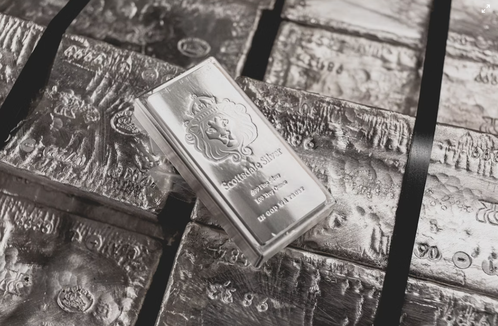
Featured Image - Source: Unsplash















