x




Gold and silver have surged to repeated record highs, but the Federal Reserve chair downplayed the significance of the rally and rejected claims that it reflects doubts about the central bank’s credibility or political independence. After the Fed kept its benchmark rate unchanged at 3.50 to 3.75 percent, in line with expectations, he said inflation risks and labor market risks have both eased and that policymakers are comfortable observing how the economy develops. Markets currently anticipate the next rate cut around June, while he maintained that a hike is not the base case but remains possible if conditions warrant.
Despite the neutral tone and lack of policy easing signals, gold continued to climb, trading near 5,387.70 an ounce and posting a sharp daily gain, suggesting investors are focused on longer-term factors rather than near-term Fed guidance. Analysts argue that markets are already looking ahead to potential leadership changes at the Fed later in the year that could bring a more rate-cut-friendly stance, as well as ongoing geopolitical uncertainty, which has helped drive gold up more than 24 percent this month. Powell also noted that global risks have so far had limited impact on oil prices and the broader U.S. economy, but those same uncertainties remain a key pillar of support for precious metals. Source
Gold and silver continue to trade near record highs, supported by a sharply weaker U.S. dollar and rising doubts about the dollar’s long-term role as the world’s main reserve currency. Silver has climbed above 110 an ounce and gold is holding around 5,300 as investors react to geopolitical tension, policy uncertainty linked to President Donald Trump’s trade agenda, and concerns over U.S. debt and central bank independence. Analysts say that while prices could see short-term pullbacks, the broader trend reflects accelerating de-dollarisation, strong demand from emerging markets, expanding global money supply, and a renewed wave of “Sell America” sentiment that began after aggressive tariffs were introduced in 2025.
The dollar has suffered one of its worst declines in decades, falling about 9.4 percent in 2025 and extending losses into the new year, recently hitting multi-year lows, even as Trump publicly welcomed the move. Market strategists warn that a weaker currency may lift exports but risks importing inflation by raising the cost of foreign goods and raw materials, further strengthening gold’s appeal as a hedge and store of value. Beyond the dollar, confidence in fiat currencies more generally is being tested by instability in global bond markets, including in Japan, and fears of long-term currency debasement. Analysts expect continued portfolio reallocation into gold, with some projecting allocations of up to 15 to 20 percent and further price gains as investors seek protection from monetary disorder and systemic risk. Source
The Federal Reserve voted 10–2 to keep the federal funds rate unchanged at 3.50 to 3.75 percent, in line with market expectations, citing solid economic growth, low but stabilizing job gains, and inflation that remains somewhat elevated. Policymakers said uncertainty about the economic outlook is still high and emphasized that they are closely watching risks to both employment and inflation, reiterating their commitment to maximum employment and returning inflation to the 2 percent target. Gold prices showed little reaction to the decision, trading around 5,285.60 an ounce and posting a modest gain on the day.
The Fed said future policy moves will depend on incoming data, the evolving outlook, and the balance of risks, and that it is prepared to adjust rates if conditions threaten its goals. Two members, Stephen Miran and Christopher Waller, dissented in favor of a 0.25 percentage point rate cut, while the rest supported holding steady. Market participants largely interpreted the decision as a strategic pause rather than a shift away from easing, with some analysts noting that the dissenting votes signal the door remains open to rate cuts later, reinforcing expectations of a more patient and data-driven path toward looser policy. Source
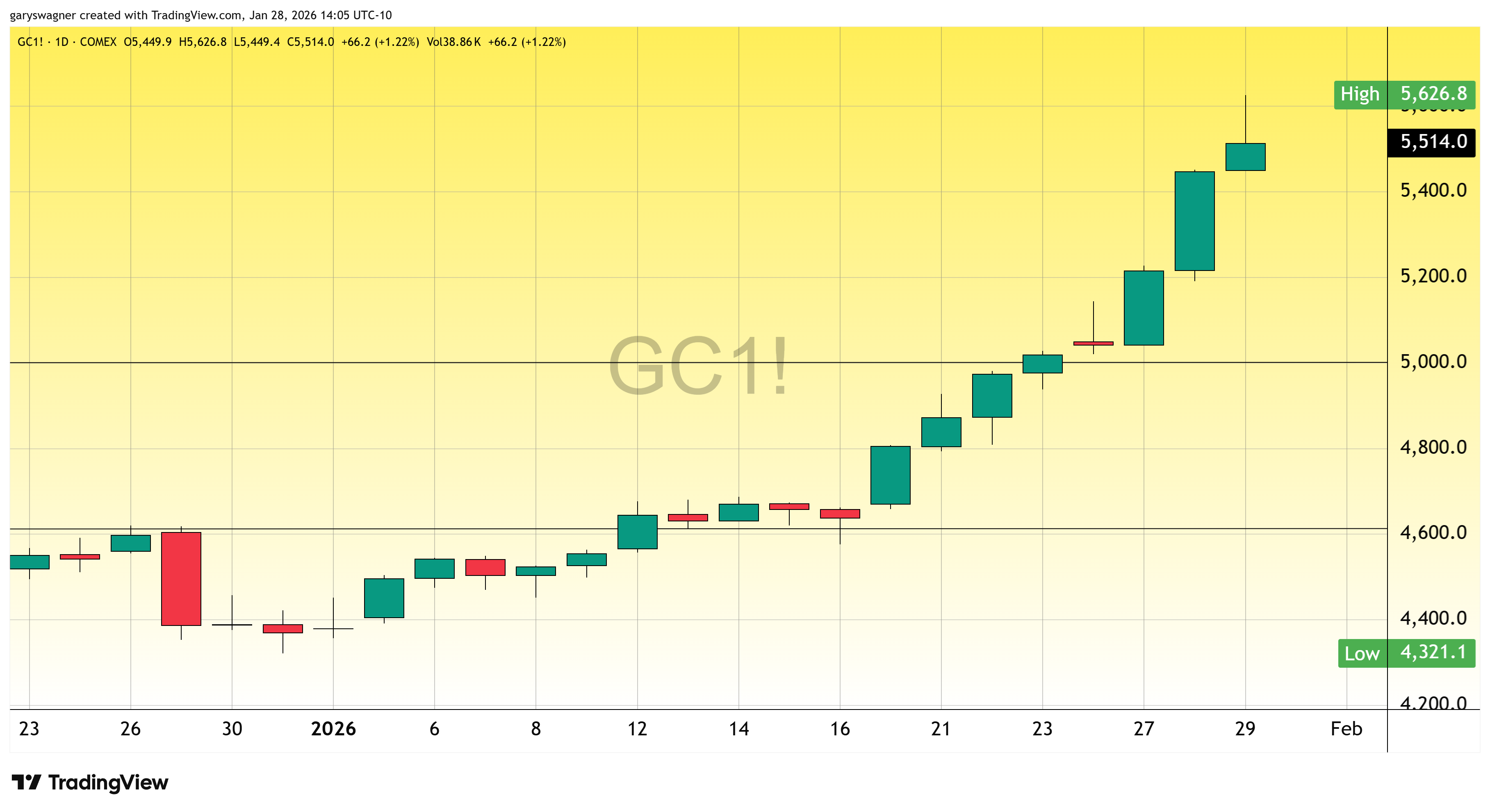
Image source: Kitco News
Gold futures recorded their largest single-day dollar gain on record, jumping 231 per ounce to settle at 5,447, before extending gains in overnight trading to around 5,524 on the most active April 2026 contract. The surge marked the strongest daily percentage increase since March 2020 and extended gold’s winning streak to seven consecutive sessions, during which prices have risen more than 700, or over 15 percent. Gold is now trading nearly 92 percent above its level a year ago and more than 22 percent above its low at the start of 2026, with both month-to-date and year-to-date gains exceeding 22 percent.
The rally has been driven by a sharply weaker U.S. dollar, heightened geopolitical uncertainty, and a broad flight to safety, with futures breaking above 5,200 after the dollar slid to a near four-year low ahead of remarks from Federal Reserve Chair Jerome Powell. President Trump signalled he was unconcerned about the currency’s decline, reinforcing expectations that a softer dollar will continue to support precious metals by making them cheaper for overseas buyers. Analysts at Deutsche Bank said gold could reach 6,000 this year if dollar weakness persists, citing sustained central bank purchases, reserve diversification, and growing investor allocations toward non-dollar and real assets as key structural drivers of demand. Source
Gold and silver surged sharply, with gold hitting a record high of 5360.60 per ounce on April Comex futures and posting its largest ever one-day gain in dollar terms, while silver climbed above 111. Prices were driven by strong safe-haven demand as the US dollar weakened to multi-year lows, a move reinforced by market reaction to comments from President Trump that the currency’s decline was not excessive and could benefit US businesses. The weaker dollar helped push gold to repeated record levels, while crude oil traded slightly higher near 62.75 a barrel and US 10-year Treasury yields hovered around 4.26%.
The Federal Reserve left interest rates unchanged at 3.5% to 3.75% after recent cuts, noting steady economic growth, stable unemployment, modest job gains, and still-elevated inflation, with markets awaiting further guidance from Chair Jerome Powell. Meanwhile, CME Group announced higher margin requirements for silver, platinum, and palladium futures following heightened volatility and record prices in silver. Technically, traders see potential for further upside in both gold and silver if key resistance levels are broken, though significant support levels remain well above recent norms, reflecting the strong bullish momentum in precious metals markets. Source
China’s net gold imports through Hong Kong dropped 24% month on month in December to 12.205 tonnes, while total imports via the hub slipped 7.3% to 28.014 tonnes. Analysts attributed the decline partly to sharply higher prices dampening short-term demand, though domestic prices remain above international levels, indicating the market is still resilient. Attention is now turning to January data, which is expected to better reflect seasonal stocking ahead of the Chinese New Year, traditionally one of the strongest periods for gold buying. The People’s Bank of China also reported that it extended its official gold-buying streak to 14 consecutive months.
Despite weaker wholesale demand last year, retail demand has surged, with gold trading at premiums of up to 8 per ounce over global spot prices and exceeding 5300 per ounce internationally for the first time. Jewelry stores in Shanghai and Hong Kong have been crowded with buyers, while traders report some of the strongest business in decades, alongside supply shortages of small gold bars due to refinery bottlenecks. At the same time, record prices are encouraging some holders to sell, with long queues forming at gold shops in Hong Kong as people seek to cash in on the rally. Source
Gold prices have moved firmly above 5200 an ounce, and according to Standard Chartered’s head of commodities research Suki Cooper, the rally is being driven by deep structural forces rather than short-term speculation. While tactical investors have added to their positions in January, the increase in fund holdings has been modest compared with the roughly 300 per ounce price rise, suggesting other drivers are at work. Cooper points to growing concerns over Federal Reserve independence, expectations of looser monetary policy, rising geopolitical tensions, and renewed trade and tariff risks as key factors encouraging longer-term allocations to gold, particularly from retail investors. Although speculative positioning is elevated, it remains well below historical extremes, indicating the market is not excessively stretched.
She also noted that options markets are signalling expectations for higher prices, with implied volatility and call option demand reaching levels last seen during earlier periods of market stress. Physical demand remains healthy, led by China, where gold is again trading at a premium on the Shanghai Gold Exchange and seasonal buying ahead of the Lunar New Year is likely to support prices on dips. In addition, central banks continue to play a major role, with purchases accelerating in the third quarter of 2025 and early data suggesting strong buying persisted into the fourth quarter, providing a firm underlying base for the market. Source
The Bank of Canada kept its key overnight rate unchanged at 2.25%, with the bank rate at 2.50% and the deposit rate at 2.20%, citing an uncertain outlook shaped by US trade policies and geopolitical risks. The Canadian dollar briefly strengthened after the announcement before settling back near earlier levels, trading around 1.3556 per US dollar, while gold prices in Canadian dollars rose to about 7,174 per ounce. The central bank said global and domestic economic conditions are broadly in line with its October outlook, with US growth continuing to outperform expectations and the euro area supported by services activity and fiscal policy, leaving global growth projected at around 3% over the forecast horizon.
At home, officials said economic momentum faded late in the year, with GDP growth likely stalling in the fourth quarter after a strong third quarter, as exports were hit by US tariffs while domestic demand and employment showed modest improvement. Unemployment remains elevated at 6.8%, and business hiring intentions are subdued. The bank projects growth of 1.1% in 2026 and 1.5% in 2027, noting that the upcoming review of the Canada–US–Mexico Agreement is a major uncertainty. Inflation rose to 2.4% in December but is expected to remain close to the 2% target, and policymakers said the current interest rate remains appropriate while they stand ready to respond if conditions change. Source
Ray Dalio says rising debt burdens, heavy bond issuance, and escalating geopolitical tensions are pushing investors and sovereign institutions away from US Treasuries and toward gold. He argues that as debts grow relative to income, servicing costs squeeze spending and increase financial stress, while bondholders demand real returns even as supply surges. Added to this are risks from trade conflicts, sanctions, and what he calls potential capital wars, which make holding dollar-denominated assets less attractive for countries such as China and others exposed to political or financial retaliation. As a result, central banks and sovereign wealth funds are increasingly shifting reserves into gold, which Dalio describes as having become the second-largest reserve currency and a form of safer money in an unstable global environment.
Dalio views gold not as a speculative trade but as fundamental money with a long record of preserving purchasing power during periods of debt crises, inflation, currency debasement, and war. He contrasts fiat systems, which have dominated since 1971, with earlier asset-backed systems, noting that both historically ended in monetary breakdowns, defaults, or inflation driven by money creation, episodes in which gold typically outperformed paper currencies. He also highlights gold’s lower risk of confiscation compared with financial assets dependent on counterparties or governments. From a portfolio perspective, he advocates treating gold as a strategic allocation rather than a market-timing bet, suggesting a typical range of 5 to 15 percent, higher during periods of monetary stress and lower during stable times, even though gold underperforms productive assets over long horizons. Source
Gold is starting 2026 strong, holding above $5,000 an ounce and posting its best January gain since 1980, with momentum potentially pushing it toward $5,500. Ole Hansen of Saxo Bank cites ongoing concerns about fiscal debt, a weakening dollar, geopolitical uncertainty, and inflation as the main drivers supporting the metal, even though many of these risks have yet to fully materialize. While safe-haven demand may moderate if the global economy remains resilient, Hansen expects gold to experience a period of consolidation rather than a sharp correction, with structural factors and central bank demand continuing to underpin the market.
Silver, by contrast, is showing signs of a bubble, trading around $109 an ounce after a more than 52% jump in January following nearly a 150% rise in 2025. Hansen attributes this surge to retail participation, speculative positioning, and fear of missing out, pushing prices to historically high levels relative to gold and platinum. He warns that this rally could depress industrial demand, which makes up the majority of silver’s use, and create disorderly market conditions. As industrial demand slows and investors sell long-held silver, the supply-demand balance is likely to reduce price support, making gold the preferred choice for strategic exposure to hard assets. Source
Silver has surged more than 200% year-over-year, pushing the gold-to-silver ratio to multiyear lows, prompting HSBC analysts to advise investors to consider taking profits. The rally has been driven largely by momentum and retail participation rather than safe-haven demand, even as industrial demand picks up. While gold has also risen significantly, silver’s rapid advance suggests it may be overheated, and investors should exercise caution given the potential for a correction after such a steep run-up.
HSBC maintains a cautiously positive outlook for gold, forecasting a high of 5,050 per ounce in the first half of 2026, though they anticipate volatility and possible pullbacks later in the year, with average prices for 2026 slightly lowered to 4,587 per ounce. Beyond 2026, they expect gold to continue appreciating, projecting averages of 4,625 in 2027, 4,700 in 2028, and 4,775 in 2029, supported by central bank demand, interest in gold-backed ETFs, and concerns over a weaker US dollar. The bank notes that downside risks exist if the Federal Reserve adopts a more hawkish stance or global economic conditions improve, but gold remains a key diversifier and resilient asset for navigating market uncertainties. Source
BMO Capital Markets projects a highly bullish scenario for gold and silver, driven by global uncertainty over government balance sheets, fiat currency resilience, and shifting geopolitical influence. With gold already above $5,000 an ounce, the analysts envision continued strong demand from central banks, ETFs, and investors seeking safe havens, forecasting prices could reach around 6,350 per ounce by the end of 2026 and 8,650 per ounce by the end of 2027. They emphasize that current models may underestimate potential price movements due to the scale of disruption in the financial system and global order, noting that gold’s historical correlations with the US dollar, treasuries, and equities are less predictive in this environment.
Silver is also seen as having strong upside potential, with its recent surge above $100 an ounce pushing the gold-silver ratio to multi-year lows. While previously expected to underperform gold, silver could continue to gain momentum as investors treat it increasingly as a safe-haven asset alongside retail participation, despite its industrial uses. BMO’s bull case assumes the gold-silver ratio stays between 40 and 50 for an extended period, pointing to silver prices of roughly 160 per ounce by late 2026 and 220 per ounce by late 2027, reflecting a scenario in which the broader precious metals market benefits from ongoing global uncertainty and investor demand. Source
Disclaimer: These articles are provided for informational purposes only. They are not offered or intended to be used as legal, tax, investment, financial, or any other advice.
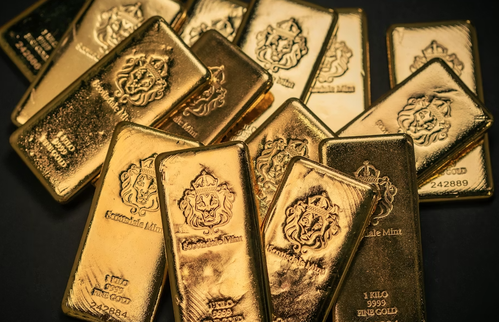
Featured Image - Source: Unsplash















