x




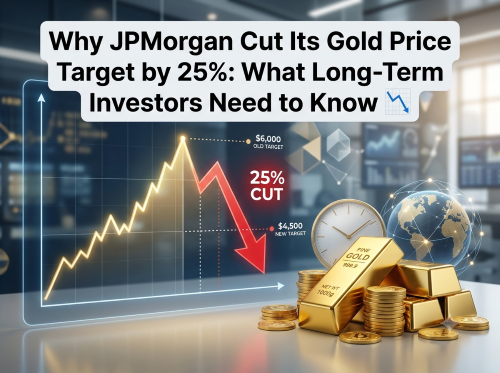
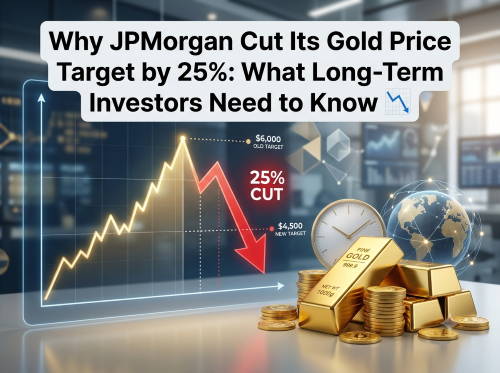
In the financial world, few things generate headline noise quite like a sudden pivot from a major Wall Street institution. On 9 June, JPMorgan informed clients that gold was on track to reach a staggering $6,000 per ounce by the end of the year. Just twenty-four days later, on 3 July, the bank revised that target downward by 25% to $4,500 per ounce.
Predictably, the headlines swung between apocalyptic claims that the gold bull run is dead and cynical dismissals of bank forecasting altogether. Neither extreme offers useful guidance for precious metals holders.
To understand what is truly happening, we need to look past the surface numbers and examine the mechanics behind JPMorgan’s revision, how other major investment banks view the market, and whether the long-term thesis for holding physical bullion has genuinely changed.
JPMorgan’s updated outlook stems from a convergence of two main drivers: shifting institutional demand and a renewed sensitivity to real interest rates.
1. A Shift in Global Demand
On the demand side, institutional flows have cooled compared to earlier projections:
2. The Return of Real Yield Sensitivity
The more critical mechanism, however, is macro-economic. JPMorgan estimates that since late February, gold has dropped approximately $20 per ounce for every 1 basis point rise in US 10-year real yields.
This negative correlation re-established itself forcefully following Federal Reserve Chair Kevin Warsh’s debut FOMC meeting on 17 June. Holding rates unchanged at 3.50%–3.75%, the Fed delivered a hawkish shift: half of the dot-plot submissions signalled at least one rate hike in 2026. Coupled with Warsh’s decision to eliminate explicit forward guidance, real yields moved sharply higher. Because gold provides no yield, rising real yields increase the opportunity cost of holding the asset, placing a direct cap on near-term upside.
It is vital to note that JPMorgan now sits at the most conservative end of institutional forecasts. While JPMorgan projects a Q3 average of $4,300 per ounce before recovering to $4,500 in Q4, the wider consensus on Wall Street remains considerably more bullish:
This $700-per-ounce spread represents one of the widest institutional divergences in recent years. It highlights that major analysts are interpreting the exact same macro data in fundamentally different ways, depending on how aggressively they expect real yields to weigh on bullion.
JPMorgan’s report outlines a severe downside scenario where gold breaks below $4,000 per ounce and tests the $3,500–$3,600 level. However, understanding the context of this prediction is essential.
For gold to test $3,500, two specific conditions must occur simultaneously:
This scenario represents a tail risk, not JPMorgan’s baseline expectation. JPMorgan’s own rate strategy team expects the Fed to remain on hold throughout 2026, delaying any potential rate movement until Q3 2027. Without an aggressive Fed hiking cycle, a drop into the mid-$3,000 range remains an outlier possibility rather than the central trajectory.
The revision was not limited to gold; JPMorgan adjusted its projections across the broader precious metals complex:
Despite the near-term downgrade, JPMorgan explicitly maintains its long-term bullish structural thesis for gold, projecting a renewed upward cycle beginning in 2027.
The mathematical relationship driving the current price ceiling works both ways. The exact same yield sensitivity that subtracts $20 per ounce for each basis point increase in real yields will add $20 per ounce when real yields eventually compress or rate-cutting cycles resume.
More importantly, the core structural drivers that propelled gold from under $2,000 in 2023 to its peak above $5,500 in early 2026 remain entirely undisturbed:
JPMorgan’s revision is a tactical adjustment to near-term interest rate headwinds, not a structural reversal of precious metals' role in the global financial system.
For a deeper dive into the market mechanics, data breakdowns, and original reporting behind this analysis, you can read the original article at GoldSilver:
👉 JPMorgan Cut Its Gold Forecast by 25%. Here’s What Long-Term Holders Need to Know.
Disclaimer: This article is provided for informational purposes only, mistakes may be made, and it's not offered or intended to be used as legal, tax, investment, financial, or any other advice.