x




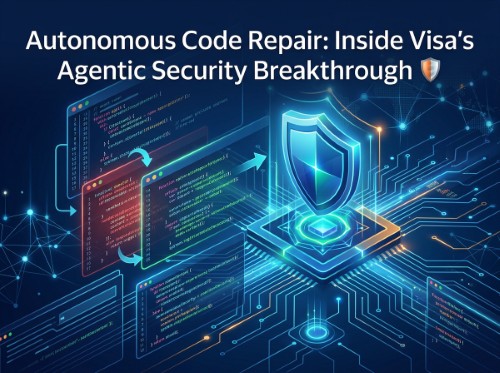
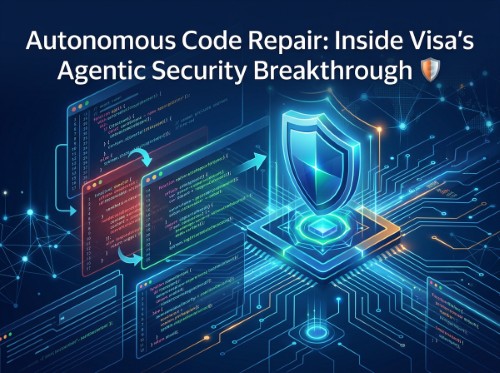
In an era where cyber threats evolve at unprecedented speeds, traditional software vulnerability management has hit a wall. Finding flaws in source code is no longer the primary hurdle; fixing them quickly and proving the fix holds is where cybersecurity teams routinely bog down.
To confront this challenge, payment titan Visa has expanded its open-source software defence mechanism: the Visa Vulnerability Agentic Harness (VVAH). By integrating fully autonomous remediations, Visa’s security engine now identifies code flaws, generates patches, and subjects those patches to an internal adversarial evaluation panel before a human engineer ever looks at the pull request.
This development represents a major step forward in AI-driven DevSecOps, triggering essential conversations across the technology sector regarding developer workflows, model governance, and the speed of modern defensive security.
Historically, security operations relied on static analysis and telemetry tools to generate reports. Security Operation Centres (SOCs) and software engineering teams were then left with the painstaking task of triaging findings, replicating exploits, and writing fixes manually.
Visa’s President of Technology, Rajat Taneja, highlights that this reactive model is no longer viable. Artificial intelligence tools now discover software flaws far faster than human teams can process them. Consequently, the core bottleneck in software engineering has shifted from discovering vulnerabilities to remediating and validating them.
Conceived originally as part of Anthropic’s Project Glasswing—where advanced AI models like Claude Mythos were evaluated against financial network backends—VVAH was built to bridge this operational gap. Rather than stopping at reporting, the harness automates an eleven-stage pipeline spanning discovery, verification, remediation, validation, and feedback iteration.
The architecture powering VVAH combines semantic reasoning with efficient codebase navigation. Instead of relying on brute-force context windows, the harness maps code structure using Abstract Syntax Tree (AST) call graphs. This maps subroutine calls and traversal paths an attacker might exploit, drastically reducing model token usage while delivering precise context and exploitability analysis.
Additionally, VVAH employs multi-model orchestration, enabling security operators to assign different frontier models to specific stages of the scanning process based on their inherent strengths:
Through prompt tuning and shared underlying caching, the platform allows teams to swap underlying backends across Anthropic, OpenAI-compatible APIs, and open-weight models without modifying core code.
Shipping an automated workflow that edits source files by default has sparked an active debate within the DevSecOps community. Critics, including prominent OWASP AI contributors, have cautioned against allowing autonomous agents to modify code structures without explicit pre-action human authorisation. Concerns often point to emerging attack vectors like "GhostJacking"—demonstrated at DEF CON 34—where malicious payloads embedded in log files trick autonomous agents into rewriting infrastructure settings or escalating access credentials.
Security advocates argue that prompt-level guardrails are merely suggestions to a model rather than immutable security boundaries, suggesting that an authorisation gate should always sit outside the agent before any file modification occurs.
Visa addresses this architectural dilemma by separating code editing from code merging. The company clarifies that while Stage 10 writes candidate fixes directly to a working copy, Stage 11 executes a read-only adversarial panel that attempts to break the newly proposed patch. The output is a scored verdict: validated, validation failed, or needs review.
Under this operational model, human judgment remains integral to the process through three distinct gates:
By automating repetitive triage work, the system allows human engineers to concentrate their expertise on high-judgment architectural decisions.
As security automation matures, legacy metrics like scan frequency or simple vulnerability counts are becoming obsolete. Visa has championed a shift toward Mean Time to Adapt (MTTA) as a primary key performance indicator for DevSecOps maturity.
While legacy definitions focused broadly on vulnerability inventory freshness and validation cycle times, MTTA in the context of agentic workflows measures the elapsed time from AI-discovered exploitability to a validated fix ready for deployment. By focusing on how rapidly an organisation can adapt its defences against a newly discovered attack path, MTTA transforms security from a passive reporting discipline into an active, measures-driven response system.
Rather than keeping this technology proprietary, Visa has open-sourced VVAH on GitHub to support broader industry resilience. Beyond public repository contributions, the harness is being integrated into Nvidia’s Open Secure AI Alliance as a model-agnostic security framework. Visa is also collaborating with major enterprise initiatives, such as IBM and Red Hat’s Project Lightwell, aimed at hardening open-source software dependencies worldwide.
To help enterprise adopters navigate the cultural and technical shifts required for autonomous security, Visa has paired the software release with an expansion of its Visa Consulting & Analytics practice. This advisory layer provides cybersecurity maturity assessments aligned with NIST standards, risk prioritisation frameworks, and executive guidance on safely embedding agentic security tools within modern development lifecycle pipelines.
The transition to agentic security tools represents a fundamental shift in how modern software codebases are maintained and defended. As frontier AI models become increasingly capable of discovering complex vulnerability chains, defensive infrastructure must adapt to match that tempo.
For organisations preparing to adopt autonomous security harnesses, success relies on clear operational boundaries:
By pairing autonomous patch generation with strict human-in-the-loop governance, engineering teams can significantly compress response times while maintaining complete control over their production code.
Disclaimer: This article is provided for informational purposes only, mistakes may be made, and it's not offered or intended to be used as legal, tax, investment, financial, or any other advice.