x




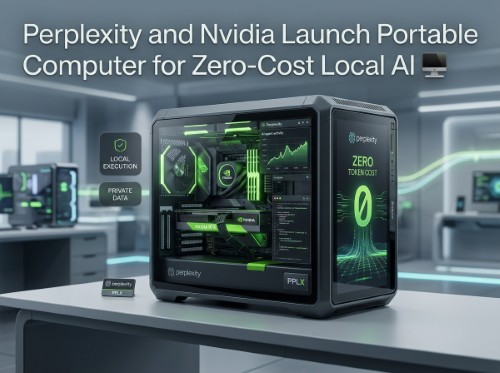
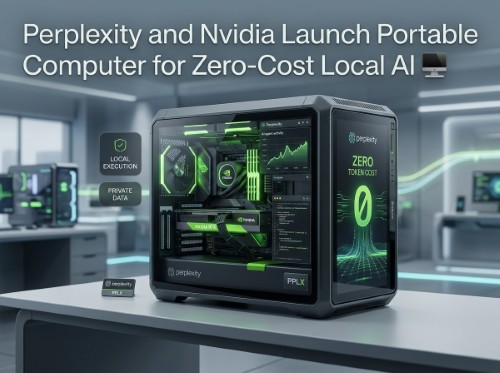
Artificial intelligence is shifting away from massive cloud data centres back down to the hardware sitting directly on your desk. In a landmark collaboration, Perplexity and Nvidia have launched Portable Computer, an agentic AI platform designed to run entirely on local, user-owned hardware.
By executing models, files, and complex multi-step workflows directly on local machines, Portable Computer eliminates the recurring token fees associated with cloud API calls while ensuring sensitive enterprise data never leaves the device.
While traditional AI chatbots operate on brief, bursty interactions, autonomous agents operate differently. Agentic workflows run continuously, processing files, evaluating context, executing tools, and verifying their own work across extended periods. In a cloud environment, this continuous token consumption quickly leads to staggering operational costs.
Portable Computer fundamentally alters these economics. Because the entire processing stack runs on local silicon, the marginal cost of generating tokens drops to zero. Users can set an agent to review hundreds of financial documents, conduct deep research, or write code without worrying about consuming billing credits or depleting API quotas.
Data privacy remains one of the largest obstacles to enterprise AI adoption. Uploading confidential tax forms, proprietary source code, or internal customer funnel data to third-party cloud servers poses significant compliance and security risks.
Portable Computer addresses this challenge by keeping the model, the user files, and the agentic execution within a local sandbox boundary. During demonstration workflows, the system successfully analysed sensitive tax documents and flagged unnecessary investment fees—all while operating entirely offline with the credit counter parked at zero.
To protect system integrity, Perplexity built always-on OS-level sandboxing directly into the harness. If the sandbox environment is unavailable or compromised, the system disables tool execution automatically rather than running unverified commands with full user permissions.
A key technical achievement behind Portable Computer lies in how the software harness and local models were co-designed. Standard agent frameworks often struggle on smaller, local hardware because they assume access to vast frontier cloud models capable of absorbing massive prompt contexts and sprawling tool definitions.
Perplexity discovered that even modern open models advertising 260,000-token context windows begin to experience performance degradation beyond 100,000 tokens. To solve this, the engineering team engineered a streamlined stack:
Internal benchmarks on Perplexity's Local Knowledge Work Bench show that Computer running Qwen 3.8 27B scored 82.6 per cent accuracy, outperforming competing open-source agent frameworks. On complex web research tasks, it reduced execution time by 51 per cent and token usage by 70 per cent compared to standard open setups.
While Portable Computer prioritises local-first execution, it is not completely isolated from cloud capabilities. When an agent encounters an extraordinarily complex reasoning barrier, it can ask the user for permission to escalate the task to a cloud-based frontier model.
Before any data leaves the local machine:
Testing on coding benchmarks revealed that allowing a local model to consult a cloud advisor recovered roughly three-fifths of the performance gap to pure frontier models at just a fraction of the cost.
Portable Computer is available now for Perplexity Pro, Max, Enterprise Pro, and Enterprise Max subscribers on Linux systems, with Windows support arriving in September 2026.
To deliver smooth inference and agentic performance, the hardware floor requires an Nvidia RTX GPU with at least 24GB of VRAM (such as an Nvidia GeForce RTX 3090 or higher) or an Nvidia DGX Spark desktop supercomputer.
The release marks a significant milestone in bringing powerful, private, and unmetered artificial intelligence off remote cloud clusters and placing it squarely into the hands of professionals.
Disclaimer: This article is provided for informational purposes only, mistakes may be made, and it's not offered or intended to be used as legal, tax, investment, financial, or any other advice.