x



Across modern software engineering teams and platform commit histories, an undeniable shift is taking place. The historic friction associated with drafting syntax, writing repetitive boilerplates, and wire-framing integration pipelines has largely evaporated. Driven by autonomous coding tools, agentic workflows, and sophisticated Large Language Models embedded directly into local developer environments, producing an initial code implementation is no longer the primary development bottleneck.
Describe a complex event-driven stream or a multi-endpoint REST API integration in natural language, and an AI agent can inspect your repository, draft unit tests, navigate stack traces, and submit a functional pull request within minutes.
This technological leap forces a critical question upon the engineering discipline: if autonomous agents are rapidly becoming the primary authors of local application logic, what is the core responsibility of the human software engineer? Are developers destined to become mere rubber-stampers reviewing an overwhelming stream of plausible code changes?
The reality is far more profound. The software engineer's role is not disappearing; it is migrating upward. The primary task of modern software engineering is shifting away from writing line-by-line micro-logic and toward designing the strict boundaries, contracts, and feedback loops that autonomous AI agents cannot break.
To understand why autonomous agents require rigid structural boundaries, it is helpful to evaluate them through the lens of thermodynamics. Stripped of speculative hype, an AI agent is a computational heat engine. It consumes resources—compute power, context windows, tokens, and direction—and attempts to convert them into directed, productive work.
In isolation, an LLM sitting in a data centre possesses tremendous potential energy, yet it accomplishes nothing without structured intent. A system prompt, an open issue, a failing integration test, or an architectural instruction provides the directional vector needed to transform raw model capacity into targeted code modifications.
However, just like mechanical engines experience thermodynamic losses, agent loops suffer from what can be termed operational entropy.
When an agent is assigned a complex task across an extensive, non-trivial codebase, its reasoning path can quickly begin to degrade. It may follow a stale assumption, fix a surface symptom rather than a root cause, or misinterpret legacy exception-handling logic as standard behaviour. As tool calls accumulate, the agent’s context window fills with competing, highly plausible details. Without external intervention, operational entropy rises, and subsequent iterations drift further from a valid solution.
A human engineer's intervention restores order by injecting clear signal into the system. Similarly, a failing end-to-end test, a deterministic schema rule, or a strict semantic contract serves as an automated constraint that halts drift. Without these firm guardrails, an agent can generate massive computational motion while accomplishing zero useful work.
A common misconception in the era of AI-driven development is that autonomous code generation scales linearly with task complexity. To understand why this assumption fails in enterprise environments, consider two mental models: the Infinite Monkey Theorem and the Three-Body Problem.
The Bounded Search Space
The Infinite Monkey Theorem posits that a monkey hitting keys randomly on a typewriter for an infinite amount of time will eventually produce the complete works of Shakespeare. Modern AI agents act as vastly hyper-intelligent monkeys equipped with compilers, linters, test runners, and contextual awareness.
In a tightly bounded task—such as writing an isolated utility function, transforming a static JSON schema, or refactoring a clean class—the agent operates within a narrow search space. It proposes a change, executes local tests, observes compiler errors, absorbs the feedback, and rapidly converges on a correct outcome.
Enterprise Complexity and Non-Linear Chaos
Enterprise environments, however, rarely remain static. Real-world systems suffer from the software equivalent of physics’ three-body problem.
In classical mechanics, predicting the motion of two gravitationally interacting bodies is mathematically straightforward. Introduce a third body, and the system becomes dynamic, non-linear, and chaotic, where minute variations in initial conditions yield radically different trajectories.
An enterprise data architecture operates in much the same way. It is a constantly moving target shaped by interacting, dynamic forces:
When an AI agent is introduced into this chaotic ecosystem, surface-level code correctness is insufficient. For instance, suppose an agent is instructed to populate a new customer_tier field in an analytics model. The agent scans the database, finds a column named account_status, writes a clean SQL transformation, passes local null-value tests, and delivers a green build.
Code syntax is valid, tests pass, yet the business output is completely wrong because, in business logic, customer_tier must be computed from rolling twelve-month transaction volume rather than operational status.
Without a semantic data contract to enforce this business rule at the boundary level, the agent’s mistake remains undetected until it corrupts downstream executive reporting. The engineer’s key contribution was not the transformation code itself; it was the structural contract that made the agent's contextual mistake instantly visible and recoverable.
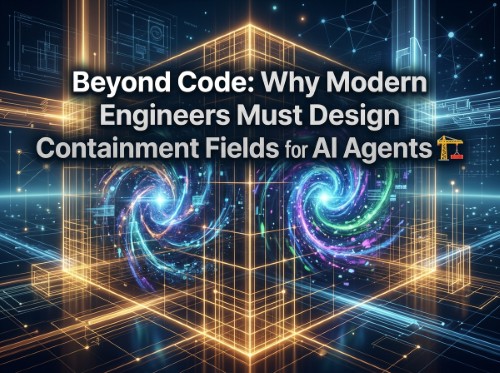
If software logic is increasingly synthesised by machines, the core mandate for human engineers becomes designing equilibrium—building the architecture, containment fields, and safety boundaries that guarantee generated code remains reliable, secure, and aligned with domain reality.
To safely unleash AI agents at scale, engineering teams must focus on several foundational structural patterns:
1. Explicit Semantic Layers and Data Contracts
Engineers must move away from implicit business rules buried in procedural code. By codifying domain rules into explicit, machine-readable semantic layers and data contracts, engineers establish immutable truths. When an agent attempts a code generation task, these contracts act as absolute constraints that reject invalid logic prior to deployment.
2. Immutable Event Logs and Idempotent APIs
Autonomous agents thrive in environments where actions can be safely attempted, evaluated, and retried without causing destructive side effects. Designing systems around immutable event logs and idempotent API endpoints ensures that if an agent loop strays or fails mid-execution, the underlying state remains untainted and recoverable.
3. Deterministic State Machines
When agent workflows involve complex multi-step orchestrations, relying on open-ended LLM decision-making at every step introduces unacceptable variability. Engineers must bound agent autonomy within deterministic state machines, defining clear state transitions and explicitly bounding what actions an agent is permitted to perform at any given point in a execution path.
4. Continuous Evaluation and Guardrail Harnesses
Traditional unit testing validates whether static code meets predictable criteria. In an agentic ecosystem, testing infrastructure must evolve into comprehensive evaluation harnesses. These harnesses run automated checks for semantic correctness, security regressions, operational performance, and contextual compliance, offering immediate, precise feedback directly to the agent loop.
The emergence of powerful AI coding agents does not signify the end of software engineering; rather, it marks the end of syntax as a primary value metric. As the marginal cost of producing raw logic approaches zero, the strategic value of system architecture, boundary design, and control engineering rises exponentially.
When engineers construct robust containment fields, strict semantic boundaries, and clear feedback loops, autonomous agents transform from volatile, drift-prone engines into immensely effective force multipliers.
The future of software engineering is not about typing lines of code faster than a machine. It is about designing the resilient systems, feedback mechanisms, and immutable boundaries within which autonomous intelligence operates safely.
Disclaimer: This article is provided for informational purposes only, mistakes may be made, and it's not offered or intended to be used as legal, tax, investment, financial, or any other advice.