x




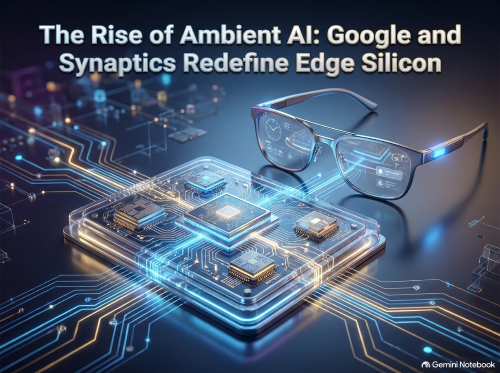
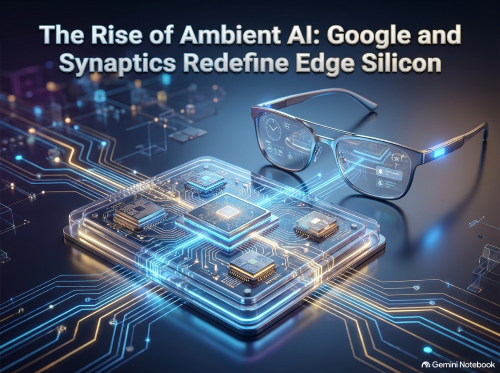
Artificial intelligence is undergoing a quiet, profound transformation. For years, the narrative around modern AI has been dominated by sprawling cloud data centres, server racks, and massive foundation models. Yet, the real frontier of intelligent computing isn't sitting in a distant server farm — it is arriving directly on our wrists, inside factory inspection cameras, and across lightweight augmented reality glasses.
To turn this vision of always-on, ambient intelligence into reality, device makers and semiconductor engineers must overcome three formidable barriers: severe battery constraints, bloated component costs, and fragmented processor architecture. Taking a decisive step to address these exact pain points, Google and semiconductor specialist Synaptics recently unveiled a landmark partnership to power the next generation of smart wearables and industrial endpoints, as reported by VentureBeat.
For embedded hardware engineers, bringing machine learning models onto low-power devices has traditionally required painful compromises. General-purpose microcontrollers offer flexibility and straightforward programming, but they lack the sheer matrix maths muscle required for modern AI workloads. Conversely, traditional application processors supply plenty of compute power, but they devour battery life within hours, demand complex thermal management, and require expensive external memory.
Google Research and Google DeepMind tackled this dilemma from the silicon level up by co-designing the Coral NPU architecture. Built on the open RISC-V instruction set architecture, Coral reverses standard chip design by prioritising neural network execution engines over scalar processing. As outlined in Google Research's full-stack Coral NPU platform overview, the architecture is released under a permissive Apache 2.0 licence. This royalty-free model allows semiconductor manufacturers worldwide to integrate verified neural processing units without paying steep licencing fees or getting locked into proprietary software silos.
As Google's premier commercial silicon partner for Coral technology, Synaptics has pioneered a brand-new hardware category: the xMCU™. Detailed in Synaptics' deep dive into xMCU silicon, this new class of processors bridges the gap between traditional microcontrollers and heavy application processors. The xMCU delivers Linux-class processing capabilities within the tight power and cost envelopes of a standard microcontroller.
At the heart of this milestone is Synaptics' new Astra SR200 processor series. Designed specifically for always-on vision, voice, and multimodal intelligence, the line-up features three distinct performance tiers:
Under the bonnet, each SR200 processor blends high-efficiency Arm Cortex-M85 and Cortex-M52 cores with Google's Coral NPU architecture (implemented as Synaptics' Torq NPU). Furthermore, Synaptics tackles a major industry cost bottleneck — surging discrete DRAM prices — by integrating up to 8MB of high-speed SRAM alongside package-customised DRAM configurations. This integrated memory layout consumes approximately one-third of the power required by conventional system DRAM, enabling sleek wearables and compact industrial sensors to process rich data streams without rapidly draining battery power.
Hardware is only as effective as the software toolchain supporting it. To eliminate developer pain when compiling models across diverse targets, the platform relies on an open-source toolchain built on the MLIR and IREE frameworks. According to the official Coral product brief for developers, engineers can seamlessly ingest models from PyTorch, JAX, and Google's LiteRT without wrestling with proprietary compilers.
This cohesive software ecosystem makes it practical to run compact generative AI and vision models directly at the physical edge. Developers can deploy lightweight models like Google's Gemma 3 270M, Liquid AI's LFM2.5, and Ultralytics YOLO vision algorithms locally. On the SR200 hardware, Gemma 3 270M generates an impressive 12 to 16 tokens per second, keeping sensitive user data strictly on-device for enhanced privacy and instant response times.
The real-world applications span across multiple sectors. Industrial smart glasses can interpret complex assembly lines in real time, factory cameras can identify defects locally, and smart security systems can detect voice cues or visual threats without constantly streaming raw video to cloud servers. Engineers and product creators can start prototyping today with the $99.79 Coralboard SL evaluation kit available through DigiKey, with the forthcoming Coralboard SR set to unlock the full potential of the flagship SR250 chip.
By uniting open-source RISC-V acceleration with innovative memory packaging, Google and Synaptics are establishing an accessible foundation for edge AI. As everyday devices become smarter, quieter, and more context-aware, this open ecosystem ensures that the future of ambient computing remains private, power-efficient, and infinitely scalable.
Disclaimer: This article is provided for informational purposes only, mistakes may be made, and it's not offered or intended to be used as legal, tax, investment, financial, or any other advice.