x




Imagine sitting inside a driverless robotaxi as it smoothly navigates a busy city centre. Without warning, the vehicle brakes sharply on an open road with no apparent hazard in sight. Was it reacting to a hidden danger, or was it a glitch in the software? For passengers, safety operators, and engineers alike, answering this question has historically been nearly impossible.
This transparency dilemma is known as the "black-box problem." Modern autonomous vehicles (AVs) rely heavily on complex neural networks trained on vast amounts of driving data. While these deep-learning models excel at handling complex road scenarios, they rarely reveal why they make specific decisions.
To bridge this crucial gap, researchers from autonomous technology leader Motional—including CEO Laura Major—and MIT’s Computer Science and Artificial Intelligence Laboratory (CSAIL) have developed a ground-breaking solution. Published in the journal Nature, their breakthrough system promises to make self-driving artificial intelligence fully interpretable in real-time.
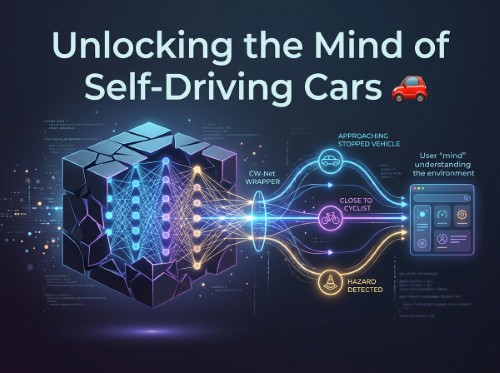
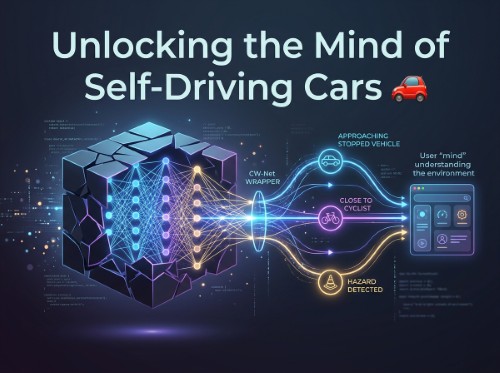
At the core of this research is a novel architecture called the Concept-Wrapper Network (CW-Net). Rather than leaving an AI system’s inner workings as an unreadable web of mathematical calculations, CW-Net translates these internal states into clear, human-interpretable concepts.
Instead of raw code or abstract confidence scores, dashboard displays powered by CW-Net can present intuitive labels such as:
This allows human observers to instantly see which concepts are actively dictating the vehicle’s behaviour as manoeuvres unfold.
A critical feature of CW-Net is that it avoids a common trap in explainable AI: generating plausible-sounding guesses after an event has already occurred. Many existing natural-language explanation tools generate descriptions that sound logical to a human, but do not actually reflect how the underlying neural network made its decision.
CW-Net is designed to be causally faithful. This means the vehicle’s decision-making system directly executes actions based on these interpretable concepts. If the car initiates a hard braking manoeuvre, that action can be traced back directly to the exact human-readable concept that triggered it.
As Motional CEO Laura Major highlighted, relying purely on opaque end-to-end deep learning poses severe limits for real-world deployment:
"The general end-to-end only approach can get to a really good 80–90 percent – maybe even 95 percent – solution, but that’s not good enough to remove a driver or to earn the trust of cities, communities, and customers."
While most research into explainable AI remains confined to computer simulations, the Motional and MIT team put CW-Net to the test on physical roads. Equipped with experienced safety operators, test vehicles evaluated the system on private closed courses and public streets across Las Vegas.
Deploying an experimental version of a deep-learning planner, the researchers encountered two fascinating real-world incidents that demonstrated the immense power of explainable AI:
1. The Phantom Hazard (Hallucinated Vehicles)
During testing, an autonomous test vehicle repeatedly came to a halt near a traffic cone. Naturally, the safety operator assumed the cone was causing the vehicle to hesitate. However, when researchers removed the cone entirely, the vehicle continued to stop at the exact same location.
CW-Net’s real-time interface revealed the true culprit: the experimental deep-learning system was hallucinated a stopped vehicle ahead. The system had developed an anomaly linked to specific patterns in its training data. By exposing this internal hallucination, engineers were able to diagnose, predict, and resolve the software defect quickly.
2. The Unseen Cyclist
In another scenario, the vehicle successfully detected and stopped for a cyclist on the road. On the surface, the AI appeared to have performed flawlessly. However, CW-Net revealed a dangerous hidden reality: the primary deep-learning planner had actually failed to base its decision on the cyclist’s presence.
Instead, the vehicle had stopped because a secondary safety backup system intervened at the last moment. Armed with this insight, the safety driver knew to exercise extra caution around cyclists, while engineers received vital feedback that the primary planning algorithm required immediate refinement.
Historically, adding layers of explainability to machine learning models came at a heavy cost in processing speed and computational efficiency. In fast-moving, safety-critical environments like autonomous driving, even a millisecond of latency can be dangerous.
Fortunately, CW-Net shatters this trade-off. When benchmarked against leading state-of-the-art autonomous driving algorithms, the implementation of CW-Net resulted in a driving capability performance difference of less than one percent.
This minimal trade-off means automotive manufacturers no longer have to choose between high-performance AI and human transparency.
The implications of Motional and MIT’s research extend far beyond driverless taxis operating in Nevada.
Regulatory Compliance and Public Trust
As autonomous vehicle technology expands into new global markets, regulatory bodies worldwide are demanding strict transparency. Regulators want clear proof of how AI models arrive at safety-critical choices. Systems like CW-Net provide a viable pathway toward meeting these impending regulatory benchmarks, helping build public trust in driverless technology.
Application in Other Safety-Critical Fields
The underlying principles of CW-Net can be applied across a wide range of autonomous domains where human life is at stake, including:
The journey toward fully autonomous transport relies as much on trust and transparency as it does on raw technical performance. By converting complex neural network logic into clear, causally faithful human concepts, Motional and MIT have fundamentally redefined how humans interact with black-box AI systems.
As explainable AI transitions from academic research into real-world vehicles, technology like CW-Net will serve as an essential cornerstone for safer roads, smarter cities, and a truly autonomous future.
Disclaimer: This article is provided for informational purposes only, mistakes may be made, and it's not offered or intended to be used as legal, tax, investment, financial, or any other advice.