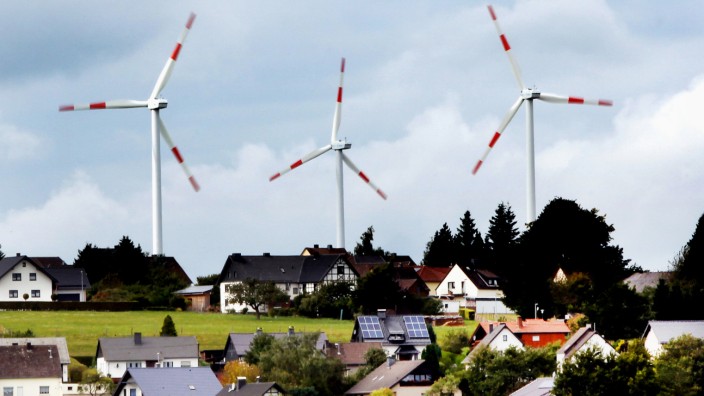
federal and state governments want green electricity again
However, there is complete disagreement as to how far wind turbines can be from settlements - and thereby endangers the expansion of green energy.
The low-loaders will soon be rolling in Pfettrach. You will charge a wind turbine that was never allowed to turn. It is stored outside in the forest, not far from the community in Bavaria. The Karlsruhe EnBW group wanted to build it, but then resistance, court hearings and Bavaria's distance rule for wind turbines came. In the end, EnBW gave up. The plant is now to be transported to Poland.
This is how things are in the motherland of the energy transition. In the first two months of this year, 77 new plants were built, which could add up to 1,500 megawatts of wind power per year. "This is a far cry from what was built in previous years," says Jürgen Quentin, who works on the extension for the wind energy agency on land. "And unfortunately far from what would be necessary." After all, according to the coalition's plans, a total of 65 percent renewable energies should be on the power grid by 2030. But this would require around 4,000 megawatts of additional wind power per year. In 2019, it wasn't even a quarter of that.
This is why the heads of the federal and state governments meet on Thursday for the Prime Ministers' Conference. The draft for the joint paper of the conference said that "there is an urgent need to accelerate the acceptance of renewable energies, in particular wind power and photovoltaics , to ensure acceptance ." Beyond the common places, however, there is controversy: the draft is full of suggestions and counter-suggestions.
At the center are the rules that also fatalized the plant in Pfettrach: those regarding the distance between wind turbines and settlements. In the course of its climate package, the coalition had decided a minimum distance of 1000 meters last September. If the countries do not actively deviate from it within 18 months, the 1000 meters should also apply to them. Shortly afterwards, the Federal Ministry of Economics submitted a proposal that this distance should apply to small settlements with five houses. The space for new wind turbines would be massively restricted. "That only added to the uncertainty in the industry," says Milan Nitzschke, member of the management team at wind farm project developer SL Naturenergie. "And that it was in the climate package of all places,
Several wind companies have either filed for bankruptcy or are cutting jobs
Like all wind farm companies, SL Energie is also facing local citizens' initiatives and unsettled authorities. "This has made the whole work infinitely more tedious." Local authorities and authorities should fear that every decision will end up in court, says Nitzschke. "What would really help would be legal certainty and a shortening of procedures."
The consequences go far. Several wind companies have either filed for bankruptcy or closed plants. Most recently, the German market leader Enercon had started to drastically cut jobs. "Everyone is waiting for the cork to be removed from the bottle," says Daniel Friedrich, district manager of the IG Metall Coast. "This unspeakable 1000-meter distance rule stops everything."
And not just in the wind. Because the coalition has agreed on the minimum distances with the lifting of the so-called "solar cover". After that, the promotion of private solar systems, for example on roofs, ends as soon as a total output of 52 gigawatts of photovoltaic (PV) is reached. At the end of January, 49.4 gigawatts were on the grid, according to figures from the Federal Network Agency. A letter from four SPD parliamentarians now says: "Even a temporary freeze on subsidies would shake the solar industry deeply. After the ongoing crisis in the German wind industry, this would seriously endanger the second driver of the energy transition." However, an application by the Greens to abolish the PV cover removed the coalition from the agenda of the Bundestag's Economic Committee on Wednesday.
What about solar power and wind power at sea?
As if that wasn't enough, the future of wind power at sea is also unclear. In order to achieve the climate targets, the target for 2030 should be raised here, from 15 to 20 gigawatts. Without an agreement on the minimum distances, this plan should remain a plan for the foreseeable future. The progress of the entire German energy transition now depends on how wind power is regulated on land. A "renewable energy stimulus package of ten billion euros annually nationwide" is currently idle, the industry calculated on Wednesday.
At the same time, the Berlin Union and SPD continued to negotiate a compromise. The Ministry of Economic Affairs had already submitted a proposal for this three weeks ago that it would have simply reversed the original regulation: Accordingly, the 1000 meter standard would only have applied if the countries actively opted for it. Otherwise the rules of the countries would have applied. At first it looked as if the coalition could agree on this line, but the Union rejected. Since then it has been going back and forth, the uncertainty is great, the anger even bigger. "Even if it ends up like the Hornberg shooting," said wind energy expert Quentin, "it would be half a year lost for the energy transition. If not more."
In the draft for the prime ministerial conference, there is therefore a lot left unanswered about the wind areas: "At the time of this decision, it is assumed that the wind clearance regulation was agreed and decided in advance together with the lifting of the PV cover," it says only. The results should then be added. Anyway "